The House
PiranesiThe House is an immense, ordered world whose halls contain their own weather, food, dangers, and forms of life. To Piranesi it is not merely the setting of his confinement: it is home, a source of nourishment and beauty, and a world valuable in itself. Its geography governs practical movement and human connection, while its threshold to another world forces the question of whether loving a place requires remaining in it.
Structure and Inhabitants
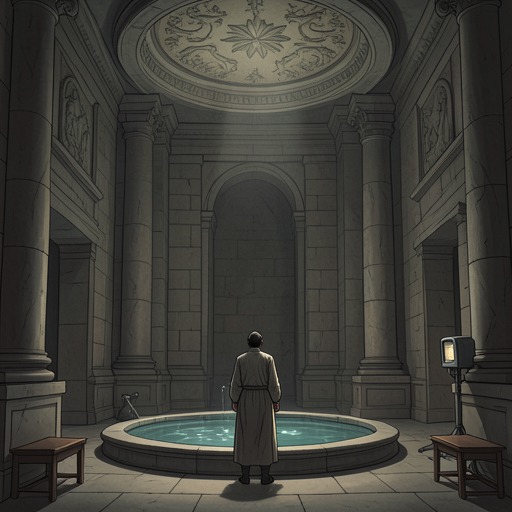
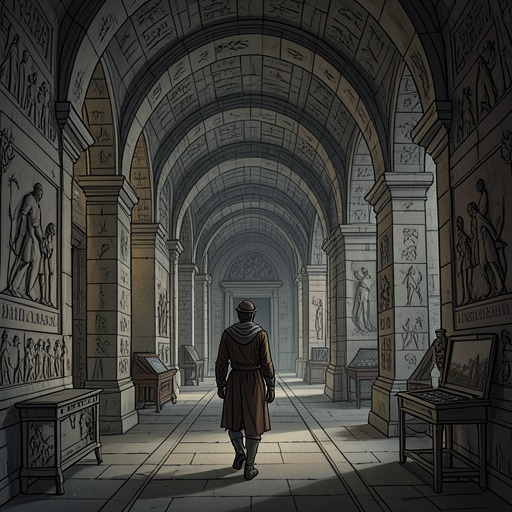
The House extends through seemingly unending halls and passageways. Piranesi has travelled as far as the Nine-Hundred-and-Sixtieth Hall to the west, the Eight-Hundred-and-Ninetieth Hall to the north, and the Seven-Hundred-and-Sixty-Eighth Hall to the south. He has climbed into the Upper Halls, where clouds move through the corridors and statues emerge from mist; explored the Drowned Halls, whose dark waters are carpeted with white lilies; and seen the eastern Derelict Halls, where ceilings, floors, and even walls have collapsed. Yet in every direction, doorways open onto further halls. The distances are enormous, but Piranesi has found no sign that the world is ending.
Statues are the House’s defining inhabitants and presence. They occupy nearly every hall and appear in vestibules, staircases, and passageways, though an empty plinth, niche, apse, or bare patch in a crowded wall interrupts the pattern. These absences are as mysterious as the statues themselves. Elsewhere, the windows look onto stone-paved courtyards, usually four-sided but sometimes six-sided, eight-sided, or an unsettling three. Beyond the House’s windows lie only the Sun, Moon, and stars.
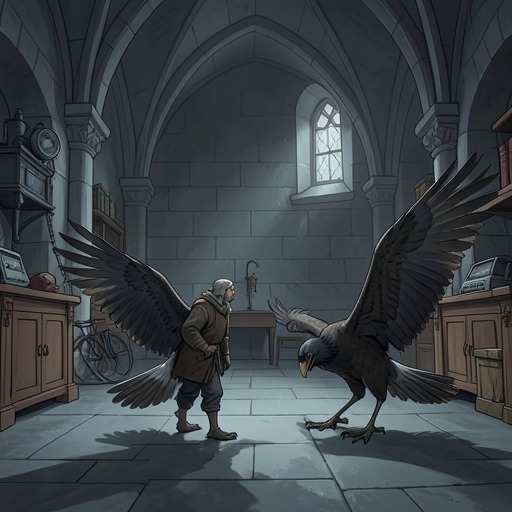
The House has three levels whose conditions divide the world into distinct environments. The Lower Halls belong to the tides: their windows appear grey-green with restless water and white with foam, and their waters provide fish, crustaceans, and sea vegetation. The Upper Halls belong to the clouds. Their mist-grey windows may flare with lightning, and rain gathers in vestibules before running down walls and staircases as fresh-water streams. Between these largely uninhabitable extremes lie the Middle Halls, the domain of birds and people. The House’s ordered arrangement is not decorative architecture alone; it is the basis of life within it.
Routes, Risks, and Restricted Knowledge
The House’s vastness makes navigation a practical discipline. A route to the One-Hundred-and-Ninety-Second Western Hall passes through the Seventy-Eighth Vestibule, where tides frequently leave debris from the Lower Halls. When the waters withdraw, broken marble remains scattered across surrounding halls. Jagged pieces can cut bare feet, and the resulting wounds risk infection, making the passage possible but slow and laborious. Piranesi’s warning to the Other becomes personal when he explains that he once had shoes and no longer does: the same route changes character according to the traveller’s equipment and vulnerability.
Written directions and repeated marks can make a route more dependable, but they do not remove the House’s scale or dangers. Following 16’s directions from the Sixth North-Western Hall toward the First Vestibule, Piranesi finds yellow chalk marks below his eye level, estimates that 16 is twelve to fifteen centimetres shorter than he is, and notices that the directions have been copied beneath each doorway. If a tide or accident erases one inscription, the others preserve the route. The markings make careful route knowledge visible as a form of preparation against loss.
That knowledge also has a personal consequence. Piranesi traces 16’s path and writes back in blue chalk, turning the passage through the House into a means of communication between people who cannot simply meet. Later, fearing that the Other has set a trap for 16, Piranesi reasons that finding the Other may be the most reliable way to find her, even though he wants to avoid him. The House’s corridors thus distribute not only physical access but information and risk: a route may provide a connection, expose a traveller to danger, or become the means by which someone is pursued.
A World with an Origin, Not a Use
The Other describes the House as a Distributary World, created by ideas flowing out of another world. In his account, it could not have existed without that prior world, though he does not know whether it remains dependent on the older world’s continued existence. The distinction between origin and present existence matters. The Other compares the House to a cave system worn into stone by water that has long since seeped away: the structure remains, but the force that formed it is no longer there to be collected.
This account also exposes a conflict in how the House is understood. The Other says that the Other cannot imagine why anything should exist if it cannot be put to use, and that he mistakes the knowledge that created the House for something hidden inside it, ready to be claimed. The House resists that instrumental view. Its halls are not simply a storehouse of secret knowledge or a device for someone else’s ambitions; their living order, resources, and beauty have value apart from what an outsider might extract from them.
The statues complicate any simple distinction between this world and the world that preceded it. In conversation with Raphael, Piranesi understands that objects such as a river or mountain are present here as statues, while the older world contains actual rivers and mountains. But he rejects the implication that representation makes the House’s forms inferior. He argues that a statue is perfect, eternal, and not subject to decay. Their significance therefore exceeds their role as images: in the House, representations are durable presences in a world with its own reality and value.
Home, Attachment, and Departure
The House’s emotional force is clearest in the contrast between Piranesi’s sense of home and other people’s perception of it. When Raphael suggests going to her house to get dry before taking him home, Piranesi answers that he is already home. The grey waters lapping the walls and the dripping statues make the place look sombre to Raphael, but they do not cancel his belonging. He hastens to explain that it is usually much drier, as though protecting his home from being judged by its flooded condition.
His attachment is inseparable from the experience of living there. In the One-Hundred-and-Ninety-Second Western Hall, darkness, cold, and the stares of unfamiliar statues make the space unsettling; no birds are audible there as they are in his usual sleeping place, the Third Northern Hall. What steadies him is the familiar sound of the sea moving through the Lower Halls. He falls asleep to that sound as a child might to a mother’s heartbeat. The House can be frightening and physically harsh, but its recurring sounds and places also provide the bodily familiarity through which it becomes home.
The Coral Halls offer a different expression of that attachment. When Raphael asks to see whatever he considers most beautiful, Piranesi initially thinks of the Drowned Halls but remembers that she dislikes climbing. He chooses the long succession of Coral Halls extending south and west from the Thirty-Eighth Southern Hall instead. As they walk through the Southern Halls, Raphael looks around with pleasure and admiration, and Piranesi shares her happiness. His desire is to show her everything, though he knows that is impossible; choosing one route becomes an act of welcome shaped by what she can enjoy.
Leaving, then, is not a simple rejection of the House. Piranesi considers what it would mean to depart from a place he believes would be empty without an inhabitant, but also recognizes that remaining would mean being alone. Raphael has promised to visit, and he trusts her as a friend; unlike the Other, who returned to his own world while Piranesi believed he was elsewhere in the House, Raphael’s departure would make that separation unmistakable. Piranesi decides to go with her, despite the cost of leaving the place and statues he loves.
Before crossing the threshold, he returns the dead to their allotted places and makes one last passage through the halls, visiting beloved statues and saying goodbye to them. He retrieves the cardboard box marked AQUARIUM, once used to hold the shoes the Other gave him, and restores the ornaments he had removed when told to hide from 16: shells, coral beads, pearls, tiny pebbles, and fishbones. He then takes his journals and favourite pens in his messenger bag. At the south-eastern corner, shadows between two Minotaurs form the suggestion of a corridor, with unfamiliar lights and moving colours at its far end. Piranesi looks back at the Eternal House, shivers, takes Raphael’s hand, and walks with her into the passage. The House remains his home even as he chooses a life beyond it.