Forty-Third Vestibule
PiranesiThe Forty-Third Vestibule is both a practical working place and a site of unexpected arrival in the House. Piranesi goes there to gather seaweed, but the vestibule becomes most consequential when an albatross enters it, returns with a mate, and raises a chick there. His efforts to provide nesting material turn an ordinary space shaped by tides and wind into a shared habitat, and the birds’ arrival becomes the event by which he names an entire year.
Setting and practical use
Piranesi visits the Forty-Third Vestibule to gather seaweed for food and fuel. Ordinarily, he must wait for spring, summer, or autumn to dry it; winter is too wet and cold. When wind offers a possible alternative, he considers hanging seaweed across a doorway so that it will dry quickly, and devises three ways to keep it from blowing away. The vestibule is thus part of his system of survival, but also a place where observation leads to experiment: he looks for ways to adapt familiar work to unfamiliar conditions.
On one visit, he descends a staircase into the Lower Hall beneath the Thirty-Seventh South-Western Hall. The wind has made the high tides more violent and the low tides lower than usual. At low tide the hall is entirely empty of water, an uncommon state, and its floor is strewn with seaweed, pebbles, starfish, and shells. Piranesi gathers cold, wet seaweed while the wind makes it difficult to stand and lashes the strands against his hands. The exposed hall and its debris connect the vestibule’s everyday use to the House’s larger tidal rhythms: what can be collected depends on the water’s retreat, while the same wind that complicates the work may offer a way to dry the harvest.
The albatrosses arrive
During one such morning, Piranesi looks through a doorway and sees what first appears to be a shining cross above the waves. It is a large white bird, gliding towards him on the wind. He recognizes it as an albatross and greets it with an attempted welcome, though the wind leaves him able only to call, “Come! Come! Come!” The bird passes through the doorway with its wings spread wider than the opening. Piranesi introduces himself as one of the House’s inhabitants and notes that another inhabitant is not fond of birds. The albatross explores the hall while Piranesi resumes his work, occasionally approaching to watch him.
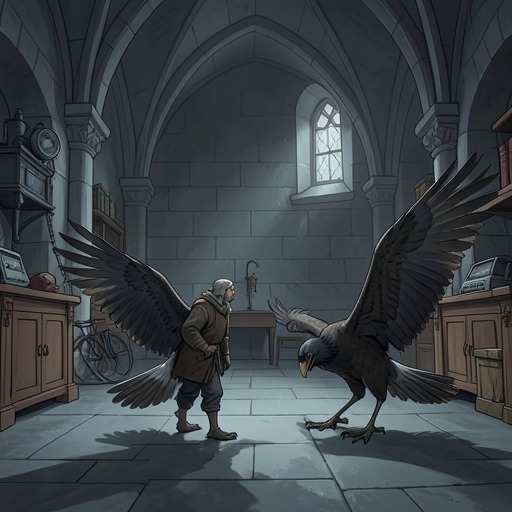
When Piranesi returns the following day, the albatross has come up the staircase into the Forty-Third Vestibule, and a second bird has joined it. He cannot determine which bird is male or female, but he distinguishes them by their wing markings: one bears white, star-like shapes, the other flecks resembling silver rain. The birds spread their wings, circle each other, point their beaks towards the ceiling, and tap their beaks together. Their arrival is not a solitary encounter but the beginning of a continuing animal presence in the vestibule.
Nest-building and care
A few days later, Piranesi finds the birds less animated. The bird he associates with the star-marked wings repeatedly gathers damp seaweed into a heap, then moves it and tries another location. Piranesi infers that the pair are trying to build a nest but lack dry material suitable for an egg. He offers his own supply of dried seaweed and goes to fetch it, treating the birds’ repeated rearrangement as evidence of a need he can meet.
To carry the material, he lines a fishing net with heavy-gauge plastic and estimates how much would suit two birds of their size. The amount is about three days’ fuel, a meaningful sacrifice because it may leave him colder. He adds clean white feathers he has saved and an old woollen jumper too worn to serve well as clothing but potentially useful as a lining. At the Forty-Third Vestibule, the star-marked bird immediately takes a beakful of the dry seaweed and tries it in different places. The exchange links Piranesi’s resourcefulness to his willingness to give up something useful to himself for the birds’ nesting effort.
The albatrosses build a tall nest, about a metre wide at its base, and lay an egg. They care for it devotedly and later tend their chick with the same diligence. The chick grows slowly and is not yet ready to fledge when Piranesi records the account. This development gives the vestibule a continuing role: it is not merely where the birds alight, but a place where they establish a nest and raise their young.
A lasting home within the House
Piranesi names the year “the Year the Albatross came to the South-Western Halls,” making the birds’ arrival part of his personal reckoning of time. The name registers a change in the world he inhabits: a new pair of residents has arrived, nested, and begun raising a chick. The Forty-Third Vestibule is the specific setting of that change, while the name carries its significance beyond the room and into the structure of his journal and memory.
The vestibule’s association with care recurs later, when Piranesi calculates how the coming flood will affect it. He finds that the water should reach no more than a thin layer there. He does not plan to carry the chick upstairs, reasoning that the adult albatrosses might not allow it and would prevail in any struggle. The calculation distinguishes protection from possession: Piranesi assesses the birds’ safety but recognizes their agency and strength rather than assuming he can simply move them.
The Forty-Third Vestibule also belongs to a much larger landscape that Piranesi regards as his home. He describes travelling through distant halls, exploring the Upper Halls, the Drowned Halls, and the ruined eastern region, and seeing no sign that the World ends. Its countless halls are filled with statues, while empty spaces among them remain mysterious. Against that immeasurable setting, the vestibule is a small, particular place made meaningful by repeated use and living relationships. Piranesi’s conviction that he is at home in the House persists even when its waters are high; his eventual decision to leave with Raphael does not erase the attachments formed there. The birds’ nesting place therefore stands as one instance of the House’s abundance and of Piranesi’s way of belonging through attention, practical work, and care.