Middle Halls
PiranesiThe Middle Halls are the House’s inhabited middle level: a domain shared by people and birds, set between the fish-bearing Lower Halls and the cloud-bearing Upper Halls. They are not merely a neutral passage between more elemental regions. Their relative order and resources make life possible, while their rooms, thresholds, wildlife, and hazards govern how inhabitants move and understand their surroundings.
Place in the House
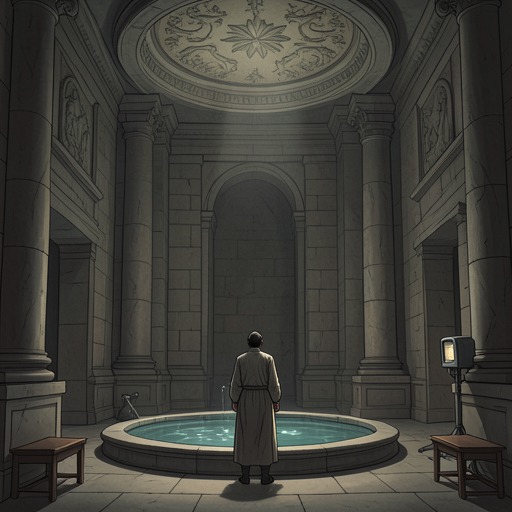
The House has three levels. The Lower Halls belong to the Tides, whose waters nourish the House with fish, crustaceans, and sea vegetation; the Upper Halls belong to the Clouds, which provide fresh water as rain and streams. Between these largely uninhabitable levels lie the Middle Halls, the domain of birds and people. Their livability rests on what Piranesi calls the House’s beautiful orderliness, a pattern that sustains life rather than simply arranging architecture.
The Middle Halls form part of a seemingly unbounded world of halls and passageways. Piranesi has travelled hundreds of halls north, south, and west, and describes the Middle Halls in contrast with the watery Lower regions, misty heights, and derelict eastern spaces. The scale is immense, but the level is also made intimate by routine: windows look across courtyards, vestibules connect routes, and particular halls become places to fish, sleep, or encounter other inhabitants.
Birds and Everyday Life
Birds are among the Middle Halls’ inhabitants, not just passing signs within the architecture. Piranesi initially considers their ordinary behavior easy to read, largely concerned with food and dislike of rain, yet he allows that their wisdom may appear obliquely. Their collective actions sometimes prompt him to observe, interpret, and alter his plans. When groups of birds move among statues, he considers the possibility that they are communicating; in one instance, he follows their apparent warning and catches seven fish and four lobsters before a storm drives fish away from their customary halls for two days.
The birds also occupy shared spaces in ways that can change access and movement. In the evening, a flock fills the Seventeenth Vestibule with a spiralling, smoke-like dance, making it impassable to Piranesi. On another occasion, birds gather first on a statue of a Gardener and then on a Woman carrying a Beehive. He wonders whether the figures suggest industriousness, and the event leads him to consider the birds’ behavior as a possible warning rather than dismissing it as meaningless. Their actions affect his understanding of the House as well as his practical choices.
Routes, Risk, and Shelter
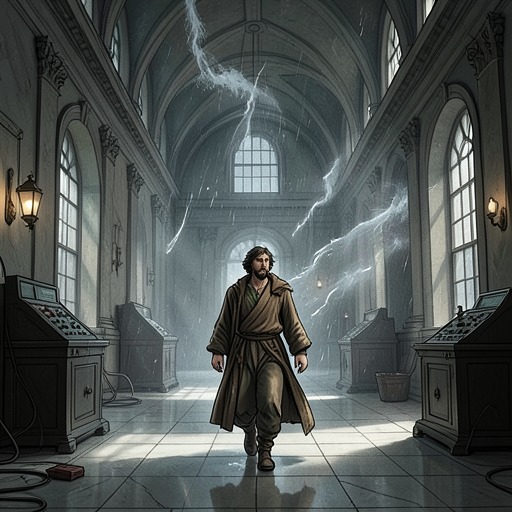
Movement through the Middle Halls depends on the condition of the routes. To reach the One-Hundred-and-Ninety-Second Western Hall, Piranesi must pass through the Seventy-Eighth Vestibule, which is prone to flooding. Tides leave broken debris there, including sharp-edged pieces of marble that can cut bare feet and risk infection. The route is passable but laborious; its danger becomes newly consequential when Piranesi no longer has shoes. Thus the same familiar passage changes from manageable to hazardous as his circumstances change.
The level also provides habitats that Piranesi actively maintains. He helps albatrosses build a nest in the Forty-Third Vestibule by supplying dry seaweed, clean feathers, and an old woollen jumper, despite knowing that giving away the fuel represented by the seaweed may leave him colder. The birds build a nest about a metre wide and lay an egg; later, their chick grows into a large bird. Before the great flood, Piranesi calculates that the vestibule will receive at most a thin layer of water, and leaves the chick there rather than risk a struggle with its protective parents. The halls’ geography therefore shapes both his resource decisions and the limits of his care.
Narrative Significance
The Middle Halls bring together the House’s ecological and human dimensions. Their place between tides and clouds makes them the level where people can live, but that life remains dependent on water, weather, animal behavior, and the reliability of routes. The House’s beauty and kindness are expressed through an order that supports habitation, not through a guarantee of safety: flooding, storms, broken marble, and inaccessible spaces remain part of the same world.
For Piranesi, the Middle Halls are a lived landscape whose meaning emerges through attention. Birds can interrupt a route, influence a meal, or become possible partners in communication; a vestibule can be a nesting place and also a point of exposure to flood. This close knowledge does not make the world fully legible. Instead, it allows Piranesi to respond to its changing conditions with observation and care, even when the evidence of what the House or its other inhabitants intend remains uncertain.