Upper Halls
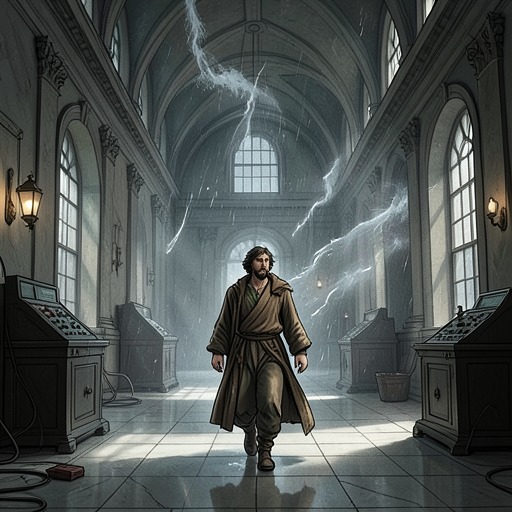
PiranesiThe Upper Halls form the House’s cloud-governed upper level, a realm of mist, lightning, and rain that supplies fresh water to the lower spaces. They are also a difficult, sometimes perilous route through the House: ascent demands effort, visibility can vanish, and broken floors connect them to the Drowned Halls. For Piranesi, this expansive landscape is both a subject of exploration and a practical environment whose dangers determine what he can safely reach.
Place in the House
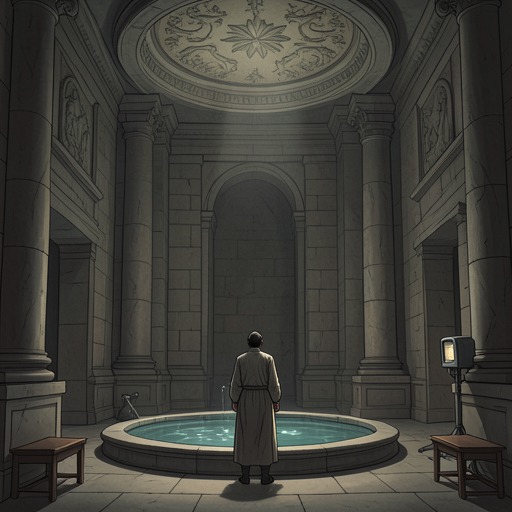
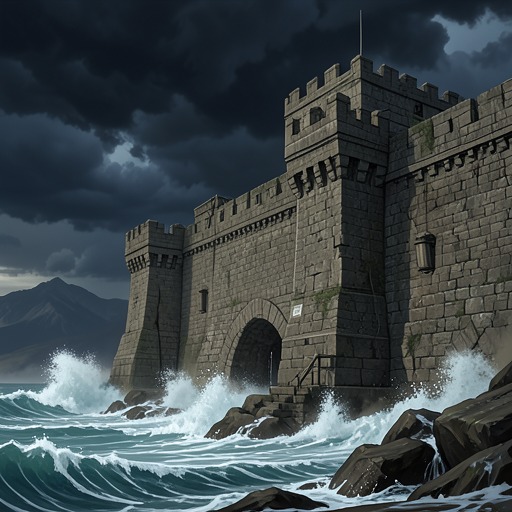
The House has three levels. The Lower Halls belong to the Tides, while the Upper Halls belong to the Clouds; between them lie the Middle Halls, associated with birds and people. Seen across a courtyard, the Upper Halls’ windows are grey-white with mist. Lightning can illuminate a whole line of windows at once, and water falls in the vestibules as rain before running in streams down walls and staircases. The upper level thus participates in the House’s elemental order, providing fresh water just as the lower level provides food from the sea.
Piranesi’s account places this system within a world whose scale resists any visible boundary. He has climbed into the Upper Halls, where clouds move slowly and statues can appear suddenly out of the mist; elsewhere he has explored drowned chambers and eastern halls broken by collapse. From doorways, he has never seen the House approaching an end, only halls and passages continuing into the distance. The Upper Halls are therefore not an isolated destination but one region in a seemingly unending environment.
Routes, Hazards, and Access
The upper level is difficult to navigate as well as difficult to climb. Its staircases are built on a grand scale, with steps nearly twice the height comfortable for Piranesi. When hunger drove him to seek fish in the Drowned Halls, he had to climb to the Upper Halls and descend through wreckage and great rents in the floor. The route made the upper level a passage between regions, but not a safe or easy one.
Weather and visibility could make that route unusable. On one journey, Piranesi reached the Upper Hall directly above the Nineteenth Eastern Hall intending to descend toward the Drowned Halls, only to find the space filled with cold, grey cloud. His journal recorded detailed observations of a neighboring hall but nothing about this one, leaving him without reliable knowledge of what lay ahead. Hunger had brought him to the threshold; obscured sight and missing records made proceeding dangerous. He later recognized that he had risked too much by entering a hall he could neither see nor document.
Even where a passage was passable, its condition could impose a bodily cost. The route toward the One-Hundred-and-Ninety-Second Western Hall went through a vestibule subject to flooding, where the Tides scattered broken debris. Jagged marble could cut bare feet and expose a traveler to infection. Piranesi explained that the journey remained possible but laborious, and that it would take time; the obstacle had become more serious because he no longer had shoes. Routes through the House depended not only on knowing where a passage led, but also on the traveler’s equipment and physical condition.
Exploration and Knowledge
Piranesi’s explorations extend across the House’s distant regions, and the Upper Halls are among the places that make its scale tangible. He describes their moving clouds and sudden appearances of statues alongside the still waters and lilies of the Drowned Halls and the collapsed architecture of the eastern region. His journal and maps turn travel into accumulated knowledge, but the cloud-filled hall he had failed to record reveals the limits of that method: a route may be familiar in general while a particular threshold remains unknown.
Route knowledge is also social and practical. Following directions left by 16, Piranesi traced a path back toward the First Vestibule, marking doorways in yellow chalk and copying directions beneath the frames so a Tide or mishap would not erase every guide. Elsewhere, the prospect of reaching the Other required weighing a flooded route, scattered debris, and the danger to unprotected feet. In the House, records and marks can extend a traveler’s reach, but they do not remove the hazards of the architecture.
Meaning and Significance
The Upper Halls embody the House as both an ordered world and a demanding physical environment. Clouds produce rain that sustains the levels below, while the same clouds can erase sightlines and obstruct movement. Stairs and openings connect regions, yet their scale and damage make connection costly. The House’s order is therefore not equivalent to ease or safety: its systems sustain life while requiring careful attention, memory, and adaptation from those who move through them.
This tension helps explain why Piranesi’s relationship to the House is more than that of a navigator. He regards it as home and holds that its beauty is immeasurable and its kindness infinite, even though its routes can expose him to hunger, exhaustion, and injury. Near the end of his life in the Halls, he chooses to leave with Raphael, taking his journals and favorite pens with him. The decision gives the House’s geography an intimate consequence: the world he has carefully explored remains beloved, but belonging to it does not make departure impossible.