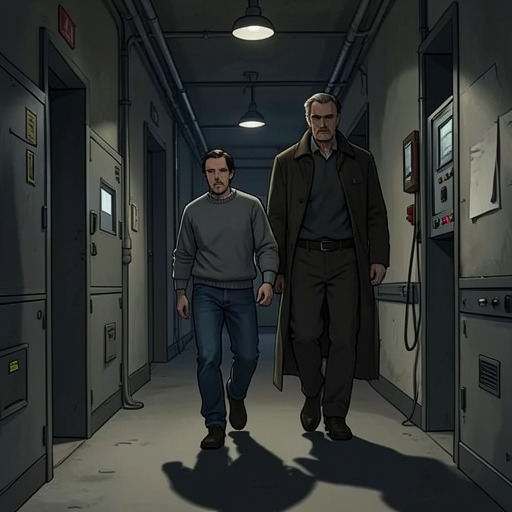
Manchester
PiranesiManchester connects the House’s impossible geography to the ordinary institutions and streets of the outside world. It is where Valentine Ketterley worked as an anthropologist before publicly denouncing Laurence Arne-Sayles, and where James Ritter later lived as a caretaker; years afterward, Matthew Rose Sorensen travels there to find Ritter and offer to take him back to the labyrinth.
Academic and Personal Connections
Ketterley was a research fellow in Social Anthropology at Manchester after studying under Arne-Sayles. In 1992 he left the city for a teaching post at UCL. That June, he wrote to The Times to accuse Arne-Sayles of deliberately misleading and manipulating students with pseudo-mysticism and stories of other worlds, and called on the University of Manchester to dismiss him. The university did not do so until 1997, after Arne-Sayles was arrested for false imprisonment. In later years Ketterley refused to answer questions about his former teacher, leaving his break with Arne-Sayles publicly documented but his subsequent account unavailable.
Manchester also figures in the uncertain trail of people associated with Arne-Sayles. James Ritter spoke to journalist Lysander Weeks in 2010; a research note reports that, according to Weeks, Ritter worked as a caretaker in Manchester Town Hall. The city thus appears not only as the setting for Ketterley’s academic departure and denunciation, but as the place where one of Arne-Sayles’s former associates could still be found after the events that had separated him from the labyrinth.
Ritter’s Rescue
After Raphael teaches him how to find both the way into the labyrinth and the way out, Matthew can travel between the House and the Other World. He decides to write a book about Arne-Sayles, a project that belongs both to the person Matthew had been and to the person he has become. His renewed access to the outside world makes that investigation more than an intention: he takes a train to Manchester, then a bus to Miles Platting, and walks through an autumn landscape to a flat in a tower block.
Ritter answers the door as a thin, ravaged-looking man who smells strongly of cigarettes. Matthew asks whether he is James Ritter; after Ritter confirms that he is, Matthew says he has come to take him back. The sequence turns Manchester into a threshold in the reverse direction from Ketterley’s earlier journey: rather than leading away from the House, it becomes the route by which Matthew seeks to bring one of its lost human connections back.
A City Between Worlds
Manchester’s significance rests on its double role as a place of institutional history and a practical point of return. The university and Ketterley’s letter place the city within the public dispute over Arne-Sayles’s teaching; the report about Ritter and Matthew’s journey locate it within the private aftermath of Arne-Sayles’s influence. These strands meet without making the city itself mysterious: its railway, bus route, municipal workplace and residential tower provide the concrete geography through which characters connected to the House can be traced.
The broader contrast is between the House, which Matthew has come to regard as home, and the outside world where he can now travel and act. His journey to Manchester demonstrates that leaving the labyrinth need not mean severing its relationships. Instead, the city becomes the starting point for an attempted return, as Matthew uses the freedom Raphael has given him to seek out Ritter and reopen a path between their lives.