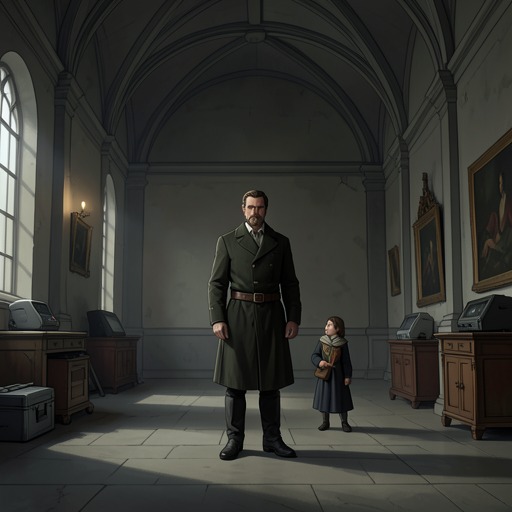
Second South-Western Hall
PiranesiSecond South-Western Hall is one of the House’s recurring meeting places, and a stage on which Piranesi and The Other’s partnership is repeatedly tested. The Other’s absorption in his devices and experiments meets Piranesi’s detailed knowledge of routes, tides, and bodily risk there; the hall’s Empty Plinth becomes a practical landmark for their encounters and a witness to the growing distance between their understandings of the House.
Setting and Spatial Context
Second South-Western Hall lies within a world Piranesi understands as an immense, continuous succession of halls and passages. He has travelled far west, north, and south, climbed to the Upper Halls, explored the water-lily-covered Drowned Halls, and seen the collapsed eastern region. From doorways in these distant places, he has found no sign that the World ends, only further halls extending into the distance. Statues fill nearly every available surface throughout this world, though empty plinths, niches, apses, and bare patches interrupt their abundance. The hall’s Empty Plinth is thus both a distinctive feature of this particular meeting place and part of a wider pattern of mysterious absences.
The hall is also connected, through Piranesi’s journeys, to routes whose conditions can change with the tides. On the way to the One-Hundred-and-Ninety-Second Western Hall, the route through the Seventy-Eighth Vestibule crosses a region subject to frequent flooding. Even when the water has receded, the tides leave broken debris scattered across nearby halls; sharp fragments can cut bare feet, and a careful crossing is possible but laborious. When Piranesi explains why this route has become difficult, the obstacle is not simply the hall’s geography: he has lost the shoes he used to wear. His practical account makes the House legible as a lived environment in which tides, debris, footwear, and distance determine who can travel safely.
A Meeting Place for Piranesi and The Other
Piranesi meets The Other in Second South-Western Hall at ten in the morning. At one such meeting, The Other is already leaning against the Empty Plinth and tapping at a shining device; intent on his work, he asks for data without first offering a greeting. Piranesi says this manner is typical of him and does not take offence, because he admires The Other’s dedication to scientific work. The repeated meeting place establishes a routine that can make their relationship appear companionable, even as the imbalance in their attention is evident: The Other is occupied by his projects, while Piranesi observes his habits and accommodates them.
The Other also uses the hall to work aloud on the ritual he hopes will free the Great and Secret Knowledge from whatever holds it captive in the World and transfer it to them. By this point they have performed the ritual four times, each in a slightly different version. The Other tells Piranesi that he has made changes and wants to hear how they sound in situ. The hall therefore serves not only as a place to meet but as a working setting where their shared pursuit is rehearsed and revised.
Gifts, Routes, and Unequal Knowledge
The Empty Plinth becomes a point of exchange when The Other leaves a cardboard box there for Piranesi. The deep-grey box bears an octopus and the word AQUARIUM; under its thin white paper is a pair of blue-green canvas shoes with thick white soles and white laces. Piranesi puts them on and finds that they fit perfectly. Their cushioning makes walking pleasurable, and he spends the day running and dancing. The gift answers a specific hardship disclosed during their discussion of the debris-strewn route. For Piranesi, the shoes are not merely equipment: he later tells The Other that he values the proof they offer of their friendship even more than the shoes themselves.
The same meeting brings out a difference in how the two men understand their work together. When Piranesi says the House has shown him they should abandon the search for the Great and Secret Knowledge, The Other stops taking notes, sets down his device, covers his face, groans, and massages his eyes. His reaction turns the habitual meeting into a confrontation over the purpose of their shared undertaking. The Other needs time to think, while Piranesi has already reached a conclusion through his experience of the House. The hall’s routine is therefore the setting for both practical cooperation and a fundamental disagreement.
Warning and Foreshadowing
Later, Piranesi comes to Second South-Western Hall intending to tell The Other about his meeting with the Prophet. He considers the information urgent because the Prophet intends to tell 16 how to find their halls. But The Other is pacing, his hands in his pockets and his face dark with suppressed anger; he brushes aside Piranesi’s attempt to speak and insists that he must first disclose something about 22. The encounter interrupts Piranesi’s warning and redirects the meeting toward information The Other has withheld. The hall’s familiar routine becomes charged with competing urgencies: Piranesi knows that 16 may be approaching, while The Other controls what he chooses to reveal.
The danger attached to 16 gives the hall’s repeated meetings a wider consequence. Piranesi later reasons that The Other may have set a trap for 16 by promising to meet her and tell her how to find Matthew Rose Sorensen. Because this makes The Other a likely route to 16, Piranesi hopes to locate her before she reaches him, while also avoiding The Other himself if possible. The meeting place thus belongs to a relationship that has shifted from ordinary collaboration toward suspicion and protective urgency.
Last Passage and Significance
At the end of Piranesi’s time in the House, his attention turns from the recurring meetings to the route out. He retrieves the AQUARIUM box that once held The Other’s gift of shoes. It has since served as a hiding place for the ornaments he removed from his hair when The Other told him to hide from 16. Preparing to enter the New World, he spends two or three hours putting them back: seashells, coral beads, pearls, tiny pebbles, and fishbones. The box therefore links the hall’s earlier exchange to the concealment and self-presentation of Piranesi’s later life.
With his journals and favourite pens in his messenger bag, Piranesi walks with Raphael toward the two Minotaurs in the south-eastern corner. A shadowed opening between them suggests a corridor; Raphael takes his hand, and together they enter it. Second South-Western Hall is not itself the exit, but its repeated appearances help define the House as a network of remembered routes and encounters. The same plinth holds the traces of scientific work, a gift that enables travel, and disagreements over knowledge and danger. The hall’s significance lies in how its familiar setting gathers these different stages of the relationship without making them equivalent: Piranesi’s attention to lived conditions repeatedly meets The Other’s plans, while the consequences of those plans become increasingly difficult to ignore.