Blanche Glover’s journal, *A Journal of Our Home-Life in Our House in Richmond*
PossessionBlanche Glover’s journal, A Journal of Our Home-Life in Our House in Richmond, begins as a record of shared domestic life and becomes an oblique, increasingly anxious witness to Christabel LaMotte’s concealed correspondence. Its importance lies in that change of register: everyday details record the household Blanche and Christabel built together, while the spaces between those details expose Blanche’s growing sense of exclusion. Later readers use the journal to investigate what happened around the letters, but its own silences keep the evidence partial rather than conclusive.
Provenance and Physical Form
The journal was one of the papers preserved from Christabel’s desk and held in the Women’s Archive at the Lincoln Library. Maud Bailey explains that Christabel had asked for her papers to be sent to her niece May Bailey, hoping May would come to care about poetry. May married a cousin, moved to Norfolk, and raised ten children; Maud, her descendant, later persuaded her father to lodge the papers in the archive. The surviving collection was small and had not been carefully safeguarded, and no additional papers had come to light. It included manuscripts of the Tales, undated lyrics on loose slips, successive revisions of Melusina, a commonplace book, letters from friends, and Blanche’s diary, which covered only three years.
Maud shows Roland Michell the journal among archive boxes catalogued as Melusina I, Melusina II, Melusina III and IV, Melusina Unassigned, Breton poems, poems of devotion, miscellaneous lyrics, and Blanche. The volume itself is a long, thick green book, like an accounts book, with sombre marbled endpapers. Its title page identifies it as A Journal of Our Home-Life in Our House in Richmond, by Blanche Glover. It opens on May 1, 1858, May Day. Roland handles it respectfully, but its appeal is different from the two letters he carries: it offers not the same magnetic immediacy, but the prospect of clues.
The conditions of reading make the journal’s role in the investigation tangible. Roland is conscious of his day-return ticket and Maud’s limited patience as he skims the excited, pretty handwriting, written in short rushes. He finds carpets, curtains, meals, a new cook-general, a method for stewing rhubarb, and a painting of the infant Hermes with his mother; among these domestic entries is an account of Crabb Robinson’s breakfast party. The diary thus gives the researchers a route into a particular period, but its routine subjects require patient reading: significant evidence is embedded in the ordinary rather than presented as a formal explanation.
A Domestic Record Turns Uneasy
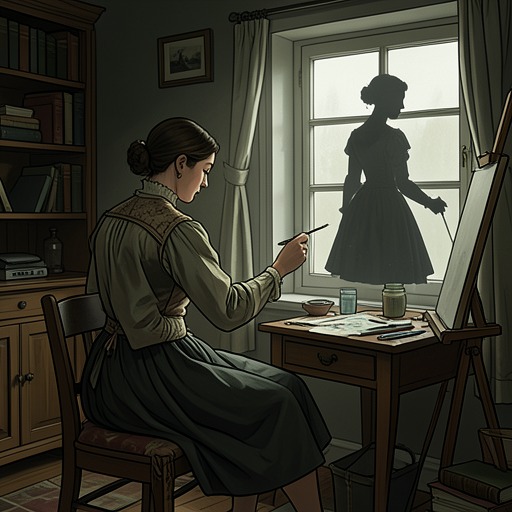
At first Blanche describes retirement and shared activity in affectionate, almost enchanted terms. She and Christabel have time for simple meals, walks, reading, music, and Blanche’s plans for paintings. Blanche imagines Richmond as Beulah, a place of repose, while Christabel jokingly hopes that no wicked fairy envies their pleasant life. The journal’s household details establish what Blanche believes the home to be: a protected, mutually inhabited space in which the two women share their days and artistic interests.
That sense of ease is unsettled by Christabel’s increasing involvement in correspondence. Blanche notes that a long letter has arrived, that Christabel smiles over it and puts it away without showing it to her. The entry itself does not identify the letter’s writer; Roland’s concern that it might be his own letter belongs to the later act of reading, not to anything Blanche explicitly knows. Three weeks later, Blanche records that Christabel is preparing a “Literary Letter” for posting while claiming to be hurrying to finish The Glass Coffin. Blanche fears that the correspondence is taking time from poetry and observes that Christabel no longer shares poems with her in the evenings as she used to. Her account joins a change in artistic routine to a change in intimacy: what Blanche cannot read in the letters, she measures through what is no longer shared at home.
Two weeks later, the journal’s repeated emphasis on letters sharpens into protest. Blanche insists that she is not a blind servant or a watcher and recalls that Christabel rescued her from becoming a governess. Her declaration of gratitude is inseparable from her awareness that letters are being hidden in a sewing basket or beneath handkerchiefs. The journal does not establish what each letter contains, but it records Blanche’s predicament with precision: she feels shut out, yet is conscious that pressing her claim to know could make her seem ungrateful or intrusive.
The Prowler and the Threatened Home
The next entries recast the secrecy through the language of intrusion. Blanche imagines a prowler circling the retreat, testing the shutters and huffing at the door. She plans to hang mountain-ash berries and a horseshoe over the lintel against fairy folk; Dog Tray raises his hackles and snaps at the empty air. The images turn private correspondence into a disturbance at the boundaries of the house. Blanche does not name a human visitor as the prowler, and the metaphor should not be mistaken for evidence of a literal intruder. What it records is her sense that the couple’s previously protected life is being watched or breached.
In the following entry, Blanche describes the intruder as a Peeping Tom looking through a crack in their walls. Christabel laughs at the fear, saying he means no harm and cannot see what matters to them, and treats his presence as tame. Blanche cannot share that assurance. She asks how much Christabel has been writing; Christabel replies that she is learning and will have new matter to write about. The answer offers Blanche neither an account of the letters nor a return to their earlier exchange of poems. Instead, it deepens her fear that the correspondence is reshaping Christabel’s work and their companionship.
The journal also preserves a moment of attempted reassurance. Christabel comes to Blanche after Blanche has prayed in distress, raises her from her knees, and says they must never quarrel and that Blanche must not think she would give her cause to doubt her. Blanche believes she means it; she notes Christabel’s agitation and tears, then describes the two women as quiet together for a long time in their “special ways.” The intimacy is still real, but it is now placed beside concealment and apprehension. That juxtaposition makes the journal more than a chronicle of estrangement: it records how closeness persists even as Blanche feels that its terms have changed.
Evidence, Gaps, and Afterlife
The journal’s evidentiary force depends on its limits. Maud says that Christabel almost certainly did not keep a journal herself and points to a letter in which Christabel advised a niece against habitual self-examination, urging her instead to shape thought into art or live within daily obligations and affections. Blanche’s record therefore provides a rare, situated view from within the Richmond household, but it is not a neutral account of Christabel’s inner life. It is Blanche’s own writing, attentive to daily labor and affection, and increasingly shaped by the injury of being excluded from correspondence she can see but not read.
The surviving record is also incomplete in a larger archival history. Maud says that many papers were not cared for and that no further material had surfaced. Later, Beatrice Nest remarks that Ellen Ash anticipated biographical scavengers and did not burn all her own journal, though she destroyed many letters; Beatrice thinks Ellen, rather than Patience and Faith, burned some of them, and says others were buried with her. That later discussion concerns Ellen’s papers, not Blanche’s journal, but it clarifies the wider conditions in which private writing survives: preservation, destruction, and burial determine what a researcher can recover. Blanche’s diary survives as one fragment among absences, not as a complete explanation of the secret it helps disclose.
Its clues emerge through the researchers’ interpretation rather than through a final revelation by Blanche. Much later, Maud finds an unsigned, unheaded sheet that says its recipient did wrong to keep the writer’s evidence, that the evidence was not theirs to keep, and that the writer’s words had been ill-chosen although true and urgent. Maud wonders whether this refers to a clandestine correspondence, a Yorkshire trip with a solitary naturalist, or a manuscript of Swammerdam; the sheet does not settle which. This uncertainty reflects the journal’s own method of disclosure: its concrete notes make certain questions newly possible without answering them all.
The book’s narrative effect comes from that difference between what a domestic diary can see and what it can know. A cook, a loaf with unexplained cuts, jelly-muslin hung among inverted chairs, concealed letters, and a dog bristling at the door belong to the same household record. As the entries move from domestic pleasure to watchfulness, ordinary objects acquire the pressure of evidence. The journal preserves Blanche’s perception of a home changing around her, while refusing to turn her perception into a complete account of Christabel’s secret life.