Carnegie-Illinois Steel Quality-Test Falsification Case
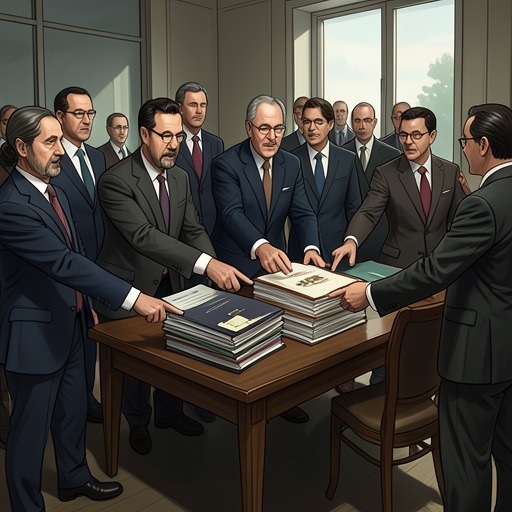
TrumanThe Carnegie-Illinois Steel Quality-Test Falsification Case turned a technical question about shipbuilding steel into a public test of wartime oversight. Investigators found that a Carnegie-Illinois mill had falsified tests and records for steel plate supplied to the government; at a five-hour Senate hearing, testimony exposed the practice while company leaders disputed its significance and promised corrective action. The proceeding made the committee’s central concern plain: whether a contractor could substitute its own judgment for government specifications while the country depended on rapid wartime production.
Background and the warning signs
The inquiry began with reports from employees who believed they had a patriotic duty to alert the committee. Similar complaints arrived from around the country, but many appeared to be crank mail, and investigators could not pursue every lead. The issue became urgent after the newly launched tanker SS Schenectady, built by Henry J. Kaiser, broke in two at Portland, Oregon, in January 1943. The failure made the quality of steel plate a matter of immediate concern, although the hearing would not establish that defective plate had caused the ship to break apart.
At the Irvin Works, a Carnegie-Illinois rolling mill at West Mifflin, Pennsylvania, investigators found that at least five percent of production—about 3,000 tons of steel each month—failed to meet Navy specifications but was labeled and delivered as compliant. Chemical analyses used to measure the steel’s composition, including its carbon content, had been altered. Tests of tensile strength were also falsified. Murray Stewart, the mill’s chief specifications examiner, explained that an unknown chemical analysis might simply be invented for the record book, with results adjusted “to conform to what the customer expected to receive.”
The allegations concerned not just an inaccurate test but a routine that could disguise noncompliance in the plant’s own records. Stewart said that fabricated entries were written in pencil while ordinary entries were in ink, and that a prefix letter was commonly placed before them. Under questioning by Hugh Fulton, he acknowledged that the letter “F.” meant fake, despite having earlier told an investigator it meant phone. The exchange gave the hearing a strikingly concrete clue to the system: the record itself distinguished, in a coded form, between ordinary results and invented ones.
The hearing exposes the practice
Stewart testified on March 23, 1943, alongside other employees. Assistant metallurgist David B. Ireland, Jr., said he had learned to fake tests at another large Carnegie-Illinois mill, the Edgar Thomson Works, and could fool a Navy inspector when one was present. He added that only one tester had been caught by an inspector, explaining that the man “cheated more than he was supposed to cheat.” Senator Homer Ferguson asked whether the tester had been fired. Ireland said he had been demoted; Harry S. Truman then pressed a higher-ranking employee on whether the demotion followed because the tester had gone too far. The exchange suggested that the misconduct was not necessarily met with dismissal, even when it came to light.
The investigators’ own visit to Irvin Works had already raised suspicions about the company’s cooperation. They first went to Carnegie-Illinois headquarters in Pittsburgh, where company president J. Lester Perry said they could not speak with employees without a company attorney present. They would not be admitted to the mill until Perry called Truman to ask what the inquiry was about. When the investigators eventually arrived, they waited, were offered lunch, and continued to ask for the mill’s record book. It was not produced until two o’clock. By then, they were told, it had been taken apart the previous night and distributed among people doing work for the company attorney; it took two hours to reassemble. The investigators could not determine how much had been removed or altered.
When Perry appeared at the witness table, Truman challenged that handling of the inquiry and asked why the company had not acted promptly to investigate and clean up the plant. Perry said he did not intend to be controversial. Truman replied, “You can be as controversial as you like,” and, after further evasions, made clear that investigators had not been sent to the mill for amusement. Perry acknowledged that nothing had yet been done to correct the situation, saying he needed time to understand its fullest implications. Truman countered that the company had received the information when the investigators did and said he would have sought the facts at once if he had been president.
Management’s defense and the unresolved responsibility
Perry maintained that management deplored the practices but had not been involved in them. He argued that the substandard plates were still suitable for their intended use, and objected to calling the conduct cheating, preferring “misrepresentation.” On the SS Schenectady, he said that steel-plate failure had not caused the breakup; even if it had, the plate at the point where the break began was not made at Irvin Works. The hearing therefore laid out the falsified tests and the mill’s failures to follow procedures without establishing that Irvin steel had caused the tanker’s destruction.
Ferguson confronted Perry with the possibility that steel had been sold to the government under false representations. Perry accepted that this would be so if the conduct described had occurred, but questioned whether it applied to material tested or inspected by the Navy. He continued to argue that the steel was not inferior for its end use, even as he conceded that the company should have followed government specifications. Truman’s response—“I’ll say you will”—made the exchange a demand for compliance, not merely an argument over terminology.
The company attorney, testifying after Perry, said he needed to master the technical details before “justifying this situation.” Truman answered that technical expertise was not required to recognize tampered books and crookedness. He said he knew nothing about the steel business and did not expect to, but could see when records had been altered. The point sharpened the contrast between the complexity of metallurgy and the more basic obligation to maintain honest records and remove people responsible for deception from critical jobs.
The hearing did not settle who ultimately bore responsibility. No one above chief metallurgist W. F. McGarrity admitted knowing about the rigged tests or falsified records, and the testimony offered no substantial motive for the deception. The plausible explanation raised was that employees had sought to produce an impressive record of output, despite having nothing to gain and much to lose if discovered. At the hearing’s close, U.S. Steel president Benjamin F. Fairless promised Truman that whoever was responsible would “walk the plank.” Fairless also called the operation at Carnegie-Illinois an example of very poor management. The promise and admission marked a sharp judgment of the mill’s performance, but the available account leaves the chain of responsibility and the promised consequences unresolved.