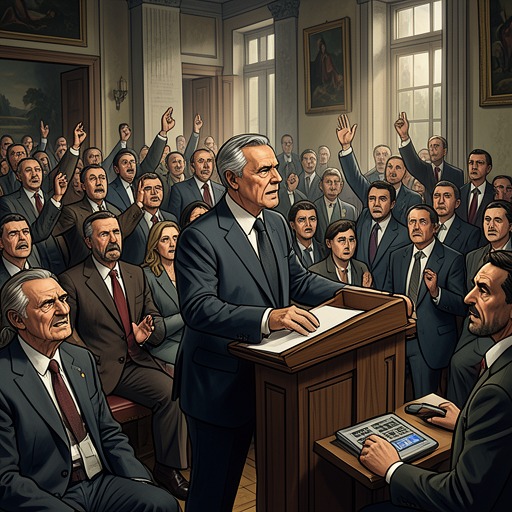
1946 United States Midterm Elections
TrumanThe 1946 United States Midterm Elections marked a decisive reversal in Harry S. Truman’s political fortunes: Republicans won control of both houses of Congress, while Truman returned to Washington with diminished public prestige and a hostile legislature. The defeat was not simply a change in party control. It exposed the distance between Truman’s determination to keep asking for ambitious policies and the dwindling support available to him in Congress and among the public.
Declining Support Before the Election
In the months before the vote, Truman continued to press proposals even when Congress resisted. He requested a national compulsory health-insurance system, funded through payroll deductions, that would provide medical and hospital care regardless of a person’s ability to pay. He also called for universal military training: one year of training for young men aged eighteen to twenty, intended to prepare a citizen reserve rather than enlist them in the armed services. Truman argued that peace required military strength as well as goodwill, and that the country could not assume it would have time to prepare after an emergency began.
His persistence reflected a broader pattern in his dealings with Congress. When lawmakers balked, he asked again rather than changing his approach. But the public mood was turning against him. In the autumn, Truman was mocked for his manner, his Missouri associates, and his attachment to his mother; jokes and cartoons presented him as befuddled and perpetually liable to say the wrong thing. His approval rating was about 80 percent earlier in the period, but polls released in the first week of October showed only 40 percent approving of his performance. Within weeks, it had fallen further, to 32 percent. The figures registered a steep loss of popularity before voters went to the polls, though they do not by themselves explain every result.
The Republican Sweep
The Republicans won both chambers of the United States Congress for the first time since before the Great Depression. They took the House by 246 seats to 188 and the Senate by 51 to 45, and won a majority of state governorships. In New York, Thomas E. Dewey secured reelection as governor by the largest margin recorded there. The scale of the victory made the result a national repudiation of Democratic control, not merely a setback in one chamber or region.
The reversal also reached into cities long associated with Democratic political organizations. Democratic machines lost in Chicago, Detroit, Jersey City, and New York. In Kansas City, Truman’s handpicked congressional candidate, Enos Axtell, lost to his Republican opponent by 6,000 votes. Truman’s daughter, Margaret, remembered the defeat as mortifying to her father. The local result gave the national swing a particularly personal edge: even the president’s own chosen candidate could not hold the seat.
The election-night scene on the presidential train contrasted with the scale of the defeat. Truman and his family began the journey back to Washington before the polls had closed, with returns arranged to reach the train roughly every hundred miles. That evening, reporters joined Truman in his private car for a poker game that continued until about two in the morning. The returns arrived steadily, but he did not consult them or discuss the election. When Margaret brought him the result from Independence, he glanced at it, smiled, and reassured her that things would turn out all right. The episode captured his refusal to let the returns dictate his demeanor in the moment, even as the result itself made the limits of his political position unmistakable.
A Minority President
The Republican victory was quickly framed as a historic break. The Chicago Tribune described it as the country’s greatest victory since Appomattox and declared that Roosevelt’s New Deal program had been driven from power. Truman, already called an accidental president, was now also a minority president. The language conveyed how completely the election had altered the balance in Washington: he remained in office, but the other party held both legislative chambers.
One Democratic congressman, J. William Fulbright of Arkansas, was so dismayed by the prospect of two years of stalemate that he proposed Truman appoint Republican Arthur Vandenberg as secretary of state and then resign, making Vandenberg president. Truman later used a mocking nickname for Fulbright. The proposal was less a practical transfer of power than an expression of how bleak some Democrats thought the new political arithmetic had become.
When Truman returned to Washington on a bleak, misty November morning, he stepped off the train smiling, silent, and carrying a book. The arrival attracted little notice. Cabell Phillips later described Truman as having lost prestige and leadership more thoroughly than any president since Andrew Johnson. The book and smile stood in stark contrast to the political retreat implied by the election: a president still visibly composed, but returning to a capital where his party no longer controlled Congress.
Governing After the Reversal
Truman did not treat the result as a reason to abandon his program or to make foreign policy a partisan contest. He accepted the election as the verdict of a fair vote and argued that the country’s domestic and foreign problems remained unchanged. In foreign affairs, he insisted, policy should be national rather than party-based. He expected conflict with the Republican Congress but said he would act according to what he believed served the welfare of the people, not according to political advantage.
The new congressional leadership made that challenge concrete. Joseph W. Martin Jr. replaced Samuel Rayburn as Speaker of the House. In the Senate, Robert Taft and Arthur Vandenberg became central Republican figures, with Taft focused on domestic matters and Vandenberg, as chairman of the Foreign Relations Committee, influential in foreign affairs. Truman knew Vandenberg from his own Senate years and regarded him as capable and trustworthy. Vandenberg had once been an isolationist, but the attack on Pearl Harbor had changed his view; his conversion helped make him a consequential partner in foreign policy despite the party divide.
The election thus produced both obstruction and a possible channel for cooperation. In the crisis over aid to Greece, Truman brought congressional leaders together to hear Secretary of State George C. Marshall warn that Soviet domination might extend across Europe, the Middle East, and Asia. Marshall framed the choice as acting energetically or losing by default. Truman agreed that Greece needed prompt, substantial assistance. The meeting showed the new political setting at work: a president facing a Congress controlled by his opponents had to build support across party lines, and the election’s consequences shaped the way urgent foreign-policy decisions were presented and pursued.