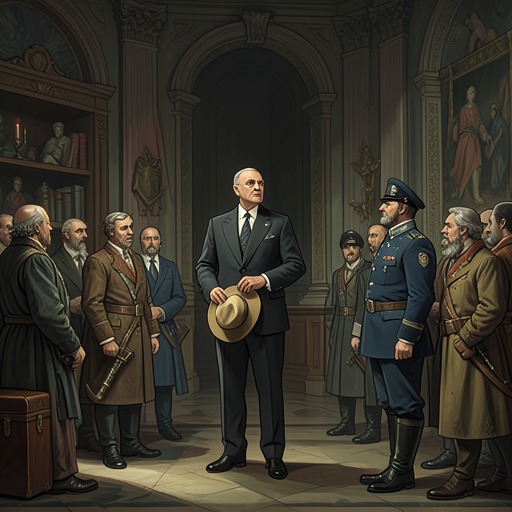
1952 Democratic National Convention nomination of Adlai Stevenson
TrumanThe 1952 Democratic National Convention nomination of Adlai Stevenson is represented in the book by a precise public handoff: on July 26 in Chicago, Harry S. Truman introduced Illinois Governor Adlai E. Stevenson as the party’s new, somewhat reluctant standard-bearer. The brief scene captures Truman in the role of incumbent president presenting a successor to the convention, while emphasizing that Stevenson himself was not an eager candidate.
The Convention Scene
The account identifies Chicago as the setting and July 26, 1952, as the date. Truman introduced Stevenson to the Democratic National Convention, presenting him as its new standard-bearer. The passage gives no account of the balloting, the nomination negotiations, or the delegates’ response; its focus is the moment of introduction and the contrast between the party’s choice and Stevenson’s reluctance.
Truman’s Role
Truman’s part in the scene is public and direct: he stands before the convention to introduce the candidate. The wider account portrays a president whose authority had been tested in several arenas. His first address to Congress after succeeding Franklin Roosevelt won repeated applause, while later conflicts with Congress did not stop him from pressing for policies the legislators had rejected. Those episodes provide context for his appearance at the convention, but the account does not say that they determined the nomination or explain how Truman came to introduce Stevenson.
Stevenson as Standard-Bearer
The description of Stevenson as somewhat reluctant is the scene’s defining qualification. He was the new standard-bearer, but the account does not elaborate on his reasons for reluctance or on his response to Truman’s introduction. It likewise offers no details of the convention’s internal contest. What it does establish is the central outcome represented by the scene: Stevenson emerged as the Democratic Party’s candidate, with Truman publicly introducing him in Chicago.
Significance and Limits of the Account
The introduction marks a visible transfer of the party’s campaign role from the incumbent president to a new candidate. Its significance rests less on procedural detail than on the contrast the caption preserves: Truman performs the confident public act of presentation, while Stevenson is characterized as a reluctant standard-bearer. The book supplies no further account here of the convention or of the campaign that followed, so the scene records the handoff without claiming to explain its political negotiations or consequences.