World War I
TrumanWorld War I was both a world-shaping conflict and a personal turning point for Harry S. Truman: a war he might have remained outside, but chose to enter, and whose unfinished peace became a lasting measure in his later political thinking. His path led from the family farm in Grandview, Missouri, to an artillery command in France, where the scale and modernity of the fighting tested the ideals that had drawn him into service. Long afterward, he invoked the war to argue that American withdrawal from international responsibility had helped make a second catastrophe possible.
A European war reaches an unlikely recruit
In the first week of August 1914, about sixty thousand German troops crossed into Belgium at Liège. By September, German armies had swept through Belgium and into France as far as the Marne River, where French forces made a stand. For people far from the front, including farmers following events through newspapers, the conflict threatened more than immediate safety or property: it unsettled a familiar way of understanding the world. The war’s scale and consequences would repeatedly resemble a natural disaster, beyond the reach of ordinary expectation.
The military reality made old ideas of battle increasingly inadequate. Machine guns, automatic rifles, massed artillery, poison gas, flamethrowers, aircraft, and tanks changed the character of warfare. In 1916, the Western Front, stretching roughly 350 miles from the North Sea to the Swiss border, suffered about two million casualties while its battle line moved very little. During four months at the Battle of the Somme, German losses exceeded the number of soldiers killed in all four years of the American Civil War. The mismatch between immense human cost and limited movement formed the grim background to the American intervention.
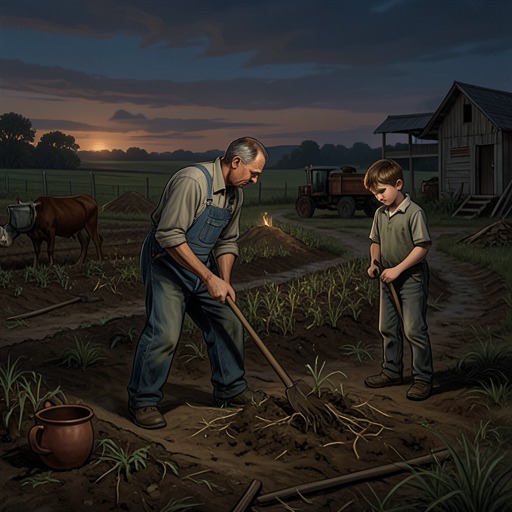
For Truman, the war could easily have remained distant news. In spring 1917 he was thirty-three, two years beyond the age limit set by the Selective Service Act. He had been out of the National Guard for nearly six years, his eyesight fell far below the service requirements, and he was the sole supporter of his mother and sister. As a farmer, he was also expected to stay on the land as a patriotic duty. President Woodrow Wilson had argued that the country’s farmers bore responsibility for the fate of the war and, with it, the nation and the world.
Truman nevertheless chose to serve, almost from the time Wilson asked Congress for a declaration of war in April 1917. The decision was his own and became a turning point in his life. He left the farm and responsibility for their mother’s care to his sister, Mary Jane Truman. She later summed up the family’s endurance simply, but the arrangement narrowed her own prospects: at twenty-eight, unmarried and still living in Grandview, she took on worries that had weighed on Truman since their father’s death. He later acknowledged that his departure had been a blow to his mother and sister, and came to feel the cost to Mary Jane particularly keenly.
His explanations for going combined duty, self-testing, and idealism. He disliked guns, had never fought, and had never risked his life for anything; still, he believed the work had to be done and that he must not be a slacker. He thought military service would make a man of him, expected the war to end soon once American forces entered it, and felt the United States owed France a debt because of Lafayette. Wilson’s messages stirred him, as did the prospect of joining a noble cause across the ocean. Those motives did not erase the family burden he left behind, but made the choice more than a matter of military eligibility: he went because he believed participation was a personal obligation.
From Missouri artillery to the Marne
In spring 1917, Truman helped organize a new Missouri artillery battery. His later wartime identity was captured in the official images and records that marked his transformation: an American Expeditionary Force identity card showed the newly commissioned Captain Harry S. Truman without glasses and with a regulation haircut; a photograph placed him among fellow artillery officers somewhere in France. The portrait of Bess Wallace that he carried with him bore her written hope that it would bring him safely home. These objects joined military service to the people and life he had left in Missouri.
By spring 1918, Captain Truman was at Montigny-sur-Aube as the German numerical advantage on the Western Front became apparent. The urgent question was whether American forces would reach the front in sufficient numbers to affect the outcome. In June, German troops were again on the banks of the Marne, within cannon range of Paris. France, Italy, and Great Britain warned Wilson that the war might be lost unless American forces arrived rapidly. Although John J. Pershing had insisted on committing American troops only as a separate command, the emergency brought more than 250,000 Americans to the front in support of the French under Marshal Ferdinand Foch.
American forces fought at Chateau-Thierry and Belleau Wood. On July 15, Germany launched another major offensive aimed at Paris, the Second Battle of the Marne. Fifty-two German divisions faced thirty-four Allied divisions, nine of them American. The balance shifted within three days, from July 15 to July 18. Erich Ludendorff later identified the American presence as decisive, describing the reversal from confidence that the Allies would seek peace to the recognition that the war was lost. In the book’s account, the battle’s turn is not only a change on the front: it shows how rapidly the arrival of American forces altered the strategic outlook.
The artillery assault that began on September 26, 1918, conveyed the industrial scale of the fighting in a different way. At 4:20 in the morning, 2,700 guns opened fire along the front. In three hours, the bombardment expended more ammunition than had been used during the entire American Civil War, at an estimated cost of a million dollars per minute. From Hill 290, Truman saw a sky lit by the artillery fire. The scale of the operation placed a Missouri battery captain inside a war in which technology, expenditure, and destruction had outgrown older notions of battlefield heroism.
Truman’s own conduct under pressure later became a comparison for his political leadership. In the Vosges Mountains in 1918, when his battery panicked under an enemy attack, he stayed by the guns and rallied his men with a forceful reprimand. The episode gave concrete form to the image of a captain who did not abandon his post when those around him were losing order. Years later, accounts of him steering the country through crises returned to that wartime example: the test was not simply courage in isolation, but the ability to restore a group’s resolve under pressure.
Armistice, return, and the unfinished peace
When the Great War ended, its victors could regard the outcome as a triumph for civilization, but the work of creating a lasting peace fell to statesmen. Less than a month later, Wilson sailed to France aboard the George Washington, the same ship that had carried Truman and thousands of other American troops across the Atlantic. The juxtaposition linked the soldier’s passage into the war with the president’s passage toward its settlement, while leaving open the question of whether victory could be translated into durable peace.
The war’s demands did not leave Truman’s family untouched. Mary Jane Truman’s life became more confined after she assumed the farm and family responsibilities he had carried. Bess Wallace also faced the uncertainty of his service: a photograph she sent with him to war contained a wish for his safe return. The book presents the choice to enlist as both an assertion of Truman’s independence and a transfer of burdens to the women at home. His later recognition of that cost complicates any simple account of enlistment as personal adventure or public duty alone.
The war also became part of Truman’s political vocabulary. In 1940, as a senator, he supported defense expansion and rejected the argument that the United States should remain neutral by refusing to sell arms to countries he regarded as friends. On Armistice Day that year, he wrote to Bess Wallace about the unease felt by some veterans of the first crusade over the fate of civilization. The memory was not a neat story of victory: it carried the unresolved worry that the world had failed to learn what the war was supposed to teach.
In 1942, Truman described the ongoing conflict as a tragic continuation of the one fought in 1917 and 1918. He argued that the victors of the earlier war had had an opportunity to compel a peace that might protect later generations, but had missed it; in his view, isolationism helped bring about the greater calamity that followed. He called for a second front in Europe to relieve the Soviet Union, presenting the case as a military necessity. The connection he drew between the two wars made the first war’s aftermath a guide to action: peace required more than winning, and disengagement could leave the conditions for another conflict in place.
A remembered war across Truman’s life
The war remained present in Truman’s later encounters with Europe. On a 1956 visit, he arrived at Le Havre and went by train to Paris. At the Café de la Paix, near the Opéra, he recalled having been in the city during World War I. In a separate conversation about the origins of the first war, he discussed the Austrian prime minister, the situation involving Serbia, and the reasons for the Austrian ultimatum that began the conflict. His own service thus sat alongside an interest in the political sequence that had brought the war about.
The first war also provided a personal frame for his later encounter with Korea. By midsummer 1951, American troops had been fighting there for nearly as long as Truman and his generation had fought in France. The fighting had settled around the 38th parallel, with heavily defended hills and ridgelines becoming the focus of repeated battles. Truman knew what a soldier endured and understood the anguish of families at home, yet could not say when the conflict would end or what more he could do to stop the anxiety and loss. The parallel did not make the wars identical; it made the older experience a measure of the human burden carried by another generation.
The book places World War I within the larger arc of Truman’s life, from a rural upbringing and a farm in Missouri to command over a powerful industrial nation. His service in France was one passage in that transformation, but it also supplied a durable political lesson. The young man who went because the work had to be done returned from a war whose settlement, in his judgment, had failed to secure the future. As a result, World War I appears not only as the conflict that made him a soldier, but as the historical warning through which he interpreted American responsibility in the conflicts that followed.