Truman’s 1948 Campaign Tour
TrumanTruman’s 1948 Campaign Tour carried Harry S. Truman from a spring of bleak political forecasts into an autumn campaign defined by packed halls, cheering crowds, and direct contact with voters. Its significance lay not simply in the speeches along the way: the travel itself restored Truman’s confidence, while the public response repeatedly challenged the confident predictions that he would lose.
A campaign against expectations
At the beginning of the campaign season, the outlook appeared nearly settled. Press attention to scientific polls helped sustain the expectation of a Republican victory and a crushing defeat for Truman and his party. Against that atmosphere, two experiences helped shape Truman’s confidence. One was his memory of the 1940 Senate primary, when he had faced long odds against Lloyd C. Stark without money, newspaper support, or the endorsement of Franklin D. Roosevelt. The familiar certainty of his coming defeat in 1948 reminded him of that earlier contest, in which forecasters had also failed to anticipate his eventual success.
The other experience was immediate: a widely publicized, ostensibly “nonpolitical” cross-country rail tour in June, recommended in the Rowe Report. The expedition lasted two weeks. It had its blunders and embarrassments, and at moments seemed to have been a mistake, but Truman found it exhilarating. He returned to Washington feeling and looking more vigorous and self-assured than at any point in his political life. The tour therefore mattered before the autumn campaign had reached its most dramatic rallies: it gave Truman renewed confidence in a season when predictions and defections might otherwise have narrowed his sense of possibility.
The journey becomes a campaign
That renewed confidence was reinforced by Truman’s taste for the work of campaigning among people. He enjoyed travelling through the country, meeting crowds, and greeting local politicians who came aboard the train. The handshakes were not presented as mere ceremony: he took time for each visitor and genuinely enjoyed these encounters. In a campaign widely framed by forecasts, the train made political contact immediate and personal, bringing local supporters into the candidate’s presence stop after stop.
By October, the tour was unmistakably a contest for public support. Writing to his sister from the White House on October 20, Truman said, “We’ve got them on the run and I think we’ll win.” He had spent a day in Washington, then flown to Miami, where 200,000 people filled the streets. In Raleigh, he encountered people lining the route from an airport fifteen miles outside town. The scale of these receptions offered a visible counterpoint to the expectation that the campaign was already lost.
The journey also unfolded alongside events that gave the campaign a more hopeful atmosphere. On October 22, Truman authorized twenty-six additional C-54 transports for the Berlin airlift. After months of experience, better landing facilities, and more efficient air-traffic control, the airlift was succeeding, and winter supplies for Berlin were assured. The campaign train and the airlift belonged to different arenas, but the narrative places them together as signs that outcomes could improve despite earlier forecasts. On the train, Truman told a delighted crowd in Johnstown, Pennsylvania, that the Republican Party stood for “Grand Old Platitudes.” At a large rally in Pittsburgh’s Hunt Armory, he said, “I am an old campaigner, and I enjoy it.” The remark joined his confidence to the pleasure he took in campaigning itself.
Crowds, conflict, and momentum
In Chicago, the scale of the welcome startled people who had witnessed earlier Roosevelt rallies. As many as 50,000 people may have marched in a parade from the Blackstone Hotel to Chicago Stadium, while another half million lined the route. Bands played and fireworks burst overhead. Yet the crowd was not simply jubilant: Paul Douglas recalled people with tears in their eyes, fearing that gains made under the New Deal might be taken away. Their visible sympathy for Truman connected the spectacle to a sense that the election put something precious at stake.
At the stadium, before 24,000 people, Truman delivered the campaign’s most savage speech, attacking Dewey and arguing that a vote for him was a vote for fascism. David Noyes and Albert Carr had written the speech in the hope of provoking Dewey into a reply, and Truman accepted that strategy. Dewey was outraged and drafted a response for his own Chicago appearance, but advisers persuaded him to discard it rather than risk a slugging match. Truman offered no explanation or apology as he continued east. The episode exposed a sharp contrast between the campaign’s theatrical aggression and Dewey’s decision not to answer in kind; it also showed that Truman’s course was not invariably restrained or free of desperation.
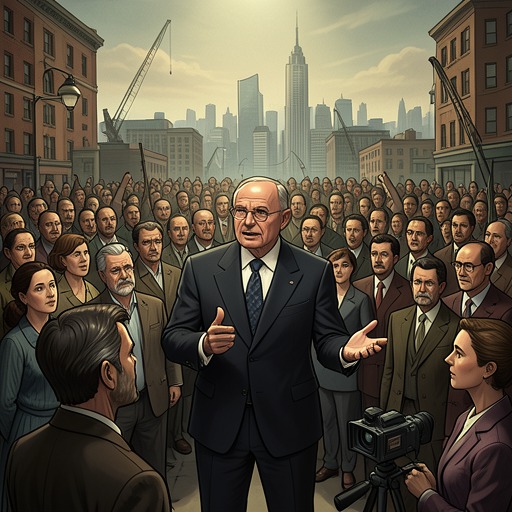
The reception grew larger as the train moved east. At Boston, a quarter of a million people lined the parade route, cheering and responding to the evident enjoyment on Truman’s face. After nine stops and nine more speeches across Massachusetts, Rhode Island, and Connecticut, the campaign reached New York on October 28. More than a million people turned out. From Grand Central Station, Truman’s open car travelled nine miles through the city under the escort of a hundred motorcycles, with Bess and Margaret following six cars behind. Confetti, ticker tape, and shredded telephone books filled the air along 42nd Street; through the falling paper, Truman kept smiling and waving to people at the curbs and at upper-floor windows. On Seventh Avenue, loudspeakers played “Happy Days Are Here Again.” The vast welcome made the candidate, his family, and the crowd part of a single moving public scene.
The final rally and the tour’s meaning
The last platform appearance Truman would make as a candidate for public office took place at Kiel Auditorium in St. Louis. The immense hall had no empty seats. Truman set aside the speech prepared by his staff and attacked the Republican Congress, the Republican press, the Republican “old dealers,” and the Republican candidate. The crowd stomped and cheered him on. Afterward, he felt he had done well; at minimum, he had done the best he knew how. The moment closed the tour not with a quiet recapitulation, but with one more direct confrontation between candidate and audience.
The tour’s movement—from a June journey that revived Truman’s confidence to autumn crowds that visibly contradicted predictions of defeat—made campaigning itself a central part of the story. Truman trusted the American people and felt a need, as President, to meet ordinary Americans rather than rely only on reports about them. The crowds did not erase the campaign’s fatigue, tactical risks, or bleak forecasts. They gave him a different measure of the contest: the response of people encountered in streets, at stops, and in packed halls. Dewey’s defeat became the final reversal of the predictions that had framed the campaign, while the tour’s lasting narrative force rests on the contrast between those predictions and the public scenes Truman met along the way.