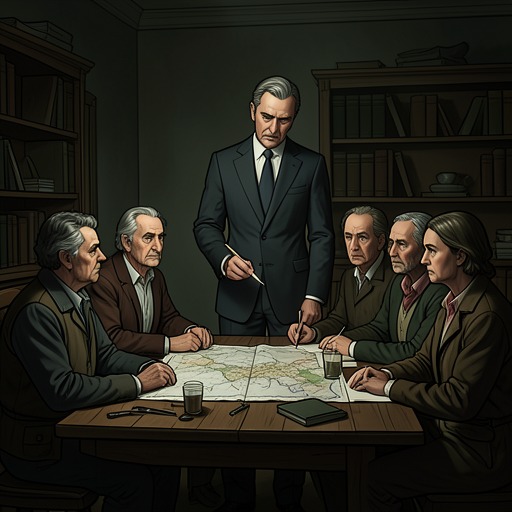
Southern Democratic Revolt of 1948
TrumanThe Southern Democratic Revolt of 1948 was a challenge to the Democratic Party’s civil-rights agenda and to Harry S. Truman’s leadership. Southern Democrats pledged to oppose the program, threatened to withdraw from the national convention, and warned that the South could no longer be counted on as a dependable part of the party’s coalition. Truman did not retreat: as he sought reelection, his party chairman announced that his civil-rights position remained unchanged. The revolt exposed the political cost of that stance while making clear that Truman would not soften it to preserve Southern support.
Causes and political stakes
The confrontation followed Truman’s civil-rights message, which called for action on discrimination and on claims by Americans of Japanese descent who had been forced from their homes and confined during the war because of their racial origin. The proposed remedy for those claims would not come for years. The message also confronted the entrenched discrimination faced by Black Americans, particularly in the South, where their social standing and legal position had scarcely advanced in more than half a century. When asked what informed his position, Truman cited the Constitution and the Bill of Rights.
The response showed how sharply civil rights divided the party. Clark Clifford regarded Truman’s course as right on both moral and political grounds. Ed Flynn, a powerful Democratic leader in the Bronx, welcomed it in part because of his concern for the Black vote in New York. On Capitol Hill, however, the outcry suggested that Truman could lose the South and, with it, the November election. Southern congressmen attacked the message in language the account describes as too raw to print. Tom Connally of Texas, once an ally of Truman in the Senate, denounced it as an assault on the Constitution and vowed that the South would not accept it passively.
Racial exclusion was visible even at a dinner honoring the President. Senator Olin Johnston of South Carolina boycotted the annual Jefferson-Jackson Day dinner at the Statler Hotel, explaining that he and his wife might be seated beside a Black guest. The three Black Democrats who attended were placed at a table in the rear. The episode gave the political dispute a concrete setting: while the administration faced demands to address racial injustice, discrimination remained present within the party’s own public gatherings.
From protest to organized revolt
The resistance escalated beyond individual denunciations. Fifty-two Southern Democrats in Congress pledged to fight any civil-rights plank in the Democratic platform and, by implication, any Democratic presidential candidate who supported what they regarded as unacceptable liberal policies. Their position turned opposition to a particular message into a challenge to the party’s platform and leadership. Threats of a white Southern march on Washington accompanied the pledge, while Governor Strom Thurmond of South Carolina, speaking for a committee of Southern governors, promised to defend white supremacy and warned party leaders that the South was no longer securely in their control.
The Mississippi Democratic Committee raised the prospect of withdrawal from the national convention unless what it called anti-Southern laws were rejected. The threat made the stakes immediate: the revolt could disrupt the party’s national gathering as well as its effort to hold together a governing and electoral coalition. The account presents these actions as a mounting rebellion, not simply a disagreement over legislative detail. The demand that Truman soften his views was, in effect, a demand that he choose between accommodation with Southern opponents and continued support for his civil-rights position.
Truman’s response and the widening break
Truman met privately with several Southern Democrats who suggested that the dispute could be contained if he moderated his position. In a written reply, he acknowledged that his forebears had been Confederates and that he came from a part of Missouri where Jim Crowism prevailed. But he also drew a distinction between that background and the responsibilities of his office. He described learning that Black soldiers returning from overseas had been thrown from army trucks and beaten in Mississippi, and said that, whatever his Missouri origins, as President he regarded such conduct as wrong and would fight to end it.
That declaration was not evidence that Truman had shed every inherited bias. The account notes that old prejudices and habits of speech persisted in private, and records his sister’s view that he was no more in favor of racial equality than other members of their circle. It also stresses the limit of that judgment: Truman now understood that, as President, he could not simply stand aside in the face of glaring injustice. The findings of his civil-rights commission, published as To Secure These Rights, had further confronted him with the scale of the problem. The revolt thus unfolded against a tension between the racial assumptions of Truman’s background and the public duties he believed the presidency imposed.
On March 8, without fanfare, Senator J. Howard McGrath, who had replaced Bob Hannegan as national chairman, formally announced that Truman was running for reelection and that his position on civil rights had not changed. The declaration made the dispute unmistakable: the President would seek the party’s nomination without first yielding to the Southern demand that he soften his views. Alabama Senators Lister Hill and John Sparkman, both among the South’s more liberal congressional voices and longtime friends of Truman, then urged him to withdraw and said they would not support him at the convention. Their action showed how far the conflict had spread, reaching even Southern figures who were not identified with the revolt’s most openly segregationist position.
Significance
The revolt was both a response to Truman’s civil-rights program and a test of whether Southern Democratic support could dictate the party’s national position. Its threats and pledges revealed the coalition’s fragility; Truman’s unchanged stance made the rupture more consequential than a private dispute or a temporary protest. The episode also complicates any simple account of his motives. The evidence presents a President shaped by a region where Jim Crow remained entrenched, yet unwilling to let that inheritance justify presidential inaction when he confronted violence against Black veterans and the broader findings of his commission.
The conflict did not, in the evidence presented here, resolve the party’s future or establish the final electoral consequences of the revolt. Its immediate significance lies in the choice made before the convention: Truman continued toward reelection while the party chairman publicly affirmed that the civil-rights position would stand. The Southern challenge therefore marked a widening break between the President and a substantial bloc of his party, and made civil rights an explicit test of political allegiance rather than an issue the national leadership could quietly set aside.