United States Entry into World War I
TrumanThe United States Entry into World War I transformed a distant European conflict into an immediate choice for Harry Truman. Although his age, eyesight, family responsibilities, and work as a farmer all gave him reasons to stay home, he chose to go. That decision redirected his life and left his mother and sister to shoulder responsibilities he had carried since his father’s death.
The decision to enter the war
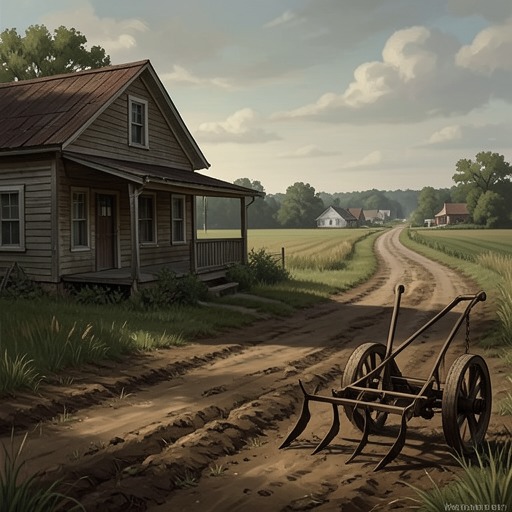
In April 1917, after Woodrow Wilson called on Congress for a declaration of war, the conflict became more than news from Europe for Truman. At thirty-three, he was two years beyond the age limit set by the 1917 Selective Service Act. He had left the National Guard nearly six years earlier, his eyesight was below the military services’ requirements, and he was the sole supporter of his mother and sister. Farmers, moreover, were expected to remain on their land as a patriotic duty; Wilson had argued that the fate of the nation and the world rested on them.
Truman could therefore have stayed on the farm without blame or surprise. Instead, almost from the moment Wilson made his appeal, he decided to go. The book presents that choice as a turning point in his life, and emphasizes that it was his own decision rather than an obligation imposed by his circumstances.
A choice with consequences at home
Truman left the farm and the care of his mother to his sister, Mary Jane Truman. She later summed up what followed with the words, “We got through,” but the arrangement changed the course of her own life. At twenty-eight, unmarried and still popular, she assumed the worries and responsibilities that had weighed on her brother. Her life became closely confined to Grandview, with little society beyond it. Truman later acknowledged that his decision had been “quite a blow” to his mother and sister; his sister, who adored him, also felt that his idealism and eagerness to act could make him self-absorbed and conceited.
Bess Wallace urged Truman to marry her before he left. He refused, arguing that she should not bind herself to a man who might return crippled or not return at all. They would wait until he came home whole. The exchange makes the danger of departure concrete: the war shaped not only Truman’s public path but also the timing and terms of his relationship with Bess.
Reasons for going
Truman described his decision in terms familiar among the American men who volunteered during the fervor of 1917. He disliked guns, had never fought, and had never risked his life for anything. But he regarded military service as “a job somebody had to do” and believed it would make a man of him. He did not want to be a “slacker,” regardless of his age, poor eyesight, or lack of experience.
His reasons also joined personal resolve to patriotic and idealistic feeling. He thought the war would soon end once American forces entered it, believed that the United States owed France a debt because of Lafayette, and said that Wilson’s wartime messages had stirred him. Most compelling was the idea of joining a noble cause across the sea. He played stirring wartime songs at the piano, including “Over There,” and later recalled that many Americans had been “stirred by the same flame.”
Economic effects and the war’s reach
The prospect of American participation also shaped business expectations. Morgan believed that oil lay beneath farmland in Kansas, Oklahoma, and Texas, and the company leased thousands of acres across those states and Louisiana. A newspaper advertisement written by Culbertson predicted that, if the United States entered the war, demand for gasoline and petroleum byproducts would send prices soaring. The outcome was the reverse for Morgan Oil & Refining: wartime demands left too little manpower to pursue oil, investors disappeared, and the company went out of business. Only afterward did the owners learn that a lease in southeastern Kansas formed part of the Teeter Pool, which could have made millions had they drilled deeper.
The venture’s failure added to the financial strain surrounding Truman. Bess Wallace lost her investment, while Truman seems to have come out even in the oil company. His loss in a zinc mine was uncertain: he gave figures of $11,000 and, later, $7,500, both sums borrowed. Combined with a possible $12,000 share of his father’s debts, his total indebtedness may have reached $23,000; in 1917, his mother placed another $25,000 mortgage on the farm. Even so, the farm remained a source of security. In good years it might provide about $4,000 in clear income, and in exceptional years as much as $7,000—far above the less than $1,000 earned by the average working family. The entry into war thus brought both a changed national economy and a deeply personal reckoning with risk, duty, and the fragile security of home.