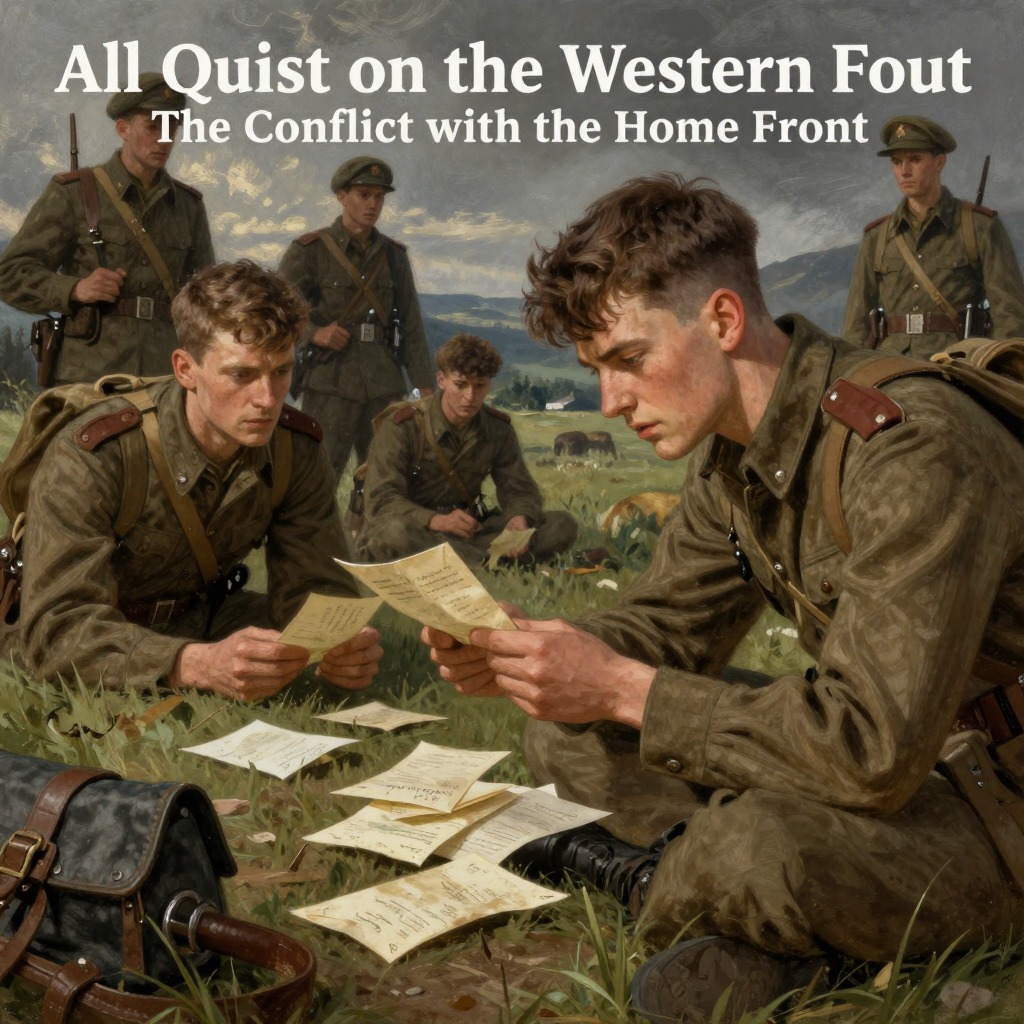
Paul's Leave at Home
Paul Bäumer's leave at home in the autumn of 1918 is a harrowing episode that exposes the unbridgeable chasm between the soldier's front-line reality and the civilian world he once belonged to. The seventeen-day leave, granted after Paul has endured years of trench warfare, becomes a psychological ordeal rather than a respite. He finds himself unable to reconnect with his family, his former teachers, or the patriotic rhetoric of the home front. The visit to his ailing mother, the awkward encounters with his father and old schoolmaster, and the crushing sense of alienation in his own childhood room all culminate in the devastating realization that the war has destroyed his capacity for normal life. The leave ends not with relief but with a deepened despair, as Paul recognizes that he is now a stranger everywhere—neither fully a soldier nor a civilian, but a lost soul suspended between two worlds that can no longer understand each other.
Journey Home and First Impressions
Paul receives his leave pass from Company Commander Bertinck, who gives him seventeen days—fourteen days leave plus three days for travel—and instructs him to report afterward to a training camp on the moors rather than returning directly to the front. The other men envy him, and Stanislaus Katczinsky offers advice to try to secure a base job. Paul feels a consuming impatience to be gone as he waits at the rail head after saying goodbye to Katczinsky and Albert Kropp, whose figures dwindle as they wave once or twice. The train journey home is a sensory awakening: the landscape becomes disturbing, mysterious, and familiar, with thatched roofs, cornfields gleaming like mother-of-pearl, and orchards sliding past the western windows. The names of the stations begin to take on meaning, and Paul's heart trembles as he recognizes the boundaries of his youth. When the train finally stops at his hometown station, he stumbles down the steps with his pack and rifle, but he knows no one among the hurrying crowd. A Red Cross sister offers him coffee and calls him "Comrade," but he turns away, irritated by her self-importance.
The Reunion with His Mother
Walking through the familiar streets, Paul passes the confectioner's where he used to eat ices, the shops he knows, and finally stands before the brown door with its worn latch. His hand grows heavy as he opens it. The stairs creak under his boots, and his eldest sister calls out from the kitchen, where she is cooking potato-cakes. When she cries "Mother, mother, Paul is here," Paul leans against the wall, gripping his helmet and rifle, unable to take another step. The staircase fades before his eyes, and against his will, tears run down his cheeks. His mother lies in bed, pale and ill; she has been sick for months, and the doctors suspect cancer. She asks anxiously if he is wounded, and he assures her he is only on leave. She has kept a jar of preserved whortleberries for him, the only one they have had for months, and stale cakes she bought cheap and saved. Paul unpacks the food he has brought—a whole Edamer cheese from Katczinsky, two loaves of army bread, butter, livered sausage, dripping, and a bag of rice—but when his mother asks falteringly, "Was it very bad out there, Paul?" he cannot answer truthfully. He shakes his head and says no, not so very, because there are always a lot of them together. He knows she would never understand, and he resolves that she never shall.
Alienation from Civilian Life
Paul changes into civilian clothes, but the suit feels tight and short; he has grown in the army. Looking at himself in the glass, he sees a sunburnt, overgrown candidate for confirmation staring back in astonishment. His mother is pleased to see him in civilian clothes, but his father would rather he kept his uniform on so he could take him to visit acquaintances. Paul refuses. He tries to sit quietly in the beer garden under the chestnuts, but he cannot get on with the people. His father wants to hear about the front, and Paul confines himself to telling a few amusing things, afraid that putting the horrors into words might make them gigantic and unmanageable. When a former teacher, Kantorek, is mentioned, Paul learns from his friend Mittelstaedt that the old schoolmaster has been called up as a territorial and is now being humiliated by Mittelstaedt, who has become his superior officer. Mittelstaedt makes Kantorek dash back and forth in skirmishing drills and creep on hands and knees over the sand, quoting Kantorek's own pompous phrases back at him. Paul finds the reversal bitterly satisfying, but it does not ease his deeper unease. In the street, the screaming of tramcars startles him because it resembles the shriek of an incoming shell. A headmaster drags him to a table of civilians who argue about what Germany should annex, and when Paul suggests that a breakthrough may not be possible, the headmaster dismisses him loftily, saying he knows nothing about it because he sees only his little sector. Paul realizes that these people talk too much, that they have worries and desires he cannot comprehend, and that he feels no contact with them. He envies and despises them at once.
The Failed Return to His Former Self
In his old room, Paul sits on the brown leather sofa and looks at the bookshelves, the pictures pinned to the walls, the butterfly collection in a glass case. He tries to think himself back into that time, to feel the old quiet rapture and the breath of desire that used to arise from the colored backs of the books. He implores the room with his eyes: "Speak to me—take me up—take me, Life of my Youth—you who are care-free, beautiful—receive me again." But nothing stirs. A terrible feeling of foreignness rises up in him. He cannot find his way back; he is shut out. The past withdraws itself, and he stands there dumb, dejected, as before a judge. Words, words, words—they do not reach him. Slowly he places the books back on the shelves and quietly goes out of the room, never to return to it in the same way. The room, with its familiar objects, has become a museum of a life that no longer belongs to him.
The Weight of Parting
The days grow ever more strained, and his mother's eyes more sorrowful. She counts the days; every morning she is sad because it is one day less. Paul visits Kemmerich's mother, who quakes and sobs and cries out, "Why are you living then, when he is dead?" He lies to her, saying Kemmerich died instantly, shot through the heart, and swears by everything sacred to him—though he reflects bitterly that such things change pretty quickly with them. On the last evening at home, everyone is silent. Paul goes to bed early, seizes the pillow, presses it against himself, and buries his head in it. Late in the night, his mother comes into his room, thinking he is asleep. She sits long into the night, though she is in pain and often writhes. At last Paul pretends to wake up. She asks gently, "Are you very much afraid?" He says no. She warns him to be on guard against the women in France. She tells him she will pray for him every day. She has saved two pairs of wool underpants for him, knowing what they cost her in waiting, walking, and begging. Paul thinks, "Ah! Mother, Mother! how can it be that I must part from you?" He bites into his pillow and grasps the iron rods of his bed with his fists. He ought never to have come on leave. Out there he was indifferent and often hopeless; now he will never be able to be so again. He was a soldier, and now he is nothing but an agony for himself, for his mother, for everything that is so comfortless and without end.