Panu
KalevalaPanu is the personified fire-child of Ukko, a celestial flame whose passage through the story turns fire from a force gently cradled in the heavens into a dangerous, elusive presence that must be recovered and contained. His brief appearances give the element a mobile, childlike identity: he can escape, be swallowed, and be carried, yet remains powerful enough to provoke a deliberate effort to end his destructive fury.
Identity and Celestial Origin
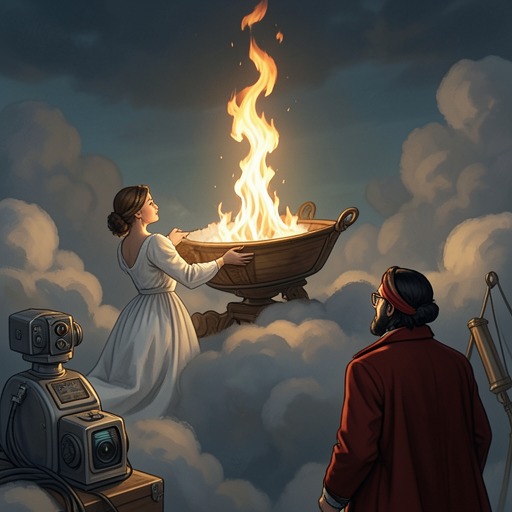
Panu is identified with the fire of Ukko and called the Fire-child. His origin is described through the rocking of lightning and the rocking of Ukko’s fire; the flame is then gently cradled by Ilmatar, the virgin of the ether. This image gives the fire a vulnerable beginning, held in a celestial setting rather than introduced as an ordinary household flame. The passage also describes the maiden as fair and faithful, placing Panu’s first care within an image of patient guardianship.
That tender beginning contrasts with the later language of threat. When the fire becomes an intruder, it is called both the wicked Fire-child and the flame of evil. Near the end of the episode, Ilmarinen addresses it as evil Panu from the heavens. These descriptions do not erase its heavenly origin; instead, they set celestial source against harmful conduct, making the same fire at once a gift associated with Ukko and a danger requiring control.
Escape and Capture
After asking Ilmatar where the Fire-child wandered, Wainamoinen is associated with an account of its passage through narrow openings: through the eyelet of a needle and through the death-hole of a hatchet. The images make the flame difficult to confine even in spaces too small for an ordinary creature. Panu’s movement is not presented as a settled journey with a clear destination; the emphasis falls on escape and on the difficulty of tracing a fire that can slip through minute apertures.
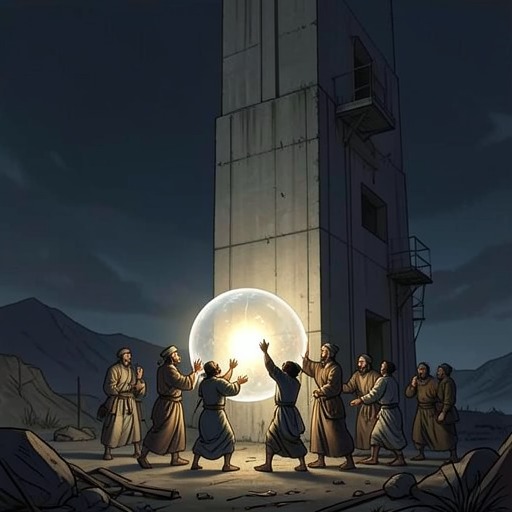
The pursuit reaches a reversal when a daring whiting catches the fire-intruder and swallows him, taking in the flame along with the Fire-child. Panu is thus not simply extinguished: the flame remains inside a living creature, and the story’s recovery depends on following that transformed containment. Later, the fire is found within a scarlet ball, identified as the flame fallen from the heights of the seventh heaven. The discovery restores its celestial provenance while showing how far it has passed from its original cradle.
Ilmarinen and the Contained Flame
In the recovery sequence, Ilmarinen takes the willing Panu, also described as the willing fire of Ukko, and lays him in a box of tinder. The action treats the fire as something that can consent and be transported, preserving its childlike personification even as it is handled as a material flame. The tinder box supplies a concrete boundary for a force previously characterized by escape, flight, and passage through narrow openings.
Ilmarinen’s handling of Panu is not merely an act of retrieval. He reflects before addressing the flame, and the stated purpose is to still the Fire-child’s fury and end its persecutions. The episode therefore holds two aspects of the encounter together: Panu is willing to be taken, yet his power has caused trouble that calls for restraint. His containment in the tinder box marks a practical change in the relationship between people and fire, from pursuit of an escaping celestial force to deliberate custody of it.
Narrative Role and Significance
Panu’s part is brief, but his changing forms organize the fire episode: a flame cradled by Ilmatar becomes an escaping child, is swallowed by a whiting, reappears as a scarlet ball, and is finally placed in tinder by Ilmarinen. Each change alters how the fire can be approached. It begins as something cared for, becomes a fugitive force, survives inside another creature, and ends as a recoverable flame that can be carried and controlled.
The episode does not resolve Panu into a purely benevolent or purely evil figure. The fire is linked to Ukko and the seventh heaven, but it is also called wicked and addressed as evil when its destructive effects are confronted. That contrast makes Panu a figure for fire’s double capacity within the narrative: celestial in origin and useful once recovered, yet dangerous when it escapes human control. Ilmarinen’s final containment answers the immediate crisis without removing the story’s sense of fire as a potent, animate presence.