Ilmarinen
KalevalaIlmarinen, the eternal smith of the Kalevala, is a divine-origin maker whose work reaches from the forging of the heavens to the making of the Sampo and a golden bride. His mastery can shape metal into objects of cosmic consequence, but it does not guarantee success in love: the lifelessness of his artificial bride marks a sharp limit to what the forge can create.
Identity and the Art of the Forge
The poem presents Ilmarinen as one of its three principal heroes, alongside Wainamoinen and Lemminkainen, and describes the central figures as divine in origin. His identity is bound to making: he is the eternal forgeman, the ancient blacksmith, and the master of metalwork. In an account of the world’s powers, he is credited with forging the heavens and shaping the air as a hollow cover. The absence of visible hammer-traces in that work sets his craft at a scale beyond ordinary workmanship: the sky itself bears witness to a making that leaves no ordinary marks.
His arrival on earth is also tied to the metal he works. The poem says that he came to earth to work metal and was born upon the Coal-mount. That origin links the smith to the furnace before any particular commission begins. Ilmarinen’s magic is not separate from his trade; it is expressed through it, in the capacity to turn metal and fire into things that have consequences beyond the workshop.
The poem also places his craft in a world where nature and objects possess life and agency. Its account of magic describes Wainamoinen’s songs giving life to a spouse forged by Ilmarinen from gold, silver, and copper. That broad claim about the power of song stands in telling contrast with the later golden image that Ilmarinen himself makes: the metal can take a maiden’s form, but it cannot speak or see. His work can approach life without reliably making a living companion.
The Sampo and the Measure of His Skill
Ilmarinen’s fame becomes a practical resource when Wainamoinen is held in the distant country and cannot forge the Sampo or its colored lid himself. He offers to be taken home and to send Ilmarinen in his place, presenting the smith as the one capable of completing the task and perhaps winning the hostess’s daughter. The promised bride is therefore connected to a commission: Ilmarinen’s skill is proposed as the means by which Wainamoinen can meet the demand placed upon him.
When the work begins, the narrative gives its making a deliberate sequence. Ilmarinen first lays out the bellows; on the third day he builds the furnace and begins to forge the Sampo. The interval and the preparations give the undertaking the shape of labor rather than an effortless spell. The object’s extraordinary significance depends on a craft process: bellows, furnace, and sustained work precede the start of the forging.
The wider poem makes the Sampo one of the defining products of his art. Ilmarinen is named the worthy smith and master of the craft, and the story turns that reputation into a cause of action: Wainamoinen goes to the smithy to address him, and the work of the forge draws him into journeys and obligations beyond his own workshop. His skill is never merely ornamental. Other characters rely on it, and what he makes changes what they can ask, bargain for, or attempt.
Trials, Travel, and Service
Ilmarinen’s work extends beyond the forge into dangerous tasks. In the wooing narrative, he plows the field of serpents safely, lifting the vipers as he works. The feat makes the craft figure an active hero: his success is not limited to making tools or wonders but includes confronting a perilous obstacle as part of a courtship. The field’s danger and his safe completion of the plowing make the trial a test of action as well as skill.
In another Northland task, he takes a pike-head to the hostess. The image is specific and practical: a hard-won object passes from the hero to the person who has set the task. The episode belongs to a wider pattern in which Ilmarinen’s technical ability and physical daring serve a courtship, but the surviving detail also preserves the tangible result of the trial rather than reducing it to a general victory.
His mobility appears in other work as well. When a boat’s oars fail to lessen the distance, Ilmarinen takes them up with master-magic, and the boat leaps across the waves. The scene carries his workshop power into travel: magic helps overcome the limits of an ordinary vessel. Later, he joins Wainamoinen in weaving a mighty fish-net, while elsewhere he is asked to forge an iron rake with closely set copper teeth. These tasks show the smith’s usefulness in shared ventures and in the making of particular implements, not just in the creation of famous marvels.
Courtship and Household
Ilmarinen’s courtship joins his reputation as a maker to the pursuit of marriage. A rune is devoted to his wooing, and the early promise that he may win the Northland hostess’s lovely daughter makes marriage part of the bargain surrounding the Sampo. His courtship also demands action outside the forge, including the serpent-field trial. The daughter’s departure from her native fields and from the dark country of Sariola gives the marriage arc a concrete cost: union entails leaving the landscape and home in which she has lived.
The story also places Ilmarinen in a household with a servant. Kullervo is introduced as a wizard-servant of Ilmarinen and as a slave purchased from Untamo. Ilmarinen’s wife and hostess waits for the herd’s return with Kullervo. The detail locates Ilmarinen’s household within a wider social order of service and captivity, and connects the smith’s domestic life to Kullervo’s story without making the servant’s experience a mere extension of the forge’s work.
The poem gives Ilmarinen’s own grief a different domestic expression. He weeps for a day and then a second before turning again to metalwork. The passage moves directly from sorrow to the furnace: the metal-worker resumes his labor, working without pause to mould a golden image. The sequence makes the forge a response to loss, but the result will expose the limits of that response.
The Golden Image and the Limits of Making
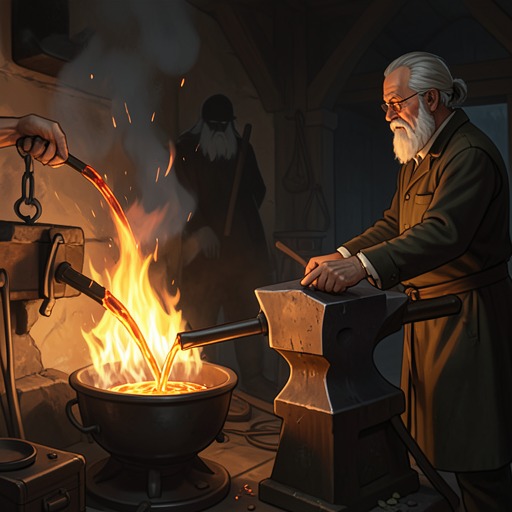
Ilmarinen labors to shape a golden maiden, with workmen fanning the furnace flames as he forges. The object is precious and finely formed, but its appearance does not give it the capacities needed for companionship. The mouth is magic yet speechless; the eyes are not able to see. Ilmarinen recognizes the difference between a valuable image and a person capable of wisdom. His own assessment turns the scene from a display of technical triumph into an acknowledgment of what the craft has not achieved.
The golden image’s failure is particularly striking beside the poem’s broader account of song and magic, in which Wainamoinen’s songs can give life to a metal spouse. In this episode, however, Ilmarinen lays the image aside and its wooing is fruitless. The narrative does not treat resemblance as sufficient: metal can be worked into a maiden’s shape, but the image cannot answer, perceive, or offer the mutual life that marriage requires. The smith’s mastery remains real, yet it meets a boundary that greater effort at the furnace cannot remove.
Narrative Role
Ilmarinen’s story repeatedly tests the difference between making and possessing. His forge can produce the Sampo, fashion a golden figure, and supply equipment for difficult journeys; his own participation in trials carries him through dangers that mere workmanship cannot settle. Yet the outcomes are not all alike. The Sampo makes his skill consequential to other people, while the golden bride demonstrates that material perfection is not the same as human life.
As one of the poem’s three principal, divine-origin heroes, Ilmarinen connects cosmic creation, practical labor, courtship, and collective action. He forges the heavens and the Sampo, plows the serpent field, equips journeys, and joins Wainamoinen in later work. Across these episodes, the smith is defined by an extraordinary capacity to transform materials and circumstances. The failed golden bride gives that power its clearest limit: even an eternal artist cannot make every desired outcome real by hammering it into shape.