Pellerwoinen
KalevalaPellerwoinen is the young sower who answers the question of how the vast, vacant island will be planted. Identified as a slender boy and as the first-born of the plains and prairies, he scatters seeds across the land and forest; later, he surveys their growth. His brief episode turns an empty landscape into a place where vegetation is taking root and spreading.
Identity and Introduction
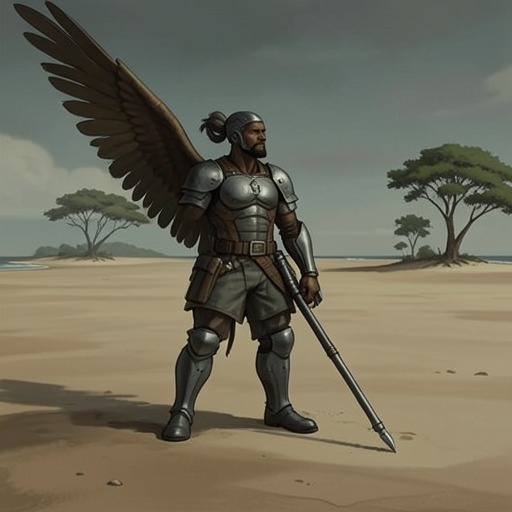
The narration introduces Pellerwoinen through a practical need rather than an account of his origins: someone must sow the island and scatter its seeds. After reflection, Pellerwoinen is chosen for the work. He is described as the first-born of the plains and prairies, and, in the same introduction, as a slender boy called Sampsa Pellerwoinen. These descriptions associate him with open land and youthful smallness, while the task given him is broad in scale: the island itself is to be planted.
The scene offers no extended biography or account of how Pellerwoinen acquired this role. Instead, it defines him by the work he accepts. That narrow focus makes the sowing his identifying action: the island’s transformation begins not with a contest or a feat of force, but with a young figure scattering seeds over an unplanted expanse.
Sowing the Island
The island is presented as vast and vacant, and the question of who will sow it is considered before Pellerwoinen comes to mind. He consents, then sows diligently. The narration emphasizes both the scale of his charge and the deliberate care of its execution: he scatters seeds over the lands and forest seeds across the island. His labor answers the landscape’s emptiness with the means of future growth.
The account also gives the planting a specific geography. Hawthorn is associated with the banks of streams, while junipers are assigned to hilly regions. The distribution is not described as an indiscriminate covering; different plants are placed in different kinds of terrain. The narration expressly identifies this planting as Pellerwoinen’s work, repeating his name alongside the image of the slender boy. In this way, the task is both an act of sowing and the shaping of a varied landscape.
Growth and Narrative Role
The consequences of the sowing appear as the seeds begin to sprout. Pellerwoinen later stands aloft to look about him and inspect how the seeds are growing, including the crop associated with his work. He sees young trees thickly spreading and the forest rising in beauty. The passage thus moves from a question about who will plant the vacant island, through the act of planting, to a view of growth already under way.
Pellerwoinen’s part in the episode is not to oversee a completed forest or to claim a final result. The visible consequence is an emerging one: seeds have sprouted, young trees are spreading, and the forest is rising. His later survey links the initial labor to its living outcome, making observation part of the episode’s pattern as well as sowing. The change is measured through the island itself—from vacant ground to a landscape marked by seedlings, trees, and forest.
The episode gives Pellerwoinen a foundational role through a modest, concrete action. He does not transform the island in a single gesture; he scatters seeds whose growth becomes visible afterward. The contrast between his slender youth and the breadth of the island’s planting underscores the scale of the work without turning it into a battle or a trial. Within the account, Pellerwoinen is the figure who initiates the island’s cultivation, while the sprouting seeds and spreading forest show the consequence extending beyond the moment of sowing.