Mielikki
KalevalaMielikki is the forest goddess whom hunters and herdsmen address when they need the woodland to yield its gifts or guard their animals. As Tapio’s consort and the keeper of Metsola’s keys, she presides over a forest imagined not as empty wilderness but as a domain with its own household, stores, servants, and rules. The Kalevala presents her both as a gracious provider and, in the account of the bear, as a maker who sets a moral condition on a creature’s strength.
Identity and the forest household
Mielikki is known as the Honey-rich Mother of the Woodland and the Hostess of the Glen and Forest. She is the consort of Tapio, the tall, slender lord of the woodlands, and has charge of the keys to his abode, Metsola. Her own bounty is figured through a chest of honey, food sought by the forest deities and by weary hunters of Suomi. These details give the forest the character of a community with a household economy: its plenty belongs to its divine keepers, and human access to that plenty depends on addressing them.
Her aspect changes with the outcome of the hunt. When hunters return successfully, Mielikki is imagined as beautiful and beneficent, adorned with gold and silver, golden garlands and earrings, strings of pearls, silvered hair-bands, blue stockings, and red shoe-strings. When the game-bag is empty, the same goddess appears hateful and hideous, dressed in untidy rags and wearing straw shoes. The contrast makes hunting fortune visible in her appearance: the relationship between people and the forest is expressed not only through what they bring home, but through the changing image of the power that governs the game.
Requests for game and guidance
Hunters appeal to Mielikki before and during the pursuit. Lemminkainen addresses her as forest-mother while hunting the moose of Hiisi, a quarry intended as a dowry for the pride of Northland. He asks her to let gold flow abundantly. Later, he calls her the queen of the woodlands and the enchanted hostess of Metsola, recalls the gold he promised, and offers silver as well. His appeal makes the hunt a relationship of negotiation: success is sought through praise and promised payment, rather than treated as something the hunter can command by skill alone.
The invocations give Mielikki several closely related titles. Lemminkainen calls her the lovely forest dame and mother-donor of the mountains; elsewhere she is addressed as Mimerkki, queen of the snowy woods. These names emphasize her authority over a landscape that can both conceal and supply the hunter’s quarry. The poems do not establish that every request is granted, but they repeatedly make the goddess a recipient of entreaty at the point when human plans depend on woodland favor.
Mielikki is also called upon to protect domestic herds. In a summer prayer, the speaker asks her, as forest-hostess and mother of the herds at pasture, to send her tallest and best servants so that the cattle will be guarded through the pleasant summer days. The request places her care between forest and pasture: the animals graze in a landscape adjoining the wild, and divine attendants are asked to keep them safe there. Her role is therefore not confined to providing game for hunters; she is also invoked as a protector of livestock.
Her authority in hunting prayers
A later appeal asks Mielikki to help the speaker become a conquering hero and clear the boundless woodlands. In the same invocation, she is called Tapio’s wife and associated with the name Tellervo, then asked to call her dogs and hold them in readiness, with her hunters waiting in their kennels. The prayer imagines the hunt as an organized operation within her domain: dogs, human hunters, and the wooded ground all fall under the authority being invoked. It enlarges her significance from a source of abundance to a coordinator whose servants and animals can be called upon.
Such speeches preserve the hunters’ dependence on powers beyond their own. Their language is practical—game must be found, herds guarded, dogs readied—but it treats those outcomes as matters for petition. Mielikki’s many titles adapt to each need: forest hostess when the request concerns the woods, mother of herds when cattle are at stake, and queen or donor when a hunt promises reward. The changing names do not erase her identity; they articulate the different kinds of access and protection her authority is expected to provide.
The bear and the limit on power
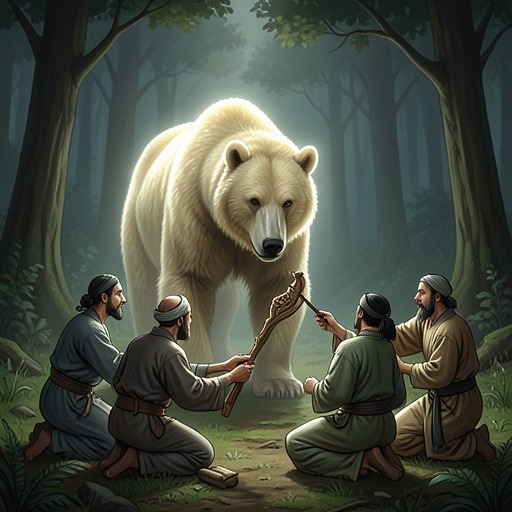
Mielikki’s role becomes more directly creative in the account of the bear. When fragments come from the seashore, she takes them near the Woods of honey. The emerging creature lacks properly formed claws and implanted teeth. Mielikki considers giving it those weapons only on the condition that it will not harm the worthy or do evil. She then seeks claws and teeth to complete it. The sequence links physical capacity to a rule: the bear receives the means to act, but its power is framed by a demand for restraint.
The bear episode gives Mielikki a responsibility different from her work as the object of hunters’ prayers. Here she is not merely asked to provide access to wild nature; she helps form one of its formidable animals and sets an ethical limit on its conduct. The forest goddess who can be approached for game also participates in the terms by which game and danger coexist. In the closing image, Mielikki is again the bewitching daughter of Metsola and a beautiful woodland maid, while Tapio shows the greatest favor. The return to the forest household joins her creative authority to the older picture of a domain whose favor must be sought and whose abundance is never simply human property.