Tuoni
KalevalaTuoni is the hard-hearted ruler of the Finnish underworld, a figure whose authority is felt through the dangerous river, the dead-land household, and the trials that bear his name. In the Kalevala, his realm is not merely a distant destination for the dead: it is a threshold that Lemminkainen cannot cross back, that Wainamoinen enters in search of knowledge, and that Ilmarinen must confront to win a bride. Tuoni himself is not always present in these scenes, but his power defines their stakes.
Identity and Underworld
In the account of early Finnish beliefs, the dead first remained in their graves while their bodies disintegrated. Kalma, the tomb god, and his daughter presided over this interval; only after purification were the spirits admitted to Manala, also called Tuonela. Tuoni, also identified in that account as Tuoui or Mana, ruled this subterranean country. He was represented as a frightening, hard-hearted old figure, and his authority extended beyond kingship: he led the dead to their home below, and served as their counsellor and guardian as well as their ruler.
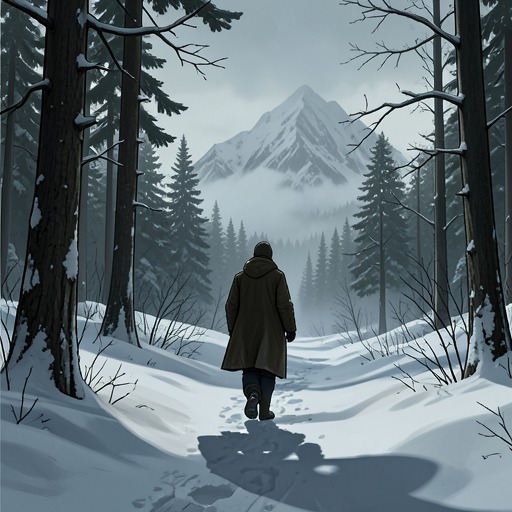
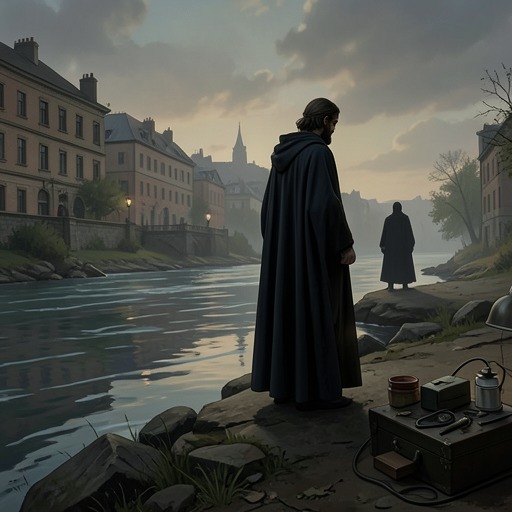
The underworld was imagined not as a bare realm of death but as a counterpart to the world above. The Sun and Moon visited it, while its forests and waters supported animal and aquatic life. That likeness makes the boundary between the worlds more striking, not less: Tuonela resembles the living world in its landscape, yet access to it is governed by death and the perilous journey there. Travellers were said to cross nine seas and then a single river, the Finnish Styx, described as black, deep, and violent, with whirlpools and waterfalls. In the Kalevala, that river becomes the most immediate expression of Tuoni's power: a passage that can be approached, but not safely presumed to be reversible.
Family and Household
Tuoni's rule is shared with a wife described as an old witch, whose appearance and iron-pointed fingers mark her as a figure of the same hostile order. The account presents her as the underworld's hostess, but her hospitality is an inversion of welcome: the food served to the dead consists of creatures associated with revulsion and danger. Their son, called Tuouen Poika and given the epithet God of the Red Cheeks, is described as bloodthirsty and cruel, an accomplice to his parents. Together, the household gives the underworld a social structure as well as a ruler; its inhabitants administer and embody the threats confronting visitors.
Three daughters of Tuoni are also distinguished. The first, a small, black maiden, is wicked but shows a limited kindness when she warns Wainamoinen not to cross the river. Many arrive in Manala, she tells him, but few return because they cannot withstand her father's wrath. After he persists, she ferries him across. Her action does not undo the danger of the crossing; instead, it makes the river a boundary that can be traversed only through the cooperation of an underworld figure.
The second daughter, Lowyatar, is described as blind and particularly malignant. In the account of disease origins, the East Wind impregnates her, and she gives birth to nine dreaded illnesses. A third daughter combines the repellent and malevolent qualities attributed to her sisters and is associated with diseases more generally. These figures extend Tuoni's dominion beyond the dead: illness, too, is represented as a force issuing from the underworld and entering human life.
Visitors and Trials
Wainamoinen's journey to Tuoni's kingdom is a search for ancient wisdom. After other efforts fail, he goes there seeking the knowledge he needs to complete his boat. Tuonetar, the death-land hostess, receives him with pitchers of strong beer and massive golden goblets. She addresses him as though he has arrived dead or dying, despite his being alive. The encounter places the hero inside the underworld's hospitality and its assumptions about who belongs there; the quest for wisdom requires him to enter a place from which return is uncertain.
Tuoni's name also governs a test imposed on Ilmarinen. When the smith seeks the Maiden of Pohyola, another trial requires him to muzzle Tuonela's Bear and overcome the wolf of Manala in the forests of the death-land. The task takes the marriage quest into Tuoni's territory, where mastery over dangerous creatures becomes a condition of success. Ilmarinen's encounter with the underworld is therefore a trial rather than a journey for knowledge, but in both episodes Tuoni's realm turns an objective into a confrontation with death's domain.
The episode continues the underworld danger through the appearance of the pike of Mana after Ilmarinen has been freed from the fatal river. The creature belongs to the waters associated with the death-land, carrying Tuoni's reach into the trial's changing hazards. The supplied account does not make Tuoni the direct agent of each obstacle; rather, the naming of the bear, wolf, river, and pike locates the trials within the sphere he rules.
Death and Narrative Significance
Lemminkainen's fate gives the river its most decisive consequence: he dies in the River of Tuoni, in the death-realm of Manala. The underworld crossing that the first daughter warned against is thus more than a setting for an encounter. It marks a separation from which Lemminkainen does not return in this episode. The contrast with Wainamoinen is central: Wainamoinen enters Tuoni's kingdom alive and is ferried across after persistent entreaty, whereas Lemminkainen's journey ends in death.
Tuoni's narrative force comes from this combination of near-familiarity and absolute danger. His realm has landscapes, inhabitants, a household, and forms of hospitality, but its resemblance to the upper world cannot make it safe. The stories also place distinct human needs at its threshold: Wainamoinen seeks knowledge, Ilmarinen faces tests connected to marriage, and Lemminkainen meets death. Tuoni is therefore both a ruler within the mythic world and the name attached to a boundary that changes the meaning of every crossing.