Kullervo
KalevalaKullervo is a magically gifted figure whose story in the Kalevala moves from a troubled birth through destructive childhood and revenge to death. The poem’s commentary calls him a hideous impersonation of ingrained evil, but the episodes also show the circumstances through which his violence takes form: an early history of failed care, harshly mismatched tasks, and a grievance that turns service into retaliation. His ending does not reconcile those forces; it leaves his destruction as the defining consequence of his story.
Identity and Background
The narrative introduces Kullervo as a boy born through magic to the virgin Untamala and a mother described as trouble-laden. The account offers no fuller explanation of this birth, but its language places him within an extraordinary, unsettled beginning rather than an ordinary family history. A separate commentary identifies Soini as a synonym for Kullervo and calls his episode the saddest in the Kalevala. It also places him among the giants of Finnish mythology, distinguishing such figures by cunning and ferocity rather than by the good-natured stupidity associated with monsters in other traditions.
The runes give Kullervo more than one descriptive identity: he is called a wicked wizard and a mighty hero, and his actions are connected with magic. The contrast does not resolve into a portrait of a conventional champion. Instead, power and destructiveness coexist: he can receive a blade of magic powers and defeat Untamo’s people, yet the narrative places those victories within a life repeatedly marked by harm. The commentary’s judgment of him as an image of ingrained evil is therefore supported by the pattern of his actions, though the plot also supplies particular circumstances behind some of them.
Childhood and Failed Care
Kullervo’s destructive behavior appears when he is still an infant. Set to nurse a child, he is entrusted with a task requiring ordinary care; by the third day, the account records that he has killed the infant and burned its cradle. The incident is presented as an early sign of his violence, not as an isolated adult act. The commentary emphasizes the starkness of the contrast between his age and the enormity of what he does, making the episode central to its image of a nature resistant to correction.
A later episode turns on the difference between an assigned task and Kullervo’s response to it. Ordered to fence fields, he constructs a boundary extending from earth to heaven, using whole pine trees and weaving their branches with venomous serpents. The scale and materials transform routine labor into an excessive display of power. Rather than producing a usable fence by ordinary means, Kullervo answers the instruction with a vast, dangerous construction. This episode adds a different measure of his character from the harm done to the infant: it shows that even when given work, he does not perform it within the practical limits the task implies.
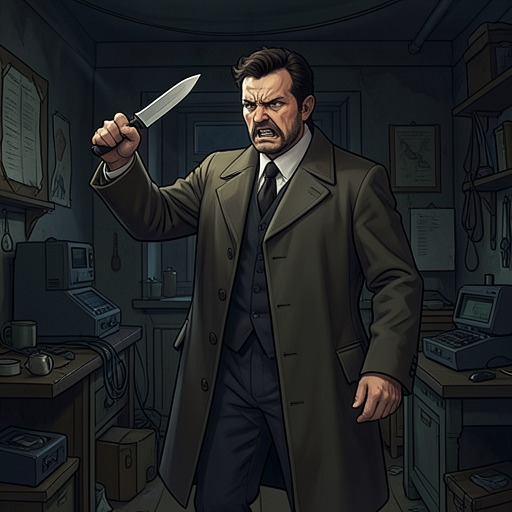
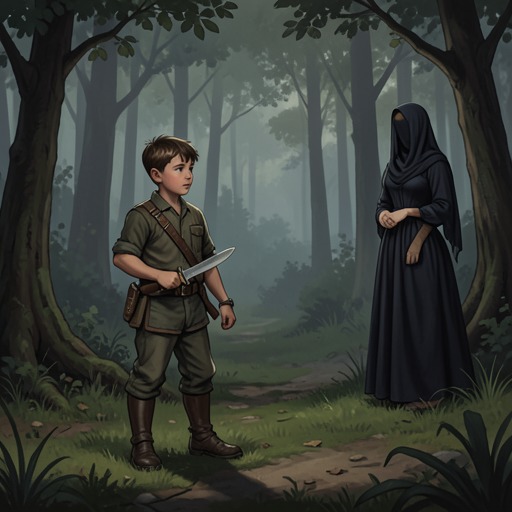
His work as a herdsman brings the story’s clearest stated grievance. After his mistress bakes a stone into his oat-loaf, Kullervo breaks his knife, the only keepsake of his people. He responds by changing the cattle into wolves and bears and driving them home to destroy her. The account links the revenge to both the damaged knife and its personal significance; the grievance is not merely about spoiled food, but about the loss of an object associated with his people. At the same time, the response is vastly more destructive than the injury that prompts it. The episode makes the knife a concrete connection to what he has lost, while showing how that connection becomes bound to retaliation.
Conflict and Revenge
Kullervo’s conflict with Untamo ends in open destruction. Equipped with a powerful magic blade, he slays Untamo’s people and burns their villages to ashes. The narrative describes these actions as a victory, but its consequences are the devastation of a community and its homes. His success is therefore not a restorative return to order: the account gives no rebuilding or reconciliation to balance the burning. The episode extends the pattern established earlier, in which Kullervo’s power turns a task, grievance, or conflict into an extreme outcome.
The story also places him in relation to kinship and origin. When a maiden is asked about her race of heroes, origin, and kindred, her answer distinguishes her family from both the largest and the smallest. The evidence does not establish the full circumstances of this exchange or the relationship it discloses, so it does not warrant a more specific account of Kullervo’s family history here. What it does establish is that questions of lineage and belonging are explicitly present in the narrative around him. That concern resonates with the lost keepsake of his people, without making the two moments identical: one centers on an object he possesses, the other on a spoken account of origin and kin.
Death and Narrative Significance
The final rune is titled Kullervo’s victory and death. In the accompanying passage, Kullervo lifts the mighty sword of Ukko. Taken together, the title and the action place the sword at the threshold of the story’s ending, but the supplied account does not detail the precise manner of his death. The ending thus confirms both victory and death without turning the victory into a lasting remedy for the violence that precedes it.
The commentary interprets Kullervo’s legend as showing the incorrigibility of ingrained evil and urges readers to look beneath the poem’s surface for its deeper meanings. His story supports that interpretation through recurrence rather than through an abstract pronouncement alone: care of an infant ends in destruction, fieldwork becomes an immense and perilous construction, herding becomes revenge, and conflict with Untamo ends in burned villages. Across these episodes, the consequences escalate, while no episode supplied here shows Kullervo repairing the harm or establishing a stable return to communal life. His story consequently stands apart from a simple account of heroic triumph. Even when he wins, the final movement is toward death, leaving destruction—not integration—as the lasting shape of his legend.