Ilmatar
KalevalaIlmatar, also called the Ether’s Daughter, is the primeval mother of Wainamoinen and one of the figures through whom the Kalevala gives human form to the emergence of life from an elemental world. Her story begins before the world has settled into familiar boundaries: she descends from the spaces of ether into the ocean, where waves become both her conveyance and her resting place. In the epic’s later account of the lost fire-child, she reappears not as a remote origin alone but as an ancient figure who meets Wainamoinen and answers his questions.
Identity and Cosmic Background
The book’s introductory account sets Ilmatar within more than one understanding of Finnish myth. The Finns proper regard Wainamoinen, Ilmarinen, and Lemminkainen as descendants of Ilmatar, the Celestial Virgin, impregnated by the winds at a time when air, light, and water were the only material existences. The Esthonians, by contrast, regard the heroes as sons of the Great Spirit, begotten before the earth was created and dwelling with their ruler in Jumala. These traditions differ over the heroes’ origin; the Kalevala’s birth narrative makes Ilmatar’s maternity concrete through Wainamoinen.
Her titles place her between elemental domains. She is the Ether’s Daughter, yet her first decisive movement is downward, from the far spaces of ether to the sea. Later, at the head of the Nawa-river, she is described as the foremost daughter of creation and speaks as the oldest of women. The two appearances give her both a cosmic distinction and a place within the epic’s narrated world: she belongs to the beginning of things, but can also be encountered and questioned by the aged Wainamoinen.
Descent and Conception
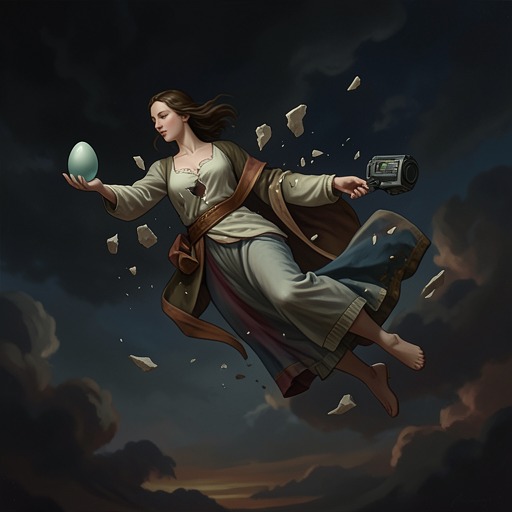
The birth episode opens in primeval time with a maiden who has passed ages in existence. Ilmatar descends to the ocean, where waves serve as her coach and pillow. The scene joins vast duration to a spare, physical image: the solitary figure rests upon moving water, suspended between the ether from which she came and the world taking shape below.
The storm-winds then play upon the salt sea and the helpless maiden. The poem identifies the result as conception, describing it as a union of force and beauty; after it occurs, the storm-winds sink into slumber. In the introductory account, these winds are likewise the agents that impregnate Ilmatar when air, light, and water are the only material existences. Read together, the accounts make Wainamoinen’s origin a meeting of elemental forces rather than an ordinary human genealogy. The wind’s activity and subsequent stillness mark a change in the story: the storm that acts upon Ilmatar gives way to the long process that culminates in her child’s delivery.
Motherhood and Wainamoinen’s Birth
The narrative identifies Ilmatar directly as Wainamoinen’s mother. When the hero is finally delivered, the poem names both him and his mother, calling her the Ether’s Daughter. That identification completes the birth account’s movement from primeval solitude through conception to the arrival of a named figure in the epic. Ilmatar’s importance is therefore not simply that she exists at the beginning of creation: she is the mother through whom the narrative brings Wainamoinen into its sequence of events.
The introductory genealogy gives her significance a wider reach, since it reports the Finnish tradition that places the three chief heroes among her descendants. Yet the narrated birth scene specifically establishes her relationship to Wainamoinen. This distinction matters: the broader account preserves a belief about heroic descent, while the episode gives the reader an intimate and particular relation, mother and son, at the threshold of the epic’s action.
Later Appearance and Narrative Significance
Ilmatar appears again in the episode concerning the fire-child. At the head of the Nawa-river, she comes to meet the travelers, and Wainamoinen questions her about where the child went. She answers that the flame is difficult to discover. The exchange presents her as a source of knowledge within a later search, not merely as a figure whose narrative function ended with Wainamoinen’s birth. Her answer is limited but consequential to the conversation: the fire-child’s whereabouts are not readily known.
Wainamoinen subsequently works with Ilmarinen to weave a mighty fish-net, in the continuing effort associated with the fire-child. Ilmatar is not identified as a participant in making the net, so her role remains that of the encountered elder who answers Wainamoinen rather than a member of the fishing pair. Across the two episodes, her position changes from the solitary maiden acted upon by the storm-winds to an ancient speaker addressed by a hero. The recurrence binds cosmic beginning to later inquiry: the mother who belongs to the world’s first generation remains present in the epic’s search for an elusive force.