Lemminkainen
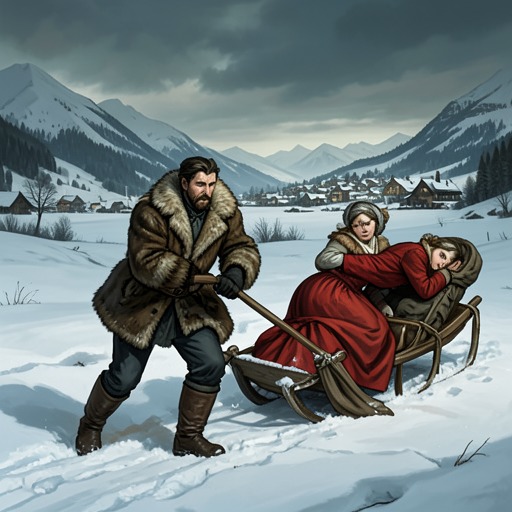
KalevalaLemminkainen is one of the Kalevala’s three principal heroic figures, presented as a reckless wizard whose adventures repeatedly bring together magic, courtship, violence, and escape from death. Known also as Ahti and Kaukomieli, he is associated with an island home and with a life of movement between domestic vows, Northland’s trials, and dangerous expeditions. His death and restoration give his story a particularly vivid place in the epic’s account of what magic and devoted kinship can accomplish.
Identity and Names
The poem and its surrounding commentary call Lemminkainen by several names: Ahti, Kaukomieli, and the reckless wizard. The names mark different aspects of the same figure, who is also described as an island hero and an ancient wizard. In the account of the water deities, his name Ahti is noted for its resemblance to Ahto, the water-god. The similarity is a point of comparison, not an identification: Ahto is described as a separate deity dwelling beneath the sea with Wellamo.
Lemminkainen belongs to the epic’s superhuman company. The commentary names him alongside Wainamoinen, the ancient singer, and Ilmarinen, the eternal forgeman, as one of its three main figures, and says that these central personages are conceived as having divine origins. His magic is part of a wider world in which songs can disarm opponents and nature is alive with human and divine attributes. Lemminkainen is therefore not merely a warrior who encounters the marvelous; he is identified as a wizard within a poem where magical power shapes action.
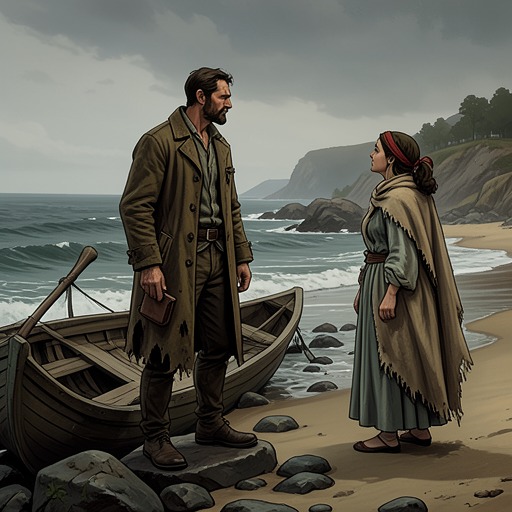
His island association recurs in more than one setting. A rune devoted to the origin of the serpent opens by placing Ahti on an island near Kauko-point and a harbor. Elsewhere he is called the island hero, and a Northland scene locates him on a jutting promontory where a village comes into view. These references give his character a mobile geography: the island is a point of identity, while the promontory and the sea-road toward Pohyola place him in the midst of travel and adventure.
Courtship, Oaths, and Exclusion
Lemminkainen’s personal life includes an oath made together with Kyllikki. The passage associates their vows with village dances and describes them as registered in heaven and sworn before Ukko. The formal, sacred language of the promise sets a bond between the two within a poem where personal commitments are repeatedly tested by desire and action.
Courtship also exposes his exclusion from other people’s plans. At the preparations for Ilmarinen’s wedding, a servant is explicitly instructed not to invite wild Lemminkainen, identified as the island-dweller Ahti. The prohibition draws a boundary around the celebration: although Lemminkainen belongs to the same heroic world, he is not welcomed into this gathering. The detail accords with his characterization as a reckless figure, but the evidence states the exclusion rather than explaining the hosts’ reasons or his response.
A separate lament frames his lack of a bride against the two great prizes named in the poem: Louhi possesses the wondrous Sampo, while Lemminkainen does not possess the beautiful bride. This contrast places romantic success and the acquisition of magical wealth side by side. The Sampo belongs to Louhi’s power and to the larger conflict over possession; the bride represents a personal desire left unfulfilled in the lament. Lemminkainen’s story thus connects the public stakes of treasure and expedition with the private disappointments of courtship.
Trials and the Approach to Death
Lemminkainen undertakes the third test of a suitor in a contest at Pohyola. The conditions are narrow and perilous: he is allowed a single crossbow and only one arrow. He faces the challenge as a handsome, reckless hero and untiring suitor, terms that join physical daring to his pursuit of a bride. The trial’s structure makes the danger concrete: there is no second shot if the first attempt fails.
The demand is to shoot the swan in the territory’s waters. At this point the narrative announces that Lemminkainen dies. The scene turns the suitor’s progression through heroic tests into a fatal encounter; courtship has brought him to an ordeal from which his courage and skill do not secure a return. Elsewhere, the poem’s compressed retrospective says that Lemminkainen died at games, a formulation that likewise associates his death with contest. The epic’s brief statements of death gain their full force from the later account of his mother’s work to recover him.
His martial identity persists beyond the suitor’s trial. A catalogue of forces and possessions names the sword of Kaukomieli alongside Wainamoinen’s belt, Ilmarinen’s forge, and Youkahainen’s bow. During the expedition to recover the Sampo, an eagle swoops onto the lid and grasps it in its talons; Lemminkainen immediately draws his battle blade. The moment places him among the armed participants in the struggle over the Sampo, while leaving the particular consequence of his drawing the sword unstated in the evidence here.
Death and Restoration
The account of Lemminkainen’s return from death centers not on the hero’s own strength but on his mother’s persistence. His body has been chopped into pieces, and she gathers its fragments from the River of Tuoni, the stream of the dead. She fears that the spirits of the death-stream may resent her intrusion, so the retrieval is not a simple act of recovery: it takes place within a dangerous domain whose inhabitants might oppose her.
The Sun answers the mother’s entreaties by casting powerful rays upon the Shades and sinking them into a deep sleep. While they are asleep, she can gather her son’s bodily fragments in safety. The commentary presents this episode as evidence for a belief that the dead can be restored to life through heaven’s blissful light. The scene makes the Sun’s intervention decisive, but keeps the mother’s labor at its center: celestial power creates the opening, and she uses it to reclaim her child from the river.
The restoration also involves the repair of the body. Suonetar, a goddess of the human frame, spins veins and sews wounded tissues for worshipers in need of her skill; the commentary specifically associates her with Lemminkainen’s restoration to life. In a separate passage, he slowly wakes, rises from a state of deep slumber, and speaks again in magical language. Taken together, these details make his return a process of bodily mending and renewed speech, rather than a bare reversal of the report of his death.
Narrative Role and Significance
Lemminkainen’s story gathers together several of the Kalevala’s characteristic tensions. His pursuit of a bride leads into tests, and a test culminates in death; elsewhere, his name and weapon accompany expeditions and contests over the Sampo. His identity as both hero and wizard links physical danger to a world in which supernatural agency can alter events. Yet the episode that most decisively defeats death depends on forces beyond his own prowess: his mother’s devotion, the Sun’s intervention, and Suonetar’s skill.
That dependence gives his restoration a different shape from a victory won in combat. The Shades are not overcome by Lemminkainen, who lies dead in the river’s domain, but put to sleep long enough for his mother to retrieve him. His survival therefore carries the story’s attention away from the solitary hero and toward the relationships and powers that can preserve him. Lemminkainen remains the reckless adventurer, but his return reveals the limits of recklessness as well as the reach of familial care and magic.