Lowyatar
KalevalaLowyatar is the blind, black daughter of Tuoni whose pregnancy and delivery bring nine personified diseases into the world. Her place in the death-land’s family of spirits gives illness a specific origin: the diseases are not merely named afflictions but children born in Tuonela, and their emergence sets them loose against human life.
Identity and Family
Lowyatar is identified as the second of Tuoni’s three daughters. The account presents her as more malignant and loathsome than the first daughter, who, despite her wickedness, once warns Wainamoinen against crossing the River of Tuoni and ultimately ferries him across. Lowyatar has no such act of kindness attached to her. She is described as blind, black, old, and wicked, and as the worst among the women of the death-land. These descriptions locate her within a family whose power is associated with death and danger, while distinguishing her particularly through the diseases she bears.
The narrative also carefully separates Lowyatar from her youngest sister. That third daughter combines the malevolent qualities of the others and is represented as mother and hostess to diseases generally. In the account of the death-land, she sits upon Kipu-Kivi, the frightful rock beneath which disease spirits are imprisoned, and turns it like a millstone. Lowyatar’s role is different and more particular: she is the mother of the nine named diseases. The distinction connects her to the larger family of afflictions without transferring her sister’s actions to her.
Conception and Birth
Lowyatar’s pregnancy begins when the east wind rises in the evening. The poem describes her as growing heavy with child through the wind’s impregnation, making the weather itself the agent of conception. No human father or ordinary household lies behind the birth. Instead, an atmospheric force reaches into the death-land and engenders a brood whose nature is already bound to suffering.
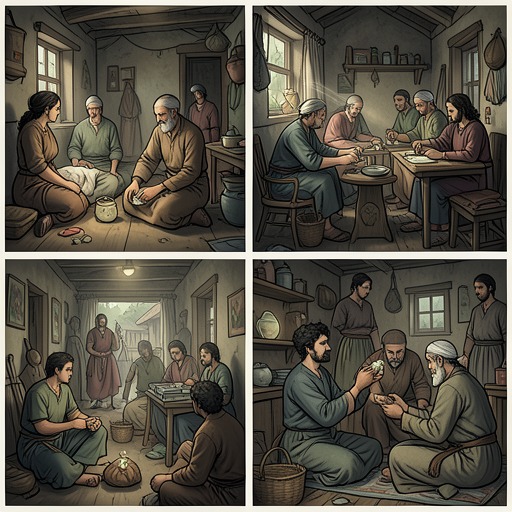
Her delivery is presented as the resolution of a burden carried through the stormy weather and chilling morning winds. At last, the blind Lowyatar gives birth and lays her offspring in a cradle beneath golden covers. The contrast between the cradle’s precious covering and the children’s destructive identity is striking: they receive the outward arrangement of cherished infants, but their arrival heralds affliction. The poem dates their birth to a summer evening, placing this emergence of disease within a season associated with life and growth rather than isolating it in winter or darkness.
The Nine Diseases
The children are nine spirits associated with ailments dreaded by humankind: colic, pleurisy, fever, ulcer, plague, consumption, gout, sterility, and cancer. The list ranges across different kinds of suffering, from acute illness and bodily pain to conditions affecting fertility. Their grouping under Lowyatar makes them a family, while their separate names preserve the variety of harms they represent.
The account situates these nine within a wider Finnish conception of illness as supernatural agency. Ailments could be regarded as evil spirits or indwelling devils; some were imagined as formless, while others took the shapes of repellent creatures such as worms and mites. The nine born of Lowyatar, by contrast, were conceived in human form. Their bodily origin therefore gives the abstract catalogue of disease a mythic presence: they are simultaneously recognizable conditions and offspring from the death-land.
That conception also ties Lowyatar’s maternity to a larger geography of disease. The spirits of illnesses are said to be imprisoned beneath Kipu-Kivi, where the third daughter of Tuoni continually turns the rock. The narrative does not make Lowyatar the keeper of that prison. Rather, the juxtaposition shows how her birth of the nine belongs to a broader account in which disease spirits can be contained, escape, and go forth to torment people. Lowyatar supplies their origin; her sister’s revolving rock gives the wider tradition an image of their confinement and release.
Narrative Role and Aftermath
Lowyatar’s episode explains where the nine diseases come from and why they appear as hostile beings rather than as impersonal conditions. The sequence moves from an evening wind, to pregnancy, to a birth in Tuonela, and finally to the children’s release from their ancient hiding places. The weather initiates the chain; Lowyatar’s body makes it a birth story; the offspring turn its consequences outward, toward human suffering.
The nine diseases are later expelled by Wainamoinen, the enchanter and wisdom-singer. His action marks the counterforce to Lowyatar’s maternity: where her delivery brings the diseases into being, his song-magic drives them away. The poem thus gives disease both a genealogy and a response. Lowyatar is central to the first movement, but the surviving account does not describe her taking part in the later expulsion or state what becomes of her afterward. Her narrative significance rests instead in the terrible transformation of a storm’s force into a family of afflictions, and in the way that birth makes suffering legible within the supernatural order of Tuonela.