Ukko
KalevalaUkko is the highest of the Finnish deities described in the Kalevala, a sky-god whose authority reaches across weather, thunder, and the changing conditions of life. He is at once a remote cosmic ruler and an invoked presence in practical crises: barley is sown in his name, heroes ask him to restrain a fiery horse or send snow for a sleigh, and sufferers appeal to him for healing. His power is immense, but not absolute. Other heavenly bodies retain divine independence, and Ukko himself does not answer every prayer.
Identity and Divine Order
The account presents Finnish divinity as a system of distinct, interdependent powers rather than a single undivided sovereignty. The gods are immortal and generally imagined in pairs, with their own abodes and families; each governs a particular sphere, while lesser deities may serve those whose domains are greater. Within this hierarchy Ukko stands at the summit as the highest deity, but the ordering does not erase the independence of other powers. Even a god of an insignificant part of the sky may rule there without a master.
The name Jumala first applied to the visible heavens and their lights and phenomena, then to a personal god associated with the sky, and eventually to the supreme ruler. As religious ideas became more differentiated, the sky was called Taivas and its god Ukko. The account suggests that Ukko may be related to the Magyar word Agg, meaning old, and so may once have carried the sense of an old being or grandfather before becoming the exclusive name of the highest Finnish deity. This history keeps the divine figure connected to the sky itself while distinguishing him as its personified ruler.
Ukko's titles express several aspects of that authority. He is Father of the Heavens, Thunderer, Leader of the Clouds, Shepherd of the Lamb-Clouds, God of the Breezes, Golden King, Silvern Ruler of the Air, and Pivot of the Heavens. They present him not only as a storm god but as a sustaining figure associated with the firmament and the ordering of the atmosphere.
Powers and Iconography
Weather is the most comprehensive expression of Ukko's rule. Frost, snow, hail, ice, wind, rain, sunshine, and shadow are all said to come from his hands, and he controls the clouds. His thunderbolts strike down evil spirits on mountains. The range of his powers makes the weather neither a neutral backdrop nor a force wholly separate from divine action: it is the medium through which his authority can be felt in the world.
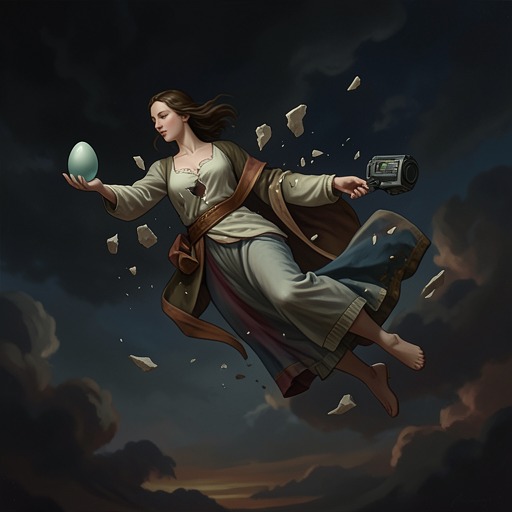
His image makes that cosmic scale visible. Ukko sits upon a cloud in the vault of heaven, bearing the firmament on his shoulders. Armed like an omnipotent warrior, he has fiery arrows forged from copper; lightning is his sword, and the rainbow his bow, named Ukkon Kaari. He also swings a hammer, recalling the German god Thor and, in his thunderous force, the Greek Zeus. The picture combines celestial burden and martial power with homelier, sharply particular details: fire sparkles on his skirt, his stockings are blue, and his shoes crimson. These features give the ruler of the sky a recognizable body without diminishing the scale of the forces attached to him.
Prayers, Aid, and Refusal
Ukko's place in human affairs is established through repeated appeals. During the sowing of barley, he is addressed as the Father of the Heavens and asked to bless the fields so that their ears will fill and ripen. The appeal connects agricultural labor to a power governing rain, sunshine, and the broader conditions of growth. Ukko's response is described as deliberation in the cloud-space, making the prayer part of an exchange rather than a mere ceremonial mention.
That exchange can result in direct, practical assistance. When Lemminkainen asks Ukko to open heaven against the flaming horse of Hiisi, Ukko hears him, opens the dome of heaven, and sends down snowflakes, ice, and iron hail to check the courser's speed. The weather becomes an intervention in a hero's struggle: a force usually associated with the sky is turned against a particular obstacle. In another journey, Ilmarinen earnestly requests snow so that his sleigh can travel freely over the hills to Sariola. Ukko sends crystal flakes gently from heaven, assisting the passage. These episodes give his power a responsive aspect, but not a predictable one.
The poems also stage requests whose outcomes differ. Ilmatar invokes Ukko for help in delivering Wainamoinen, who has remained unborn for seven hundred years, but her appeal is unanswered. Wainamoinen likewise begs him to stop the crimson flow from an axe wound in his knee, yet the account identifies this as another vain invocation. The contrast matters: Ukko is not a device that automatically resolves hardship whenever called upon. His worshipers recognize his supreme rank, but their dependence does not guarantee his intervention.
Other prayers broaden the pattern without making every request a confirmed act of Ukko. He is asked to bless a feast, and appeals to him arise amid the struggle over the Sampo and the loss of fire. In the episode of the nine diseases, Ukko is invoked as a healer and physician, while the eventual expulsion of the diseases and rescue of the people are attributed to Wainamoinen. The distinction between invocation and outcome preserves the poems' varied distribution of power: an appeal reveals who is understood to possess authority, but does not by itself establish that the authority has acted.
Creation, Celestial Powers, and Narrative Role
Ukko also belongs to stories of origins. In the account of the making of the heavens and the emergence of iron, he rubs his hands together and presses them upon his knee. The gesture places the creator of the heavens within a creation sequence that treats elemental and material origins as acts with divine histories. His authority is not only administrative, exercised over clouds and storms; it is also associated with the formation of the world.
The limits of that authority become especially clear in the relation between Ukko and the Sun and Moon. When they are stolen and hidden in a cave in a copper-bearing mountain, Ukko relinquishes his support of the heavens, thunders along the darkened clouds, and strikes fire from his sword to kindle a new sun and moon. The episode shows him responding to a cosmic disruption with the instruments of his own power. Yet the Sun and Moon are not merely extensions of his rule: the account also treats the heavenly bodies as deities in their own right, beyond his influence. Their names can refer both to the celestial bodies and to their divine persons. Elsewhere they are addressed as fashioned by Ukko, a relationship of origin that does not cancel their separate standing.
This combination of supremacy and limitation defines Ukko's narrative function. He gathers the sky's weather, thunder, and generative force into one figure, so that prayers for crops, safe travel, victory, and healing can turn toward him. At the same time, the stories resist making the cosmos a single chain of command: other gods and heavenly powers retain their own spheres, and Ukko may refuse or fail to answer. He is consequently both the greatest divine authority and one power among a living plurality, a ruler whose significance is sharpened by the boundaries around his rule.