Ahto
KalevalaAhto, the chief water-god known as the Wave-host, rules an underwater domain of fish, caverns, and hoarded treasures. His character combines a possessive appetite for what enters his realm with a capacity for generosity, while his appearances connect the loss of the heroes’ harp to the lasting abundance of the water-people.
Identity and Underwater Realm
Ahto lives with Wellamo, his cold and cruel-hearted spouse, at the bottom of the sea, in the chasms of the Salmon-rocks. Their palace, Ahtola, stands within this deep-water world. Ahto’s authority reaches across its fish-filled waters: salmon, trout, whiting, perch, herring, and white-fish are named among the inhabitants of his dominion. He is also addressed as ruler of a thousand grottoes, an image that makes his kingdom seem less like a single palace than a vast, hidden landscape.
The account distinguishes Ahto himself from the broader company of water beings. Ahtolaiset, or the inhabitants of Ahtola, is a general name for water-hosts of the sea, rivers, lakes, cataracts, and fountains; they are also called the Water-people and the People of the Foam and Billow. Some have individual names and functions, while Ahto stands out as their king. The similarity between Ahto’s name and Ahti, another name for Lemminkainen, is noted, but the Finnish language is said to offer little explanation of Ahto’s etymology.
Treasures and the Sampo
Ahto possesses the Sampo, the talisman of success, after Louhi drags it into the sea while trying to regain it from the heroes of Kalevala. Its presence places him at the end of the Sampo’s passage from the human struggle over its possession into the depths of the water-world. The account characterizes Ahto as eager for others’ treasures and generally unwilling to return whatever comes into his possession. That disposition makes his underwater kingdom not merely a habitat but also a place where valuables can be absorbed and retained.
The lost fish-bone harp provides a vivid instance of this transfer. When the harp is cast away into the water, its loss becomes a gain for the inhabitants below: the text associates it with the joy of Wellamo and her people, and with Ahto’s happiness. Ahto rises from his caverns and sees his people on the floods. The harp’s disappearance therefore changes its meaning without restoring it to its maker: what is lost above becomes a source of pleasure and richness below.
The poem later describes the harp as remaining in the deep for ages, increasing the ocean’s treasures and supplying riches to Ahto’s hosts. This consequence gives the episode a longer horizon than a single moment of discovery or possession. The harp becomes part of the continuing wealth of the Ahto-nation, and the sea’s capacity to keep what has fallen into it is rendered as an enduring inheritance for its people.
Possessiveness and Generosity
Ahto’s reluctance to surrender treasures is balanced by a story in which he gives more than the person who loses something could have expected. A shepherd lad drops his knife into a river while whittling a stick. Moved by the boy’s tears, Ahto comes to the spot, dives, and returns with a golden knife. The lad refuses it because it is not his. Ahto then brings up a silver knife, which the boy also declines, before finding the original knife on a third dive.
The shepherd’s honesty determines the outcome. Once the boy recognizes and accepts his own knife, Ahto gives him all three. The episode complicates the image of a water-king who keeps other people’s property: he is capable of testing, or at least rewarding, truthful recognition with an unexpected abundance. The gift is not simply a replacement for the lost object. It turns the boy’s refusal of riches that are not his into the occasion for receiving them as a reward.
Appearances and Narrative Significance
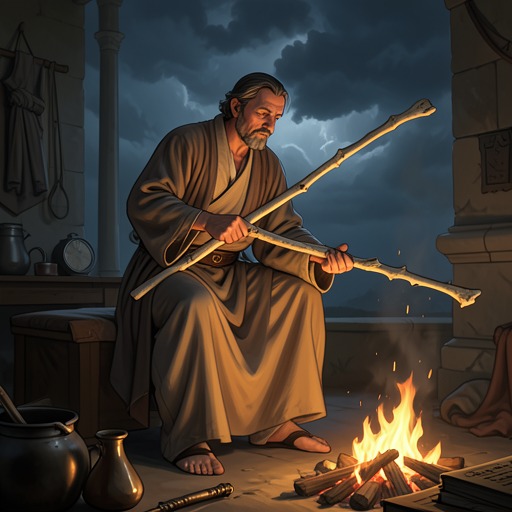
Ahto’s appearances emphasize his scale and his quiet arrival from the depths. As Wainamoinen’s songs draw an audience, Ahto raises his head above the billows. The poem presents him as an ancient king with a beard of sea-grass, approaching the coast silently in a boat of water-lilies. The brief scene gives the water-god a distinct presence: he does not arrive as a human visitor but emerges from the sea in a vessel formed from its living world.
His response to the lost harp repeats this upward movement. He rises from his caverns to behold his people on the floods, linking the hidden kingdom below with the visible surface. In another passage he is invoked as king of the waters and ruler of a thousand grottoes, then addressed with a seven-fathom pole. The words establish his authority as a figure to whom an appeal can be made, without detailing the result of that appeal.
Taken together, these episodes make Ahto more than a label for the sea’s supernatural ruler. His realm receives the Sampo and the harp, holds wealth over time, and has its own people whose pleasure matters within the poem. The contrast between the shepherd’s recovered knife and the harp retained for the water-hosts leaves his generosity selective rather than simple: honesty can win a gift, while the sea’s larger treasures remain with Ahto and his kingdom.