Otso
KalevalaOtso is the bear of Finnish myth, at once a sacred woodland presence, a partner addressed through pledges, and the object of Wainamoinen’s hunt and feast. His significance rests on that tension: the hunters honor him with affectionate names and recall a pact against harm, yet they still pursue him for a communal gathering. The account does not make reverence and killing opposites that can be neatly reconciled; it places both within the same story.
Identity and Mythic Origin
In the account of Finnish belief, Otso belongs to a tradition of reverence for animals, birds, and trees. Bear-worship is identified as a practice once common among northern peoples, and Otso is presented not merely as a beast in the forest but as a sacred being whose origin is told and whose approach commands public attention. His many names—among them The Honey-Eater, Golden Light-Foot, Forest-Apple, Honey-Paw of the Mountains, the Pride of the Thicket, and Fur-robed Forest-Friend—make familiarity and honor part of how the story speaks of him.
His mythical birth places him on the shoulders of Otava, in the regions of the sun and moon. A goddess of the woodlands nurses him in a cradle suspended by golden bands between the bending branches of budding fir-trees. The origin story gives Otso a kinship with both the celestial regions and the forest: he comes from a realm associated with sun and moon, but his nurture is rooted among trees. The contrast makes the bear’s presence in the woodland feel less like the arrival of an ordinary quarry than the return of a being belonging there.
Otso’s nurse withholds his teeth and claws until he promises not to take part in bloody strife or deeds of violence. The promise makes restraint part of his origin, but the account also says that he does not always keep it. The hunters, in turn, find it comparatively easy to reconcile themselves to destroying him. This qualification matters: Otso is not portrayed as incapable of violence, and the human justification for hunting him rests partly on the failure of his pledge. The origin story establishes an ideal of peace without claiming that the ideal is invariably kept.
Pledges and the Herd
In a passage set among the milk-yards of Metsola, with the evening star rising, the speaker addresses Otso as a forest-apple and a woodland bear with honeyed fingers. The appeal is framed as an invitation to make a lasting treaty, not as a simple command to leave. Otso is asked to keep away from the cattle and from the herdsmen’s calls, and to pass through plains and forest without harming the speaker’s harmless creatures. The desired boundary is concrete: the forest remains Otso’s domain, while the herd is to be spared.
The appeal invokes an earlier pledge at the River of Tuoni, near a waterfall and whirlpool. Recalling an agreement gives the request a history; it presents protection of the cattle not as a new demand but as an obligation already acknowledged between the parties. A later appeal again asks for agreement in honor and for a lasting treaty, linking peaceful relations to the hope that food and drink will never be wanting. In these passages Otso is treated as a being who can be addressed, reminded, and asked to participate in an arrangement. The language of treaty lends the encounter a reciprocal cast, even though the surviving lines do not establish that the compact permanently prevents harm.
The Hunt and the Feast
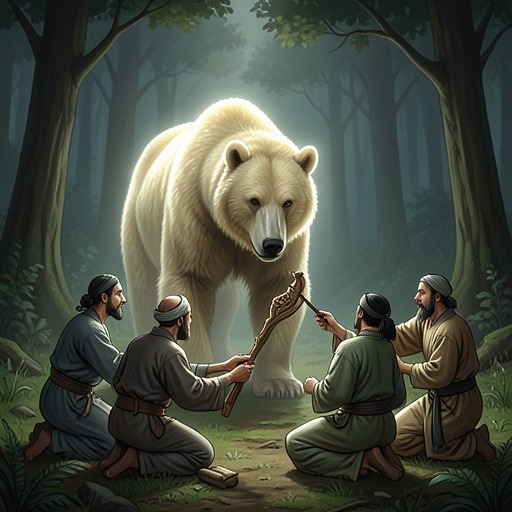
In the later hunting episode, Wainamoinen has his hunters ready and waiting in their kennels. He announces that he is following Otso and identifies the bear by the same affectionate forest titles used elsewhere. The pursuit is directed toward Otso’s cavern, at the border of the woodlands. There Wainamoinen finds the mighty bear waiting and lifts the golden covers in joy. The sequence gives the hunt a marked public and ceremonial quality: preparation, announcement, approach to the bear’s woodland threshold, and encounter are all made visible rather than reduced to an unexplained capture.
Otso’s arrival is also imagined through the response of the people. They distinguish the expected visitor from other dangers of the wild and recognize him as the forest’s pride and beauty, the master coming among them. That language preserves Otso’s elevated status at the moment when the hunt brings him into human company. The people do not speak of an anonymous animal; they recognize the same honored figure whose origin and titles have already shaped the account.
The gathering is associated with plenty for the assembled hosts and with more to give the village. The people ask about Otso’s birth—whether he was born within a manger—and the narrative answers by naming what follows as his origin and the source of the sacred booty. The question and answer place the feast beside a telling of origins: the community’s use of the hunted bear is accompanied by an account that recalls his sacred beginnings. The scene thus holds material abundance and reverent memory together rather than allowing the feast to erase the bear’s mythic identity.
Remains and Narrative Significance
After the hunt, Wainamoinen counts the teeth of sacred Otso and loosens the claws of Light-foot. The account presents these actions as part of attending to the bear, not as a graphic description of violence. Their specificity matters: the teeth and claws that were withheld at Otso’s birth until he pledged restraint are also singled out in the aftermath of the hunt. The narrative thereby connects his origin and his fate through the same features, while continuing to name him with an honorific title.
Otso’s role is defined by this unresolved conjunction of protection, pursuit, and respect. The cattle-treaty passages imagine coexistence through promises and remembered obligations; the hunt and feast show a human community pursuing its own provision; the origin story insists that the bear has a history deserving to be recounted. The repeated respectful names do not cancel the hunters’ actions, just as the hunt does not remove Otso’s sacred standing. Instead, the account makes that contradiction central to his literary presence: Otso is both the forest’s honored master and the source of the communal feast.