Mariatta
KalevalaMariatta is the maiden and virgin mother at the center of the final rune, a figure through whom the poem moves from private hardship to the emergence of a child who stands at the edge of the old heroic order. Her story begins in Northland with a mysterious pregnancy, passes through distress and separation from her infant, and turns on the Sun’s intervention: after receiving directions, Mariatta finds the child hidden in the marsh reeds and carries him home. The rune’s title joins her story to Wainamoinen’s departure, giving her the closing sequence’s generational and narrative significance.
Identity and Background
The poem introduces Mariatta as a “child of beauty” who grows to maidenhood in Northland, in her father’s cabin. Her story is thus rooted in a household and family setting, rather than in the voyages, contests, or feats that define many of the preceding heroic episodes. The domestic setting matters: her pregnancy and the child’s fate unfold through encounters with family, shelter, and the search for a safe place, while the eventual return is to her father’s dwelling.
Mariatta is repeatedly described as a virgin and as the child’s mother. The narrative does not explain her identity through a marriage, and its emphasis on her maidenhood remains alongside the pregnancy and birth. Those descriptions place her in an unusual position within the story: she is at once a young woman subject to the expectations and judgments of her household and the mother of an infant whose arrival becomes important to the poem’s ending. The text presents that tension through what happens to her, rather than through an extended account of her origins or social standing.
Mysterious Pregnancy and Distress
The account associates Mariatta’s change of state with an encounter among lambkins and a mountain berry. A short passage then describes something rocking to and fro before settling in her bosom; the poem immediately says that she became a bride impregnate. It does not identify the thing that enters her bosom in the quoted passage, or explain the event in ordinary social terms. Instead, the sudden bodily image and the abrupt announcement of pregnancy leave its cause mysterious.
After this change, Mariatta watches and waits, anxiously counting the days and anticipating trouble. The narrative makes the waiting itself part of her ordeal: the pregnancy has become a visible fact, but its circumstances remain unexplained in the evidence presented, and the poem turns toward the consequences she must face. In an exchange with her father, she answers, “I am not a child of Hisi,” a denial that shows her responding to an accusation or association without resolving the episode’s mystery. Her words give her a moment of direct speech, but the surrounding account does not supply enough detail to specify everything said to her or the precise terms of the dispute.
The narrative also presents Mariatta as vulnerable to rejection and hardship. The passage describing her as hapless and as a virgin mother ends with her falling into bitter tears and murmurs. The surviving lines do not establish every circumstance behind that distress, so the scene is most securely read as a turning point in her experience: the pregnancy has brought her into trouble, and the poem depicts her suffering rather than smoothing it over with an immediate rescue. Her tears mark the emotional cost that precedes the birth and the later search for her child.
Birth and Search for the Child
Help eventually comes to the afflicted Mariatta. Her baby is born and cradled in a woodland manger, a setting that contrasts sharply with the father’s cabin where she grew up. The manger is not described as a secure family home; it is the place where the infant is born and first kept. This makes the separation between mother and child, and the question of where the child can be found, central to the next movement of the story.
When the Star and the Moon refuse to give Mariatta the information she needs, the Sun supplies it. The Sun tells her that the child is hidden to his belt in water, among reeds and rushes. This intervention gives the heavenly body a specific, practical role in her story: rather than merely shining over events, the Sun directs a mother to her missing infant. The contrast between the Star and the Moon’s refusal and the Sun’s answer makes this help decisive. Without the location, Mariatta cannot complete the search; with it, she knows where to go.
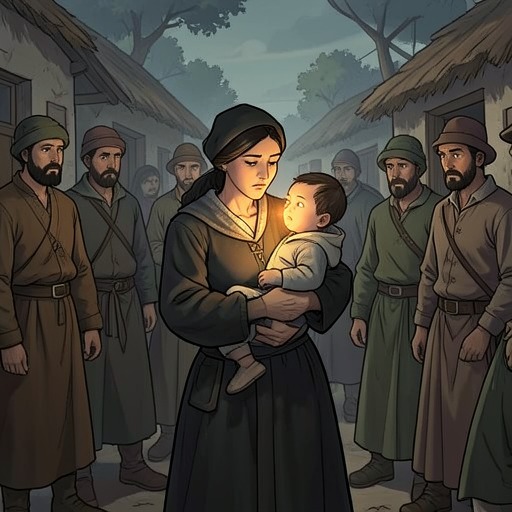
Mariatta follows the direction to Swamp-land, finds the child in the reeds and rushes, and takes him onto her bosom. She then carries him to her father’s dwelling. The movement from the woodland manger to the hiding place, and from there back to the household, gives the episode a clear sequence of separation and recovery. The child is not simply announced as found: Mariatta herself seeks him, locates him, gathers him into her arms, and brings him home. Her maternal action supplies the narrative’s resolution to this part of her ordeal.
Names, Recognition, and Narrative Role
The infant grows in beauty after returning to the father’s dwelling. Mariatta names him Flower, while others call him Son-of-Sorrow. The paired names preserve two different responses to the child: one gives him a name of beauty, the other associates him with sorrow. The text reports both without explaining that sorrow as a single settled judgment, leaving the contrast in place as part of the child’s identity within the story. His naming follows the recovery, so the episode moves from concealment and danger toward a place in the family and a public name.
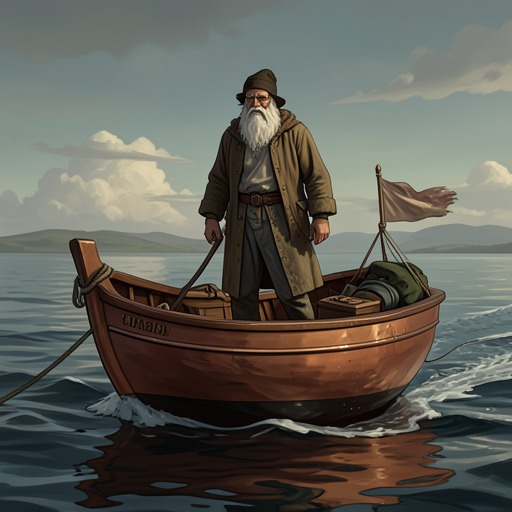
Mariatta next seeks the priesthood to have the child baptized. An old man, Wirokannas, appears in response to this effort. Elsewhere the book describes Wirokannas as a forest priest and as the figure who leaves his usual sphere to baptize Mariatta’s infant son. The baptismal episode therefore joins Mariatta’s household story to religious and communal recognition: after finding and naming the child, she seeks a ceremony through which he can be received beyond the immediate circumstances of his birth. The evidence here identifies Wirokannas’s appearance but does not detail the full outcome of the baptism or the later disputes about the child.
The final rune is titled “Mariatta—Wainamoinen’s Departure,” placing Mariatta’s account beside the departure of the older hero. That framing makes her more than the subject of an isolated miraculous birth: her story occupies the poem’s closing movement and brings a child into focus as Wainamoinen’s era gives way. The contrast is structural, not a claim that Mariatta herself causes his departure. Her sequence ends with the infant recovered, brought into the household, named, and presented for baptism; alongside it, the title announces the old hero’s leaving. Mariatta’s narrative role is thus defined by both care and transition: she endures the uncertainty surrounding her pregnancy, acts to recover her child, and becomes the mother through whom the poem’s ending opens toward a new generation.