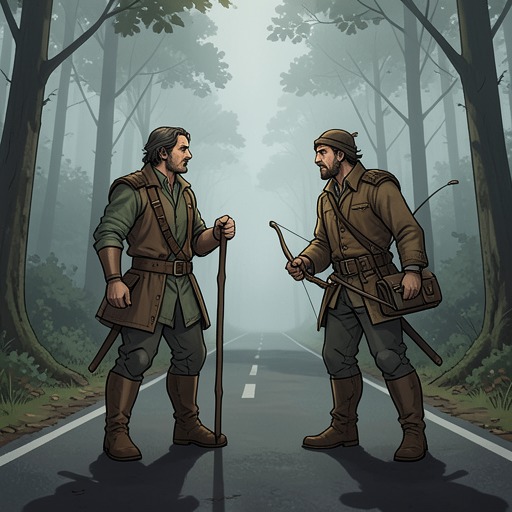
Youkahainen
KalevalaYoukahainen is a young, reckless minstrel from Lapland, introduced as the singer whose envy of Wainamoinen turns artistic rivalry into violence. His story links two contests: first, the contest to be recognized as a singer, where he cannot bear another bard’s superiority; later, the physical attack that makes Wainamoinen fall into the water. Youkahainen’s importance lies in that transition. A dispute over skill and renown becomes a grudge with consequences beyond the singers themselves.
Identity and Introduction
Youkahainen lives in dismal Northland and is identified as Lapland’s young minstrel. The introduction places him within a world where song is a public measure of ability: the echoes of the singers’ encounter travel south, and Northland hears the story. His identity is therefore not simply that of a young man who sings, but of a performer whose standing is tested against another singer’s reputation.
The contrast that provokes him is stated plainly. Wainamoinen is described as better skilled in chanting legends than Youkahainen, and even better than the person who taught Youkahainen. That comparison makes the challenge especially sharp: Youkahainen is not merely outperformed by a peer but confronted with a singer whose skill seems to exceed both his own and his teacher’s. The account supplies no name for that teacher, but the comparison places Wainamoinen at the summit of a hierarchy that Youkahainen wants to contest.
Rivalry in Song
The narrative connects Youkahainen’s anger to the circulation of Wainamoinen’s renown. The news has an audience; the echoes are heard to the south, while the story is known throughout Northland. Against this widening reputation, Youkahainen’s response is personal. He grows angry, and envy rises within him. The narrative identifies envy, rather than a factual disagreement about the songs, as the force driving the conflict.
When Youkahainen begins to sing, the act carries the weight of that resentment. He composes himself, breaks his silence, and begins a wondrous song. The sequence gives his performance a dramatic function: it is his answer to a comparison he cannot accept. The passage distinguishes this singing from childish material and women’s wit, marking the song as a serious attempt to speak with authority. Yet the account’s emphasis remains on the challenge and the emotion behind it, not on the song’s precise claims. Youkahainen’s ambition is clear even where the content of his performance is not.
From Resentment to Attack
The conflict does not end when the singers’ encounter is past. After reaching the margin of the blue sea, Wainamoinen is described as having escaped without wetting the hooves of his horse. The narration then returns to Youkahainen, calling him evil and showing him nursing a grudge. The recurrence of envy matters: anger first appears as a response to Wainamoinen’s superior skill, but it persists as a stored grievance after the immediate encounter.
That grievance culminates in a physical attack. Youkahainen strikes Wainamoinen near his golden girdle, hitting him through the shoulder as he rides. The consequence is immediate and much larger than the wound itself: wise Wainamoinen falls headlong into the waters and plunges beneath the rolling waves. The sequence turns the minstrel’s rivalry into a dangerous assault on the central singer, making the sea the scene of the conflict’s sudden reversal.
Character and Narrative Role
Youkahainen’s arc is defined by the movement from wounded pride to sustained resentment and then to violence. The account gives a direct motive for that movement—envy of Wainamoinen—and presents the grudge as the link between the singing encounter and the later shot. His youth and recklessness, announced at his introduction, acquire narrative force in retrospect: the young singer’s response to being surpassed does not remain within the bounds of performance.
The contrast between song and weapon shapes his role. Wainamoinen’s greater command of legendary chanting establishes the original imbalance; Youkahainen answers first with singing, then with a shot. The shift shows the limits of his attempt to challenge the older singer on the ground of skill: instead of resolving the rivalry through song, he makes it bodily and exposes Wainamoinen to mortal danger. The resulting fall into the sea marks the decisive consequence of Youkahainen’s envy, while the evidence here leaves his later fate unstated.