Tapio
KalevalaTapio is the chief deity of the Finnish forests: an immortal ruler whose authority governs woodland life and whose favor hunters seek as they enter his domain. Known as “The Forest-Friend” and “The Gracious God of the Woodlands,” he belongs to a mythology in which natural places are living, ordered realms, each with its own divine powers. His presence is felt not only in the forest’s personified landscape but in the household of forest deities and in the songs and rites that accompany the hunt.
Identity and Woodland Rule
Tapio’s authority is defined by the Finnish mythological order, where nature is governed by invisible deities, or haltiat, associated with particular charges. These powers are immortal, but they rank according to the importance of their domains, and lower-ranking divinities may serve greater ones. A deity connected with an aspen, for example, can be divine in its own right while remaining subject to Tapio’s woodland rule. The hierarchy does not erase the independence of each power within its own sphere: even a minor deity rules its own small domain. Tapio is therefore both a distinct person and the chief authority over a larger natural territory.
The poem gives that authority a memorable bodily form. Tapio is very tall and slender, with a long brown beard, a coat of tree moss, and a high-crowned hat made of fir leaves. His appearance makes the forest legible as a person: the materials of his clothing belong to the landscape he governs, while his stature marks him as its commanding presence. In a world where woods and waters have their own powers, the forest is not merely a setting around Tapio; it is his realm and the substance of his image.
Household and Forest Community
Tapio’s rule is represented through a family and a broader community of woodland beings. His consort, Mielikki, is the hostess of the glen and forest and holds the keys to Metsola, Tapio’s abode. Her honey chest supplies food for the forest deities, and hunters seek its bounty. The forest household thus joins divine authority to practical dependence: the powers who govern the woods also control resources and assistance that matter to people living by hunting.
The forest’s gifts and its refusal to give them are reflected in the changing image of Mielikki. When hunters return successfully, she appears beautiful and richly adorned; when their bags are empty, she is described as hateful and ragged. This contrast belongs to her portrayal rather than to a stated transformation in Tapio. It shows how the forest’s divine household is imagined in relation to the uncertain results of the hunt: the same realm can yield abundance or disappointment, and the disposition attributed to its hostess changes with the outcome.
Other members of Tapio’s family have more specific tasks. His son Nyrikki builds bridges across marshes and forest streams used by herds on their way to woodland pastures, and marks rocks and trees to guide heroes toward favored hunting grounds. Sima-suu, one of Tapio’s small daughters, guides deserving hunters by playing her honey-flute. These details make Tapio’s domain a working landscape, crossed by herds and trails and made navigable through the efforts of its inhabitants. The account characterizes the forest deities generally as gracious and tender-hearted, while distinguishing Tapio and his son as the male members among them.
Encounters with Hunters
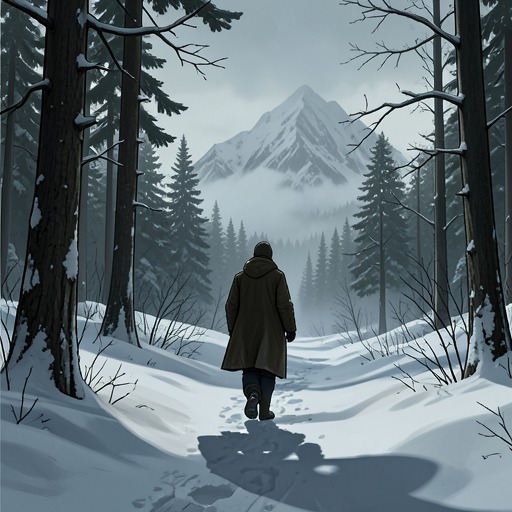
Tapio appears in the poem primarily as a power whom travelers and hunters address rather than as a figure who dominates the action through extended speech. Wainamoinen asks the mighty Tapio to be gracious, requesting passage through the forests and along their rivers. His appeal treats movement through the wilderness as a relationship with its ruler: the traveler does not simply enter the woods but seeks kindness from the power who governs them.
On another approach toward the Northland moors and marshes, Wainamoinen sees Tapio’s mansion. Its golden-colored doors shine in sunlight, presenting the forest ruler’s home as a marked destination within the northern landscape. The mansion gives visible form to the otherwise dispersed authority of the woods. In a later address, Wainamoinen invokes the host of Tapio’s mansion and the gracious host of Tapiola, again hailing the god as the bearded ruler of the woodlands. The repeated language of hosts and hospitality places the hunt within a social order: travelers ask welcome and assistance from the forest’s household.
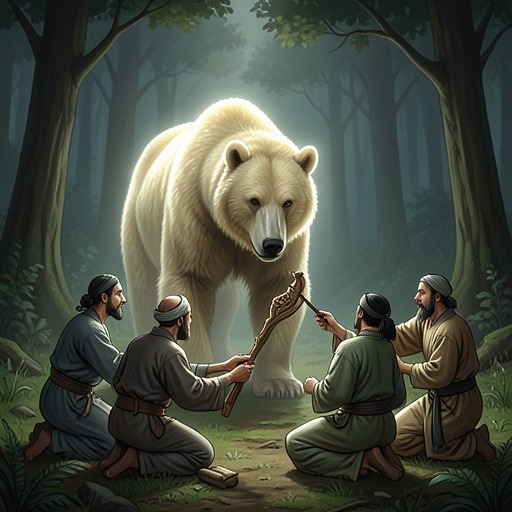
The account also associates forest powers with the movement of game. When the hunters seek the wild moose, the forest maidens start the herds from their shelter. Later, during Wainamoinen’s bear hunt, he calls upon the ruler of the Tapio forests to help him become a conquering hero and clear the woodlands. He addresses Mielikki as forest hostess and asks her and Tellervo to call and restrain the dogs. These requests show how a hunt depends on cooperation with the woodland powers, though the specific assistance is sought from Tapio’s household rather than presented as an action performed by Tapio alone.
Favor, Hunting, and Narrative Significance
The bear-hunt episode makes the relationship between human purpose and forest permission especially clear. Wainamoinen’s request is followed by his account of the forest as kind, its glen and woodland full of greetings, with Tapio showing the greatest favor. The forest’s response is expressed not as a change in Tapio’s appearance but as a welcoming condition of the landscape and the help offered by its inhabitants. The hunt’s success is therefore framed as an encounter with powers whose goodwill matters.
Mielikki’s role in the same sequence further distinguishes the household’s contributions. The bear is to be welcomed at the hearth and boiling caldrons, and Mielikki reflects on the animal’s imperfectly formed claws and teeth before giving it what is lacking. These actions are hers, not Tapio’s; nevertheless, their setting within Tapio’s domain reveals a forest world in which animals, hunters, and divine hosts are connected through customary acts of pursuit, welcome, and provision.
Tapio’s narrative importance lies in making the woodland a realm with both authority and hospitality. He is the highest forest god, yet his power is encountered through requests, routes, a mansion, and the work of his family. The hunter may ask to pass through the woods, seek a guide to the hunting grounds, or call for help in pursuing game, but the forest is never reduced to an ungoverned resource. Tapio’s favor gives the hunt a reciprocal and spiritual dimension: success depends on entering the domain of its ruler with due acknowledgment of the beings who dwell there.