Johnny Cigar
ShantaramJohnny Cigar is a trusted figure in the Bombay slum where Lin lives, known both as an unofficial accountant and tax adviser to local businesses and as a forceful participant in community crises. His public life holds a striking tension: Prabaker identifies him as a gangster working for Abdel Khader Khan, while the same neighborhood also depends on his practical skill, leadership, and readiness to act. His story moves from a childhood marked by poverty and separation toward marriage, a home in Navy Nagar, and an enduring place in the settlement’s collective life.
Identity and Background
When Prabaker introduces Johnny to Lin, he presents him as an important friend in the slum and a figure of local standing. Lin’s first impression is of a man around thirty, taller and heavier than the Indian average, with a long, alert face, steady sand-coloured eyes, a carefully trimmed moustache, and a determined jaw. The account emphasizes the confidence of his gaze and the expressiveness of his mouth: Johnny is physically composed, but rarely passive in a scene. Lin likes him immediately, before knowing the contradictions that will complicate that first impression.
Johnny’s name preserves the unlikely circumstances of his birth. He tells Lin that he was born on a footpath near Crawford Market, where his mother lived in a small shelter made from plastic and two poles, tied beneath a broken sign. Only fragments of two posters remained visible: one supplied the word Johnny, and another, advertising cigars, supplied Cigar. The name is thus not a chosen emblem or a family inheritance but a record of the improvised shelter and scraps of public advertising surrounding his infancy.
His connection to Navy Nagar is older than his own life there. Johnny says that he was conceived in that area, across a small bay from where he and Lin stand, and explains that he lived nearby because he hoped to see a person connected with his past. He also says that he never married before, and tells Lin that his mother has died. The disclosure comes at a familiar stretch of coastline, where the present landscape opens onto the history he has carried with him. The evidence leaves the hoped-for meeting and the circumstances behind it unresolved; what it makes clear is that attachment to a place has been bound up with expectation and loss.
Work, Authority, and Contradiction
Johnny’s economic importance is specific rather than ceremonial. He advises the slum’s businesses on money and taxes, and Lin’s account of the settlement’s tightly interdependent trade places Johnny inside that practical infrastructure. The shops supply a wide range of ordinary goods, as well as alcohol, hashish, and electrical appliances; Johnny estimates that residents spend twenty rupees within the settlement for every rupee spent outside it. His work serves a neighborhood whose economy is largely self-contained, helping small businesses navigate the arrangements on which daily survival depends.
That respectable and useful position does not cancel the more dangerous account of his affiliations. When Prabaker finally tells Lin that Johnny is a gangster working for Abdel Khader Khan, he describes him as a man involved in killing people for money and says that nearly everyone knows it except Lin. The disclosure changes the meaning of Johnny’s easy proximity to neighborhood life: he is not simply a local adviser who happens to be tough, but a person whose work also belongs to the criminal power surrounding the slum. At the same time, the evidence does not reduce his character to that role. His involvement in relief work, his financial service to local businesses, and his later care for family and community all remain part of the portrait.
His manner can be brusque, even when directed at someone who needs help. When Ameer comes to Lin for treatment, Johnny introduces him with a slap to the head and mocks his judgment, treating the injured man’s trouble as something he should have avoided. Lin sharply tells Johnny that Ameer should have gone to a hospital. After Lin finishes treatment, refuses payment, and sends Ameer away, Johnny gives him another parting slap. The episode establishes a rough, disciplinary style that sits uneasily beside the clinic’s care. It also shows that Johnny’s conduct can provoke anger even among people working alongside him; Lin’s refusal of money is not, by his own account, simply a matter of principle, and he is angry at Ameer, Johnny, and himself.
Community Action and Crisis
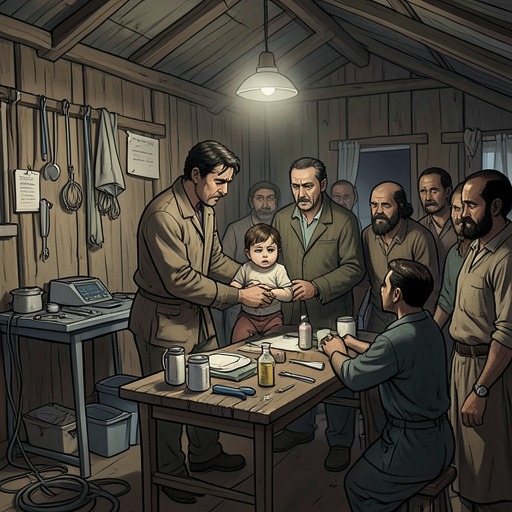
During the fire in the slum, Johnny joins the effort to beat back the flames. When Qasim Ali Hussein points Lin toward the fire, Lin finds relief in being able to obey and is glad to discover Johnny on the same team. Johnny works with a wet sack and curses the fire as he strikes at it. His outburst is an act of resistance in the most immediate sense: the threat is not abstract, and the work demands people willing to confront it together. After sunset, he and Prabaker help Lin translate and nurse the wounded in an improvised outdoor clinic founded on Lin’s first-aid kit. Burns, cuts, deeper wounds, and smoke inhalation fill the clinic’s work; Johnny is present not only at the line of defense but also in the care that follows.
The cholera outbreak gives his practical leadership a different form. Qasim Ali Hussein takes charge from his home, which becomes a command centre, and a group of about twenty residents plans to purify the water. The work is immense: it begins with holding tanks and is to continue through the pots and buckets in seven thousand huts. Qasim Ali entrusts Johnny with a thick bundle of rupee notes to buy purification tablets and other medicines. The assignment makes visible the link between Johnny’s financial competence and collective survival. In the emergency, accounting and purchasing are not background services; they determine whether a neighborhood-wide response can be carried out.
As the outbreak worsens, Johnny takes on the grim task of locating and removing the dead. The narrative places this work among the community’s other efforts: Prabaker cares for Parvati, Lin searches for medicines and oral rehydration supplies, and grieving residents are drawn into useful tasks where possible. Earlier, Johnny also helps mobilize a frightened girl to care for her sick sister. His manner is harsh, but his words guide her past her paralysis until she crosses the room and wipes her sister’s mouth. Sita’s small act of care follows, and the two gestures mark the beginning of the struggle to help the family. Johnny’s contribution is not gentle consolation; it is an urgent summons to act.
Relationships, Marriage, and Home
Johnny’s relationship with Sita develops within a family and community network. Prabaker says that Johnny loves Sita too much, describing her as Parvati’s sister, and later tells Lin that Johnny is to marry her. The arrangement appears not as an isolated romance but as part of the neighborhood’s shared social life: in one plan, Johnny and Lin are to sit on different sides of a gathering with Sita, Parvati, and their mother, making the outing a group occasion rather than a private date. The comic formality of that description reflects how courtship, kinship, and community overlap in the settlement.
Later evidence confirms that Johnny and Sita have married. Lin gives him five thousand American dollars as a wedding present, enough to buy the small hut Johnny wants in Navy Nagar, near the place where he was conceived. Because Navy Nagar is a legal slum, owning a hut there would relieve him of the fear of eviction. The gift has a personal and material force: it secures a home in the area bound to his origins and gives the couple a more stable base, rather than merely providing a temporary celebration. Johnny intends to continue his work as accountant and tax consultant to the hundreds of workers and small businesses in the surrounding slums.
The later account of Johnny’s infant son adds a new generation to that movement from insecurity toward rootedness. Johnny tells Lin that the baby grips his fingers strongly and predicts that the boy will grow bigger than his father. He also speaks warmly of Prabaker and Parvati’s baby, comparing the child’s face and smile to Prabaker’s. Family life does not displace Johnny’s community ties; it expands them, joining the future he imagines for his own son to the lives of his closest friends and their children.
Change and Narrative Role
Johnny’s history links two kinds of vulnerability: a childhood whose details survive in a makeshift shelter and poster fragments, and a present in which his neighbors face fire, disease, injury, and eviction. His response to danger is consistently practical. He joins the fire-beating team, works in the clinic, helps direct a frightened child toward care, handles the outbreak’s purchases, and takes responsibility for removing the dead. These actions do not erase his criminal affiliation or his capacity for roughness. Instead, the novel holds the different parts of his public identity together, making the slum’s everyday order depend on people whose moral and social positions are not simple.
His friendship with Lin is marked by easy familiarity and mutual participation in difficult work. Johnny is among the people Lin thinks of during fever, and Lin later continues visiting him and the others after leaving the slum, although the prison trauma has changed Lin’s sense of himself as a doctor and neighbor. Johnny’s presence in these recollections makes him part of the community Lin has lost and still seeks. At the novel’s later crisis, the friendship becomes operational again: Johnny and Lin discuss moving Kano, his bear handlers, and their helpers out of hiding in the slum. The plan is to get them to a truck near Nariman Point without attracting the police. Lin suggests disguising Kano as Ganesh and surrounding him with chanting and singing, so the group’s deliberate noise can cover the bear’s movements; Johnny is the trusted companion asked to assess the idea.
At the end of the supplied scenes, Johnny is still both a family man and an active participant in the neighborhood’s improvisations. He meets Lin at a restaurant doorway, draws him close, and updates him about the babies before directing the driver toward the World Trade Centre. His concern in that moment is not fully explained, but it appears alongside the affectionate exchange. The image is consistent with the broader portrait: personal tenderness and urgent practical business remain side by side. Johnny’s significance lies in that combination. He is not merely the comic, blunt friend or the neighborhood’s capable accountant, nor only the gangster Prabaker exposes; he is a central local figure whose usefulness, loyalties, history, and contradictions help make the slum feel like a working community.