Abdel Khader Khan
ShantaramAbdel Khader Khan is a Bombay crime lord whose public reputation as a theologian and philosopher rests alongside his authority in the city’s underworld. His principles limit the crimes he will permit, earning him what one observer calls an “immoral high ground,” while his power offers safety to thousands. For Lin, that combination becomes intensely personal: Abdel Khader Khan is at once protector, employer, philosophical mentor, and surrogate father, a man he loves even as he recognizes how completely that love can coexist with manipulation and harm.
Identity and Public Reputation
Abdel Khader Khan is known across Bombay. His name reaches newspapers, bazaars, nightclubs, and slums; the rich admire and fear him, while the poor respect him and invest him with legend. His religious and ethical discourses in the courtyard of the Nabila Mosque in Dongri attract scholars and students from different faiths. He also maintains friendships with artists, businesspeople, and politicians. The breadth of this public life makes him more than a hidden criminal figure: he is a visible civic power whose influence travels through intellectual, social, and illicit networks.
His place in the underworld is equally substantial. He is one of Bombay’s mafia lords and a founder of the council system, which divides the city into territories governed by separate councils of dons. The arrangement followed a decade of bloody power struggles and is regarded as having restored order and relative peace to the underworld. That order does not make the system lawful or benign; it shows how Abdel Khader Khan’s power operates through a criminal structure that can restrain some violence while preserving its own authority.
His authority is not simply a matter of possessing more money or weapons. Others have both in greater quantities, but Abdel Khader Khan refuses lucrative activities that violate his principles. Those limits help make his rule acceptable to people who might otherwise see only a crime lord. Lin’s guide describes him as a poet, philosopher, and lord of crime, and the combination is central to his character: ethical reflection does not remove him from criminal power, but shapes the terms on which he exercises it.
Power, Work, and Protection
Abdel Khader Khan’s criminal influence reaches the passport trade. When Lin first hears about the business, its control has recently changed hands after a small war: Bairam and his men, working for Abdul Ghani, have won and now control the passport-book operation. Abdul Ghani, in turn, works for Abdel Khader Khan. This chain of responsibility places the passport business within a wider network rather than presenting it as an isolated hustle. Later, Lin works on the operation with Abdul Ghani’s approval, expanding it beyond passports to a package of identity documents, including driver’s licences, bank accounts, credit cards, and sports-club memberships. Abdel Khader Khan welcomes these changes, showing his interest in the business’s practical development as well as its place in his organization.
His protection also shapes Lin’s prospects outside that work. When Lin is arrested, he fears that fingerprint checks will expose his identity and understands that he needs help from someone powerful enough to reach into the city’s institutions. He turns in his thoughts to Abdel Khader Khan, whose connections he believes can discover the arrest and help him. Later, Abdel Khader Khan confirms that senior police arranged Lin’s imprisonment without charge and that Lin was repeatedly beaten there, but cannot or will not explain more. The person behind the setup had not known Lin was an escaped Australian prisoner; police discovered that status through routine fingerprint checks and withheld the file when they saw an opportunity for profit. Abdel Khader Khan’s power can intervene in this corrupt system, but it does not make him omniscient or able to undo all its damage.
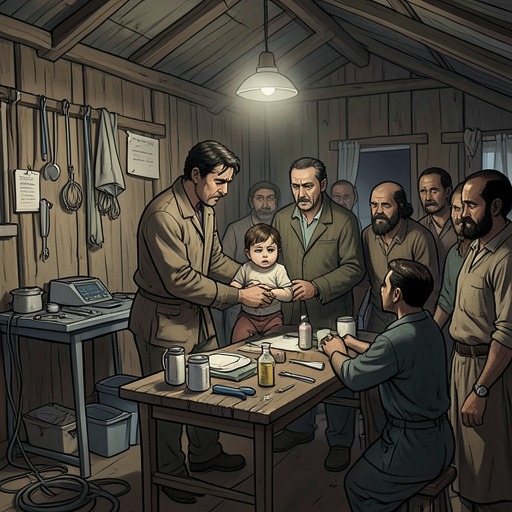
The land beneath the Colaba hutments belongs to him, and he knows that Lin has gone to live there as a doctor. He tells Lin that the work has pleased him. The remark binds Lin’s neighborhood service to Abdel Khader Khan’s authority over the site: the clinic is a form of care, but it exists within a landscape that the crime lord regards as his own. When he later tells Lin that he likes him and wants him to work for him, personal approval and recruitment arrive together.
Lin as Son, Employee, and Confidant
From their first meeting, Abdel Khader Khan casts his bond with Lin in familial terms. He tells Lin that the moment when he might have become a father was thirty years earlier and insists that fate has brought them together as son and father. He describes fate as powerful but unable to control free will or tell lies, contrasting it with the lies people tell themselves and one another. The fatherhood he proposes is not biological fact; it is a claim about connection, choice, and the meaning he assigns to their meeting. Lin eventually names Abdel Khader Khan his surrogate father, while Abdullah Taheri becomes his brother. Those relationships mark, in the narrator’s account, the beginning of a new life that will take him into war and murder and change everything.
Lin’s later reflection makes the bond more complicated than a simple rescue story. He remembers how readily he became willing to serve Abdel Khader Khan as a son might serve a father, and how quickly he came to love him. He also asks whether that attachment would have formed so swiftly had the man been powerless and poor. Lin had never felt as safe as he did in Abdel Khader Khan’s company, and hoped that entering the course of his life would help him escape the pursuit trailing his own past. Protection, need, admiration, and affection therefore meet in the relationship from its beginning; Lin’s retrospective doubt does not cancel his love, but makes its conditions visible.
Abdel Khader Khan’s care for Tariq offers a different expression of his family role. He asks Lin to teach the boy enough English to give him an advantage when formal studies begin. When Lin hesitates, Abdel Khader Khan sets a limited trial: Tariq will stay with him for two days, and Lin may return him if the arrangement proves impossible. He calls Tariq his nephew and expresses confidence in the boy. The request gives Lin a responsibility that is practical and intimate, while showing Abdel Khader Khan using trust rather than command alone to draw him into the family’s obligations.
Ethical and Philosophical Thought
Abdel Khader Khan’s ideas are not a decorative counterpart to his criminal life; they are among the means by which he interprets it. He argues that legal systems concentrate on the amount of crime in a sin rather than the amount of sin in a crime. His concern is not merely whether an act is prohibited, but what moral harm it contains. In a conversation about killing and other crimes, he points out that people often appeal to law, scripture, religious teachings, parents, or other authorities without understanding why the act is wrong. His question presses beyond obedience toward an account of ethical responsibility.
His cosmology extends that search from individual conduct to the universe. He describes existence as moving toward increasing complexity and calls its ultimate form God, the Universal Spirit, or Ultimate Complexity. When Lin later restates the model in his own words, Abdel Khader Khan listens with his eyes closed, nods, and expresses happiness that Lin can convey it accurately. The moment presents philosophical teaching as more than a lecture: Abdel Khader Khan values the idea being understood and carried forward by another person.
His talk is marked by sudden turns between subjects. Even after Lin comes to expect those shifts, he can still be caught off guard when Abdel Khader Khan changes the ground of a conversation. The method reflects a mind that moves easily among business, ethics, love, and life’s largest questions, but it also gives Abdel Khader Khan control of the exchange. His eloquence can open a subject and redirect it; intimacy and authority are present in the same conversational habit.
War, Death, and the Afterlife of the Bond
Abdel Khader Khan’s invitation to Afghanistan transforms Lin’s service into a dangerous journey toward the older history of the man Lin has come to regard as a father. Abdel Khader Khan says he is returning to his home after more than fifty years away and makes clear that Lin may refuse without losing his respect. He equips Lin for the mission with a Stechkin APS pistol, explaining its ammunition, capacity, and operation, and insists that Lin keep it visible and within reach. The instruction is practical preparation, but it also makes plain that Abdel Khader Khan’s care is exercised in a setting where survival depends on being armed.
The war brings Abdel Khader Khan’s ethical explanations into contact with human consequences. He tells Lin about Habib Abdur Rahman, once a village schoolteacher with a wife and two sons, who joined the resistance after the Russian invasion. On returning from a mission, Habib found that Russian forces had attacked his village with nerve gas. The account gives Lin a history for a participant in the conflict without reducing that history to an excuse; it places personal devastation inside the war that Abdel Khader Khan has chosen to enter.
Lin’s love is later tested by absence and suspicion. After Abdullah Taheri’s death, Lin blames Abdel Khader Khan for failing to protect him and becomes willing to believe that the older man has some connection to Sapna and the killings. He also feels abandoned when Abdel Khader Khan leaves Bombay, although he recognizes that this feeling is self-centered and that many of the Khan’s men remain in the city. His anger forms a coldness around his affection. At the same time, Lin cannot bring himself to discuss the murder of Madjid, Abdel Khader Khan’s friend and colleague: after seeing how stricken the man looked when Madjid’s name was mentioned, Lin lets the subject lapse, and they continue with business or philosophy instead.
Before the Afghanistan mission, Abdel Khader Khan tells Lin that whatever wrongs he committed were done for what he believed were the right reasons, and that he always regarded Lin as his friend and beloved son. Lin’s own memory holds both sides at once: the man had used and manipulated those around him, yet the love he saw in Abdel Khader Khan’s eyes answered a need for fatherly affection he had carried for a long time. This contradiction remains unresolved when Abdel Khader Khan dies. Nazeer is too exhausted and cold to speak as the men bring him back to camp; Lin tries to revive Abdel Khader Khan and finds that he has been dead for many hours, perhaps more than a day. His face is peaceful beneath the snow, but Lin cannot readily believe that he is gone.
For a time, anger shields Lin from fully grieving. He continues to feel loss, but only much later does a casual remark from Salman Mustaan allow the buried grief to rise. Lin realizes that he had not hated Abdel Khader Khan: he had always loved him, even while blaming him and feeling forsaken. The delayed mourning completes neither a defense nor a condemnation. It restores the relationship in its painful entirety: a bond that offered Lin safety and meaning, drew him into the Khan’s work and war, and endured beyond the father’s death because love and grievance could not be separated cleanly.