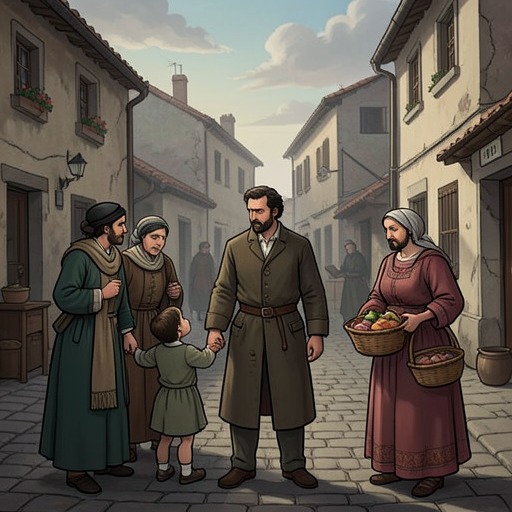
Rukhmabai Kharre
ShantaramRukhmabai Kharre is Prabaker Kharre’s mother and one of the central figures in Lin’s experience of Sunder village. Her authority is at once domestic and communal: she manages the family’s modest fortune, commands respect among her neighbors, and offers Lin a welcome that changes his sense of who he can become. When danger breaks the long spell of her grief, she also becomes the voice that turns a threatened village toward resistance.
Identity and Standing
When Lin first meets Rukhmabai, she is forty and at the height of her personal influence and public prestige. She is described as taller than her husband, Kishan, with exceptionally long black hair and amber eyes. Her appearance is distinctive, but her standing does not depend on appearance alone. Her quick wit and deep sympathy for other people’s distress give her a recognized place in village life.
Rukhmabai generally stays apart from disputes between neighbors until someone asks for her view. Once invited to speak, she is often the final authority. The respect she commands also has a material foundation: Kishan owns land, while she oversees their small personal fortune. Yet the narrative emphasizes that people heed her as a person of judgment and strength, not merely as the keeper of family resources. Her manner makes clear that disrespect toward her will have consequences.
Marriage and Private Grief
Rukhmabai’s marriage to Kishan is arranged. At sixteen, she sees her betrothed only once before the wedding, peering at him from behind a curtain. She later tells Lin candidly that her first impression disappointed her. Kishan is short, darkened by years of farm work, rough-handed, plainly dressed, coarse in speech, and unable to read. Rukhmabai, by contrast, can read and write in Hindi and Marathi; her father leads the village council. At the time, she believes that she cannot love Kishan and that the match places her beneath her own status.
The life that follows includes profound loss. Three miscarriages leave Rukhmabai grieving for two years. The account describes her as inconsolable, unable to be comforted even by Kishan’s smile, and left to the limited routine of caring for her daughters. Her laughter disappears, and sorrow seems to settle over the neglected fields. This period matters to her public story: when she later speaks out, the villagers are astonished not only by the force of her words but by her return from prolonged grief to active engagement with their shared danger.
Resistance in Sunder Village
The threat comes when armed bandits establish themselves in the area and demand tribute. Violence reaches neighboring communities, and a man in Kishan’s village is killed for resisting. He is Kishan’s cousin and the husband of a woman from Rukhmabai’s own village. At his funeral, attended by the people of Sunder, Rukhmabai addresses the assembled villagers. With her grief giving way to anger and determination, she challenges those who would appease the bandits and urges the community to defend its lives and land, even if resistance means fighting.
Her speech galvanizes the villagers. They devise a plan, and further threats, skirmishes, and raids bring the confrontation closer. When the bandits demand a large tribute and threaten consequences for refusal, the villagers arm themselves with farm tools and other weapons. Women and children are sent to a neighboring village while the men remain. Some of the men fear that resistance is futile; the murdered man’s brothers encourage them to hold their ground.
Rukhmabai is not described as taking part in the ensuing fight. The account instead gives her decisive contribution its own form: she has helped change what the villagers believe they can do together. The bandits enter Sunder shortly before sunset, and the villagers repel them. Raju kills their leader; the surviving wounded men scatter and do not return. The villagers take the leader’s body to a district police post and agree on a shared account that conceals Raju’s role. The community’s victory therefore involves both armed resistance and collective silence about how it was achieved.
Lin, Naming, and Legacy
The villagers keep telling the story of the battle as Lin learns Marathi. They take him to the places where people hid and confronted the bandits, and younger men reenact the events, often competing to play Raju. In these repeated tellings, Rukhmabai’s funeral speech remains central. The villagers admire her courage and strength of will, and they take particular pride in her return from despair to the lively, shrewd woman they knew. Their esteem is directed not only toward victory but toward the people who make village life worth defending.
Rukhmabai’s care for Lin extends beyond welcoming him into her home. She calls a meeting of the village women to choose a Maharashtrian name for him, drawing on the belief that his character is marked by peaceful happiness. Since Lin lives with Prabaker’s family, the decision gives him the family name Kharre; custom also leads him to take Kishan’s name as his middle name. The women settle on Shantaram, a name meaning a man of peace or a man of God’s peace. Rukhmabai thus helps give Lin not simply an affectionate nickname but a place within a family and a community.
Her significance lies in the connection between these acts. She welcomes Lin, recognizes a possibility in him that his former hard, hostile manner concealed, and helps the village give that possibility a name. At the same time, her own return from grief to public action becomes part of Sunder’s shared memory. The village’s repeated account of its resistance preserves her role alongside the fighters’ deeds: she does not lead the battle itself, but her words help make collective resistance imaginable, and her care helps shape the life Lin begins there.