Nazeer
ShantaramNazeer is Abdel Khader Khan’s constant companion and a formidable presence in Lin’s life, at first seeming as likely to become an adversary as an ally. His loyalty is never merely a matter of obedience: he protects Abdel Khader Khan’s people, takes responsibility for Tariq, and repeatedly risks himself for Lin. The scowl that first makes him difficult to approach becomes an expressive counterpoint to his tenderness, his grief, and the creative life revealed when he dances.
Identity and First Impressions
Nazeer enters the story as the bearer of a summons. He tells Lin that Abdel Khader Khan wants him, and when Lin hesitates, Nazeer conveys the instruction with such grim insistence that Lin briefly considers resisting him physically. The threat is real enough to shape Lin’s immediate response, but Nazeer then struggles to deliver the invitation with unusual courtesy. His effort to make the message more gracious complicates the image of a man who might otherwise seem to be only an enforcer.
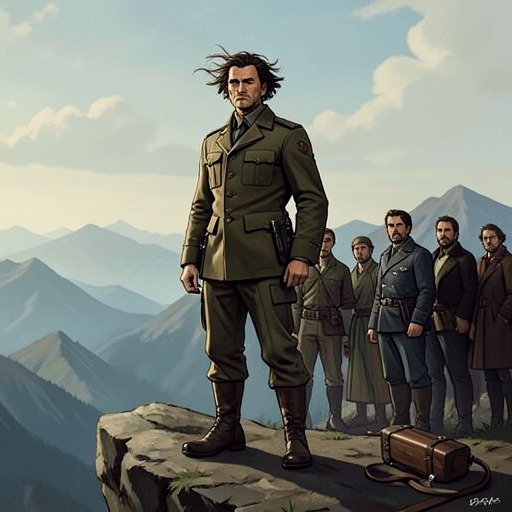
His physical presence reinforces that first impression. Lin describes a short, bow-legged, thickset man whose strength is evident even beside someone taller. On another occasion, Lin wakes to Nazeer’s fierce, unfamiliar face and finds himself helped upright. The narrator’s early descriptions emphasize the deep lines of Nazeer’s scowl; yet the same face will later be transformed by a smile and by dance. Nazeer is not introduced through an explanation of his inner life, but through acts of watchfulness, command, and physical care that gradually make that life legible.
Abdel Khader Khan’s Companion and Tariq’s Protector
Nazeer is Abdel Khader Khan’s constant companion, close enough to rise and follow him after a meal, and vigilant enough to watch the dock while Lin sits beside him. His loyalty is visible in the way he attends to Abdel Khader Khan, but it is not presented as mindless submission. At the restaurant, Abdel Khader Khan speaks to dockworkers about bullying, the distribution of work, and the needs of their families. Nazeer remains nearby as these exchanges show the social responsibilities his leader assumes and the respect he commands.
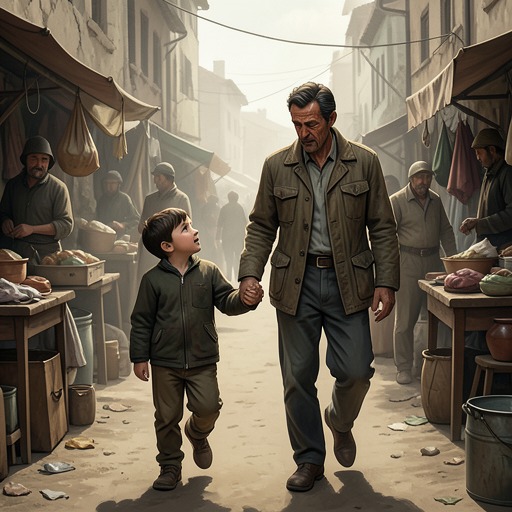
His attachment to Tariq is more openly tender. When Abdel Khader Khan leaves the boy and Lin, Tariq and Lin both feel abandoned. Nazeer accompanies them to the door, then kneels and presses Tariq to his chest. The boy clings to him, and the embrace has to be broken before they can part. Nazeer’s look toward Lin carries a clear warning that Lin will be held accountable for the child’s safety. Later, when Salman Mustaan assigns Nazeer to take Tariq to Sobhan Mahmoud’s house in Versova and watch over him, the order formalizes a responsibility his earlier behavior had already made plain.
Nazeer’s protectiveness can look like hostility when Lin is its object. As he drives away from Abdel Khader Khan, Lin remembers Nazeer’s scowl and anticipates that the two men will eventually have to settle their tension. Lin even welcomes the prospect of a fight, not because their conflict is trivial, but because his isolation in exile makes a concrete physical challenge seem easier to face than loneliness. This early antagonism becomes a recurring surface beneath which a durable bond takes shape.
Care, Language, and the Hidden Inner Life
That bond develops through practical care as well as confrontation. During Lin’s severe withdrawal, Nazeer remains beside him for two days and nights, tending to him with constancy and helping him endure the ordeal. Lin’s account emphasizes the repeated return of Nazeer’s hand and attention whenever he wakes or is overwhelmed. Care here is not a speech or a declaration: it is presence sustained through an exhausting crisis, offered by the man Lin had once expected to fight.
Their relationship also acquires a teasing, more ordinary register through language. Lin learns phrases in Nazeer’s language faster than Nazeer learns English, and Lin uses that advantage to tease him when he struggles to express himself. By pretending not to understand, Lin makes Nazeer repeat his awkward English until he curses in Urdu and Pashto and withdraws into silence. The exchange shows Lin gaining a small measure of confidence while dependent on Nazeer, but it also reveals a familiarity that would be impossible between mere captor and captive. Their humor gives their closeness room to be imperfect and reciprocal.
A public celebration discloses a side of Nazeer that his guarded demeanor usually conceals. During rehearsals for the formal festivities, he joins a group dance with grace and passion, quickly winning the admiration of the assembled men. Lin sees in the performance a creative and spiritual capacity that Nazeer’s scowling face had obscured. The dance does not erase his toughness; it makes clear that toughness is only part of him. The contrast between his habitual severity and his expressive movement becomes one of the strongest revelations in Lin’s portrait.
The Afghanistan Mission and Its Losses
Nazeer accompanies Lin on Abdel Khader Khan’s mission across international borders toward the Afghan war. Before departure, he wakes Lin before dawn. The party’s route from Bombay to Quetta involves four major changes of transport, and Abdel Khader Khan instructs the travelers to behave as separate individuals who do not acknowledge one another. Nazeer’s role in this journey is defined by disciplined discretion and continued proximity to Lin, even when the plan requires the group to conceal its connection.
The mission ends in profound loss. After Abdel Khader Khan is killed, Nazeer is found in the snow, exhausted but still trying to bring two men with him: Ahmed Zadeh, who is alive but badly wounded, and Abdel Khader Khan, who is dead. The image gives physical form to Nazeer’s loyalty and grief. He has not simply survived the battle; he has struggled to carry both the living and the dead as far as he can.
Abdel Khader Khan had left Nazeer a final duty to perform in the event of his death: to kill a named man. Lin does not know this immediately and worries about Nazeer’s state of mind as the days after the burial become weeks. In the meantime, Nazeer’s life appears to have narrowed around a single purpose. The later account reveals that the assignment has sustained him, turning grief into an obligation. Nazeer eventually avenges himself and Abdel Khader Khan by killing the traitor who betrayed their group in Pakistan, completing the act that had kept him going.
Protection, Grief, and Renewed Work
Nazeer’s care for Lin becomes most consequential during the fighting. When Lin is unconscious in the bombardment, Nazeer drags him into shelter and covers him with his own body. Nazeer is wounded while protecting him, and after the attack he brings Lin to safety. Later, Mahmoud tells Lin that Nazeer also insisted that those caring for him attend to his injuries and would not permit the loss of his fingers to be treated as inevitable. He has kept Lin’s weapons and arranged for them to be returned when Lin wakes. These acts extend Nazeer’s protection beyond the immediate danger: he argues for Lin’s recovery and safeguards the means of his defense.
After returning to Bombay, Nazeer again takes responsibility for Tariq, this time by removing the boy from a tense confrontation. He seizes Andrew by the wrist and sleeve, pushes him into the driver’s seat, and climbs into the back with Tariq. Before leaving, he gives Lin a look that holds reproach and pride alongside anger and affection. The scene recalls his earlier warning about Tariq, but now his intervention is not directed at Lin as a possible threat. It is a decisive effort to get the child away from danger.
Nazeer’s relationship with Lin ends this portion of their story not with a demand for repayment but with an opening toward shared work. Nazeer and Abdullah Taheri discuss a mission in Sri Lanka to help Tamil Muslims caught between the Tamil Tigers and the Sri Lankan Army, people described as lacking both weapons and an army of their own. Lin understands that he owes Nazeer his life, but also recognizes that Nazeer will not use the debt to force him to go. The invitation offers a way to turn Lin’s guilt about not being present when Abdel Khader Khan died into purposeful action.
Narrative Role and Significance
Nazeer’s arc is built through reversals of appearance. The man who initially seems likely to compel Lin into a car becomes the person who nurses him, protects him under fire, and offers him a way forward without demanding obedience. His severity remains real: he can menace, command, and act decisively. Yet the narrative repeatedly places those qualities beside tenderness, comic familiarity, and artistic expression, preventing any single impression from defining him.
Through Nazeer, loyalty is shown as both action and care. He carries out Abdel Khader Khan’s final instruction, but he also protects those who remain, especially Tariq and Lin. His grief does not resolve quickly or neatly; for a time it contracts his life around revenge. The later invitation to work with Lin and Abdullah Taheri points instead toward a future in which shared loss may be converted into service. Nazeer’s importance lies in that difficult passage: from a guarded companion whom Lin expects to fight to a trusted ally whose protection and generosity help Lin imagine what he can do next.