Big Rahul
ShantaramBig Rahul is a convict overseer at Arthur Road Prison and one of the prison’s chief agents of intimidation. His conflict with Lin reveals two sides of his power: he can retreat when directly challenged, yet he can also summon the force of the prison hierarchy to punish resistance. Over time, his abuse becomes both physical and psychological, culminating in a food ritual designed to make Lin crawl for a meal.
Identity and Position
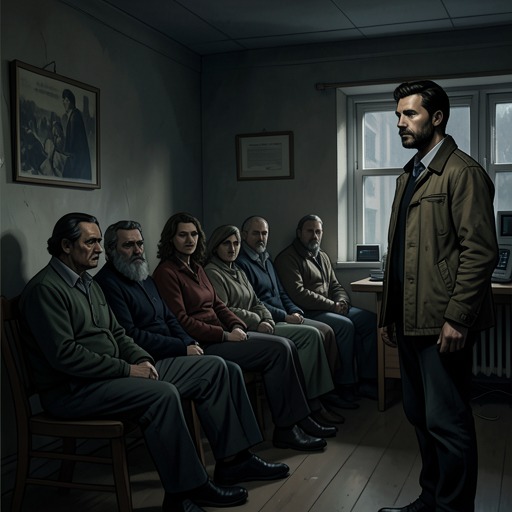
The prisoners know Big Rahul as a huge, obese man who towers over most of the other men in the room. He belongs to the convict overseers, prisoners empowered to discipline and control the rest. His authority is visible in small, repeated acts as well as in collective punishment: he strikes men who attempt to move during a prolonged wait, while others patrol and enforce the same rule.
His power does not rest on his size alone. Other overseers converge behind him when Lin challenges him, and later they take part in a beating that continues through successive shifts. Big Rahul can therefore act as an individual bully and as the focal point of a wider apparatus of coercion. The frightened prisoners’ reluctance to help Lin shows how punishment extends beyond its immediate target: even attempts at solidarity bring consequences for those who make them.
The First Confrontation with Lin
During a morning head-count, the prisoners are made to squat for an hour. They are in severe discomfort, and guards strike anyone who tries to straighten his legs. Lin initially refuses to move, unwilling to let the overseers see him yield, but Big Rahul strikes him repeatedly. Lin finally stands and challenges him. Mahesh and several other prisoners rise around Lin and try to pull him back down, pleading with him to stop before the confrontation brings further punishment.
For a moment, Big Rahul and Lin meet each other’s gaze and recognize the violence each is prepared to use. Big Rahul’s mocking expression gives way, and Lin reads his eyes as a signal of defeat. Lin allows the other prisoners to restrain him. Big Rahul turns away, striking another prisoner as he does so, and the head-count resumes. The encounter does not end the danger or change the prison’s rules, but it punctures the overseer’s apparent invulnerability: he backs down when Lin stands against him directly.
Escalation and Collective Punishment
Big Rahul later strikes Lin while Lin is trying to write down a short story he has developed in his mind over several weeks. Lin has finally obtained a pencil stub and discarded sugar wrappers for paper. The writing has served as a form of meditation; the assault interrupts this fragile private practice and brings their conflict to a breaking point. Lin takes the overseer’s stick, throws it through a barred window, and drives him backward with a kick and a series of punches.
The retaliation is followed by an organized beating. Lin is chained to a gate, and Big Rahul begins the assault before other overseers take turns continuing it. Groups arrive from other rooms, then the first group returns; the punishment lasts from the morning until the evening. Big Rahul’s role is not limited to the original attack: he helps make Lin’s defiance an example for the prisoners assembled to witness what happens to someone who resists. When another group of men is brought forward, Lin sees Mahesh and a prisoner already punished for trying to help him among them. He stops resisting and is secured to the gate as the beatings proceed.
Control Through Humiliation
After a meeting with a prison official, the sustained beatings stop. Big Rahul and some of the other overseers continue to strike Lin occasionally, but the blows are no longer delivered with the same force. Lin remains weakened by prison conditions and severe food restrictions. At meals, the overseers eat well while their flunkies perform chores in return for scraps and relative protection from beatings. Big Rahul turns this inequality into a personal taunt.
He repeatedly offers Lin food, waving a piece of chicken as if inviting a dog to take it. Sometimes he throws a piece or a sweet toward Lin, tells the flunkies to leave it for him, and urges him to crawl. If Lin refuses, Big Rahul lets the flunkies scramble for the food and laughs. The food is no simple act of generosity: its deliberately staged offer makes acceptance conditional on submission, while its public rejection gives Big Rahul another occasion to assert control. Lin knows that the scraps could keep him alive, but cannot make himself crawl across the room to accept them. He remains a witness to the meals and to the humiliation built into their distribution.
Character and Narrative Significance
Lin describes Big Rahul as a man who has found in him a target for the hatred and misery accumulated during twelve years in the prison. This is Lin’s account of the overseer’s conduct, not a justification for it. The contrast between Big Rahul’s force and his weak, false laughter sharpens Lin’s interpretation of cruelty as a form of cowardice. Big Rahul’s moment of retreat, his later use of the prison’s collective violence, and his recurring food taunts together show how intimidation can shift between open force and calculated degradation.
As a character, Big Rahul embodies the immediate, personal face of a system in which prisoners exercise power over other prisoners and resistance carries costs for an entire group. His conduct also tests the boundaries of Lin’s endurance: Lin refuses to submit during the first challenge and the food taunts, but eventually stops resisting when other prisoners are assembled for punishment. Big Rahul’s importance lies less in a separate personal history than in the repeated choices through which he turns institutional power into a direct contest over fear, dignity, and survival.