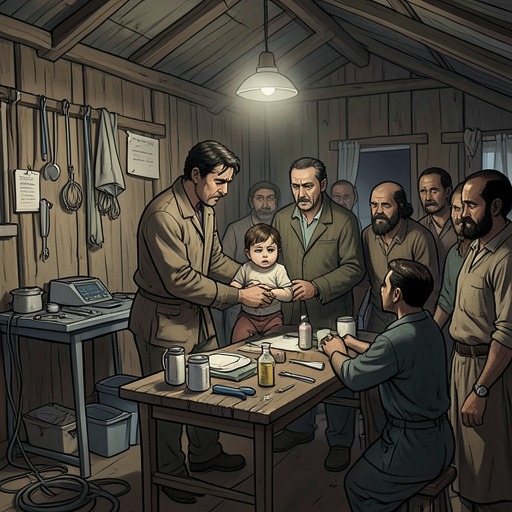
Radha
ShantaramRadha is Jeetendra’s wife and Lin’s next-door neighbor in the slum. When cholera spreads through the settlement, she is gravely ill before Lin knows she needs help; she becomes the outbreak’s first recorded victim. Her death marks the epidemic’s arrival as a personal loss for the community and becomes the focus of Lin’s remorse over his own inattention.
Identity and Place in the Community
Radha lives with Jeetendra in a hut in the slum. Her illness is first brought to Lin’s attention when Jeetendra scrambles over the rocks in alarm, calling for him and describing his wife’s fever, vomiting, and severe diarrhea. Jeetendra says the symptoms began two days earlier. The delay means Radha has already been dangerously sick while Lin, her neighbor, remains unaware.
Illness and Death
When Lin and Jeetendra reach the hut, Radha lies on a thin blanket, her body twisted with pain. Her hair and pink sari are soaked with sweat. Jeetendra’s mother, Chandrika, tries to keep her clean, but the fever has left Radha incoherent and incontinent. As Lin watches, Radha vomits violently, followed by another bout of diarrhea. The physical details make the crisis immediate: this is not an abstract outbreak but a neighbor suffering in her own home, with family members trying to care for her.
The disease spreads rapidly through the settlement. By nightfall there are ten serious cases and a dozen more suspected; by the next dawn, sixty people have advanced cases and as many as a hundred show symptoms. The first death comes by noon. It is Radha, identified by Lin as his next-door neighbor. Her death is thus both the epidemic’s first fatality in the slum and the point at which the mounting case counts become irreversible personal loss.
Significance to Lin
Radha’s death becomes inseparable from Lin’s recognition of his own complacency. A week earlier, after the treatment queue at his small clinic had dwindled to nothing, he had celebrated with Prabaker, as if the settlement’s illnesses had been cured. During the two days Radha was desperately ill, Lin was ingratiating himself with tourists at a five-star hotel, ordering ice cream and crepes through room service while she writhed on a damp earth floor.
Lin feels shame and imagines that his pride and the clinic’s conceit may have made him complicit in the disease. At the same time, he knows that nothing he did or failed to do caused the epidemic, and that cholera would have reached the slum sooner or later. That distinction does not dissolve his guilt: Radha’s suffering makes the distance between his presumed usefulness and his actual unawareness painfully concrete. Her death prompts him to accept demanding work in the community’s response, not because he believes he caused the outbreak, but because he can no longer treat the clinic’s earlier quiet as proof that the slum had been made safe.