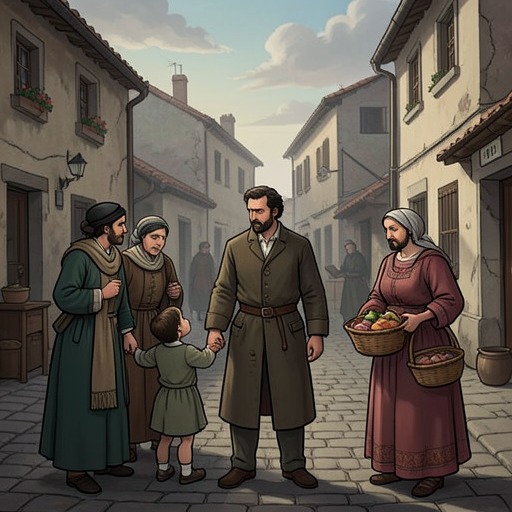
Lin · Shantaram
ShantaramLin / Shantaram’s defining struggle is between the hard, hunted identity shaped by his past and the peaceful man he discovers others can see in him. An escaped prisoner living under the threat of recapture, he accepts relationships and responsibilities that reshape his sense of himself: Prabaker Kharre invites him into village life, the women of the village give him a new name, and Lin chooses Abdullah Taheri as a brother. Yet the village cannot become a permanent refuge. Lin knows that the crimes and danger he carries with him could eventually expose the people who have offered him belonging.
Identity and Introduction
Lin arrives in Bombay as a fugitive whose escape from prison has already forced a consequential choice. When Karla asks whether he would accept a happiness that he knew would end in sadness and pain, Lin recognizes that his own life has answered the question: escaping prison was itself a choice to take the possibility of happiness, despite its risks. He says that he would choose happiness, and Karla responds with a half-smile that may carry recognition or amusement. The exchange presents his openness to painful experience not as an abstract principle but as something already enacted in his life.
That openness is tested when Prabaker takes him to a people-market. In a cramped, makeshift courtyard, children sit beneath a ragged canopy while adult purchasers and agents gather around them. Prabaker explains that the children have been displaced by disasters and conflict in West Bengal, Orissa, Haryana, and Punjab, then recruited or bought and brought by train to Bombay, often alone over long distances. The bargaining continues even as Lin and Prabaker watch. The boys are destined for camel-racing work in Gulf countries, where some will be injured or die and survivors may later be abandoned; girls are sent to household work in the Middle East, and some are sexually exploited. Prabaker also describes the far greater number of children who never reach the market because they have starved to death. Lin’s account frames this encounter as knowledge shared from one person to another: witnessing suffering does not necessarily make the world easier to love, but it can keep a person from hating it.
Sunder Village and the Name Shantaram
Lin’s invitation to Sunder village is a rare sign of trust. Prabaker explains that he returns to visit his parents about every six months, as he has done for nine years, but Lin is the first foreigner he has invited to accompany him. There Lin meets Prabaker’s father, Kishan Mango Kharre, and is introduced as Mr. Lin. The meeting begins a family relationship that goes beyond the courtesy of a host welcoming a guest: Kishan is later understood as Lin’s adoptive father, and that bond determines the name the village gives him.
Life in the village allows Lin to experience himself differently from the threatening figure he had learned to project. In Bombay, he had been a fighter, and his face and movements had come to communicate menace. The villagers do not read that language. They take him for a peaceful man, and he works, jokes with children, sings, dances, and laughs with them. During his final three months there, he helps the local schoolteacher give children special spoken-English lessons, clarifying pronunciation. The teacher and village council urge him to stay, offering him both a place and a purpose.
The name comes from a decision by Prabaker’s mother, Rukhmabai Kharre, who calls a meeting of the village women. Because Lin is part of Prabaker’s household, the family name is Kharre; because Kishan is his adoptive father, custom supplies Kishan as his middle name. Rukhmabai and the other women choose Shantaram for his first name, judging his nature to be blessed with peaceful happiness. Lin becomes Shantaram Kishan Kharre, a name meaning a man of peace or a man of God’s peace. He cannot decide whether the villagers recognized a peace already within him or planted it there as a hope. In either case, he understands the naming as the beginning of the better person he slowly, and belatedly, starts to become.
Service, Friendship, and Moral Responsibility
Lin’s later work in the Cuffe Parade Slum places this emerging identity amid stark material inequality. The settlement beside the Mumbai World Trade Centre Construction Site covers ten acres, with seven thousand huts housing twenty-five thousand people. The contrast is immediate: the commercial building has shops, display goods, neon lights, and fountains, while the settlement has no electricity, running water, or toilets, and its residents cannot be certain the authorities will continue to tolerate their homes. Lin’s move into this community brings him into a life of practical service, though he resists being mistaken for a trained physician. When introduced as the doctor of the Colaba hutments, he clarifies that he has only been drawn into helping and is not medically trained. He explains that he refers illnesses he cannot identify to St. George Hospital, but many patients return without having received care.
His relationships also become a source of strength and obligation. Prison has taught Lin how rare it is for someone to stand beside another person when violence makes the cost of friendship real. He recognizes that quality in Abdullah Taheri, whose courage and loyalty helped Lin feel able to cope. In his hut, Lin pledges himself to Abdullah as brother and friend, regardless of what Abdullah has done or who he is. In turn, Lin realizes that he gives Prabaker a similar confidence: the friendship that steadies Lin is also something Prabaker finds in him. The bond is not only emotional; it is part of the reciprocal care through which Lin begins to belong to other people.
Lin’s understanding of justice likewise develops through the slum’s communal practices. He remembers the case of Faroukh and Raghuram, who had fought over religion and were made to work together at a latrine before presenting themselves to their families and neighbors. The council’s punishment required each boy to learn a complete prayer from the other’s religious observance. Lin writes down Qasim Ali Hussein’s explanation of the decision in Lin’s black work journal: justice must be both fair and forgiving, satisfy even those who have offended the community, and seek not only to punish but to save. Later, as neighbors care for Maria after she has been beaten and Prabaker and Johnny Cigar keep watch over Joseph, Lin rereads those words. The principle has become more than an idea; it helps him interpret the community’s response to harm as an effort to protect people and restore social ties.
The Fugitive Past and the Limits of Belonging
Despite the happiness he finds in Sunder village, Lin knows he cannot return there, at least not then. A village requires a person to reveal himself more fully than the city does, and Lin believes that anyone who watched him closely would eventually see the signs of his criminal past and fugitive life. He fears the reckoning that could follow and recognizes that he might kill to avoid being sent back to prison. To remain in the village while concealing that danger would, in his judgment, compromise the people who had welcomed him. He thinks that every smile he accepts from them is obtained through deception, and that life on the run puts a lie into even its moments of affection. His departure therefore marks a painful limit: the place that helped him become Shantaram cannot safely shelter the whole truth of his life.
The same tension continues as Lin enters the world of Abdel Khader Khan. Lin recalls the night of the blind singers as a beginning, following the earlier beginning of his naming in the village. In retrospect, he sees his experiences in India before that night as preparation for a new life in which Abdullah becomes his brother and Abdel Khader Khan becomes a father figure. That life carries him toward war and murder, changing everything. The sequence complicates the peaceful identity bestowed on him: Shantaram is not a clean break from violence, but a name and possibility that persist as his relationships draw him into danger.
Narrative Role and Significance
Lin’s character arc is built around competing forms of recognition. In the people-market, he witnesses children treated as commodities and learns of catastrophes that have driven them from home; in Sunder village, women and neighbors recognize a peaceful nature in him and give him a place within a family. Later, the slum’s residents draw him into work he is not formally qualified to do, while its communal judgments offer an alternative to impersonal punishment. In each setting, Lin is both an observer and a participant, and what he learns changes how he understands responsibility.
The name Shantaram does not erase Lin’s past or guarantee that he can live peacefully. Its force lies in the possibility it marks: a self formed not only by the menace he once projected or the danger he continues to carry, but also by service, chosen brotherhood, and the willingness to accept care. The village’s acceptance gives that possibility its clearest form, while Lin’s inability to return shows the cost of living as a fugitive. His developing identity remains an unfinished effort to make conduct answer the name others have given him.