Lin
ShantaramLin is an Australian fugitive whose life in India unfolds through borrowed names, chosen loyalties, and decisions made under pressure. He first treats freedom as something fragile to smuggle across a border; later, after imprisonment and loss, he accepts a place in organized crime. The narrative’s central reversal is that neither his aliases nor the forces that seem to determine his life settle who he must become: Lin comes to understand identity as something shaped by relationships and acts of will.
Identity and the First Journey
Lin reaches India from Auckland using a false New Zealand passport bearing his substituted photograph. He has done the alteration himself and knows it is imperfect: he expects it to pass a routine examination but believes closer scrutiny, including a check with the New Zealand High Commission, would expose it. During the flight he seeks out a small group of New Zealand students making a return trip to the subcontinent, encouraging them to share travel advice and cultivating a modest acquaintance. At this stage, he thinks of himself as smuggling his own hunted freedom rather than moving goods for profit; the organized methods he will later learn belong to a different phase of his life.
At an early encounter, he gives the false passport’s name, Lindsay, as his own. The name is one of several provisional identities, not a stable account of his past. Later he tells Abdel Khader Khan that he is Australian, the first time he has admitted it since arriving in India. The admission feels to him more like a lie than any alias he has used, exposing how far exile has unsettled the connection between nationality and personal belonging. Around the same period, his documents and other people’s names for him point in different directions: a false New Zealand passport, an American business card identifying him as Gilbert Parker, the village name Shantaram, and the slum name Linbaba. In his own country, he is known to some through a wanted poster, yet he questions whether that country is truly his.
Linbaba and the Making of a Self
Prabaker proposes shortening Lindsay to Lin, and Lin accepts. What appears at the time to be a small, almost arbitrary decision becomes, in his later account, a pivotal one. Prabaker has not simply supplied a convenient nickname: the name Linbaba becomes the identity under which the fugitive is known across a broad geography, from Colaba to Kandahar and beyond. Lin’s retrospective narration distinguishes this adopted self from the aliases used to evade detection. He judges the character he became as Linbaba to have been more real and more true to his nature than any identity he had previously possessed.
That change complicates the idea that a name merely conceals a person. Lindsay, Gilbert Parker, Shantaram, and Linbaba each belong to a different social circumstance, but the name given by Prabaker becomes attached to a role Lin actively inhabits. The story treats its importance as something recognized after the fact: the seemingly heedless assent matters because it opens onto a life and a character he could not yet foresee. In that sense, the name is both an act of belonging and a form of self-making.
Care, Work, and the Costs of Imprisonment
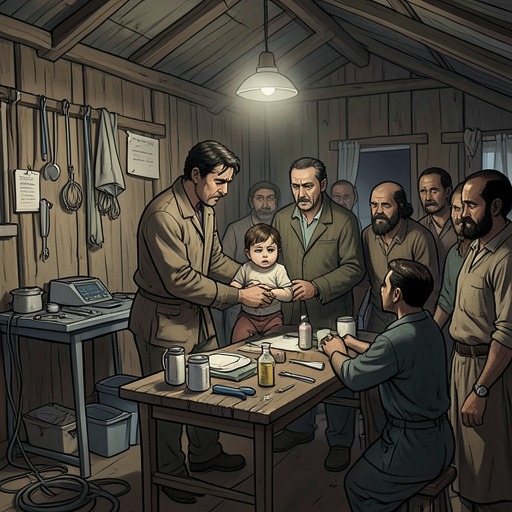
Lin’s life is not defined only by evasion or criminal work. At breakfast with Qasim Ali Hussein, he helps sort medicines and bandages delivered by Ranjit’s lepers. Qasim Ali cannot read or write English, so Lin explains the contents and uses of the capsules, tablets, and salves he has ordered. Qasim Ali’s son Ayub writes each medicine’s name and description in Urdu on small scraps of paper and attaches labels to the containers and cream tubes. Qasim Ali has chosen Ayub to learn about the medicines and assist Lin. The practical scene shows Lin working through explanation and shared labor, in contrast to the false identities and clandestine dealings that also mark his life.
After months in Arthur Road Prison, Lin stays at the India Guest House at Abdel Khader Khan’s expense. A tiled shower and a soft mattress help his wounds heal, but the greater damage, as he describes it, is to his spirit. He also carries shame about the deaths of his neighbor Radha and two boys from his English class during the cholera epidemic. Prison torment and his sense of failure during the epidemic together leave him unable to live in the slum or even spend the night there. His isolation after release is therefore not simply a matter of physical recovery: it follows from the combined weight of what he endured and what he believes he failed to prevent.
A mirror becomes part of his attempt to resume an ordinary self. In new clothes that cover the worst of his injuries, Lin practices smiling and tries to remember what it was like to be himself. The effort nearly succeeds before a harder expression replaces the one he recognizes. He resolves not to be vulnerable to the same pain, hunger, and fear again, whatever the cost. That resolve leads toward the next major change in his life. He could have left Bombay after prison, but he stays because he wants to discover who put him there and why; he wants revenge.
Bonds, Loss, and Moral Choice
Lin’s relationships give him coordinates for understanding himself. In training with Abdullah Taheri, Salman Mustaan, and Sanjay, he and Abdullah grow close through repeated workouts, boxing, and karate practice. Their friendship does not depend on long conversations: sometimes they exchange fewer than ten words during an outing, while a look or an unusual expression is enough to make them laugh together. Lin describes this quiet companionship as the gradual opening of his heart to Abdullah and the beginning of his love for him. Elsewhere, he understands his own personality as a point where Abdullah’s wildness intersects with Prabaker’s gentleness, a formulation that makes their bonds part of his sense of who he is.
The losses of Prabaker and Abdullah in the same week leave Lin feeling unlocated in the city. He likens personal identity to coordinates formed by intersecting relationships: people know and define themselves partly through those they love and their reasons for loving them. With those two friends gone, he also recognizes how much he had depended on Abdel Khader Khan and the reassurance of the council around him. His account makes bereavement a disruption of identity as well as companionship; when those relationships disappear, the self they helped orient becomes harder for him to locate.
His response to Anand Rao offers another measure of how his judgments change. When Anand reacts badly to an offer of money, Lin tells himself that the problem is not his concern and compares the offer to money he has given other people. He tries to dismiss the encounter as a misunderstanding he need not pursue. Later, he feels ashamed that he had not listened when Anand first tried to tell him about Rasheed. Remembering Anand’s final walk, Lin distinguishes his response from pity or shame: he envies Anand’s peace, courage, and apparent understanding of himself. That envy becomes part of Lin’s continuing reflection on the difference between merely witnessing another person’s suffering and learning from the way that person meets it.
From Revenge to Organized Crime
Lin describes working for Abdel Khader Khan as his first real instruction in organized crime. Before that, he sees himself as a desperate man committing crimes to support a heroin habit and, later, an exile earning small commissions from random deals. He draws a distinction between someone who has committed crimes and a criminal, locating the difference in motive and means. Prison gives him the motive to cross that line: rather than escape Bombay after his release, he remains to find the people responsible and seek revenge. His entry into Khader’s organization is thus both a practical turn and a moral self-description, one he makes while acknowledging the reasons that brought him there.
The relationship with Khader is more than professional. In Karachi, after tearing up a letter, Lin understands why he is going to Khader’s war and why he intends to return: he wants the fatherly love he feels from Khader, which fills a father-shaped absence in his life. That need has particular force after the loss of his family, friends, Prabaker, Abdullah, and Karla. Lin also takes part in dangerous work while impersonating an American, looking people in the eye and lying about weapons he cannot provide. His position combines personal loyalty with deception and complicity; the affection that draws him into the mission does not erase what he does there.
After Khader’s death, Lin recognizes a decisive break in the meaning of his criminal life. Until then, he had been able to understand his crimes as committed in Khader’s service and, in part, for love of him and for his own safety. A handshake formally inducts him into the ranks of professional criminals. He could have left, but instead joins his fate to the group, with money and power now among the reasons he identifies for staying. The difference is not that crime begins only at this point, but that his relationship to it changes: devotion to a teacher and father figure no longer supplies the same explanation.
Belonging, Responsibility, and the Ending
Lin’s later loyalties show that this change does not make attachment disappear. He remembers Abdullah helping him deal with Maurizio’s body and treats such assistance as a test of trust that few people would pass. He sees the men around the table as a dependable crew, people who can count on him and on whom he can count. Having once felt alone and unprotected, he says he has never felt safer—not even under Khader’s protection. His security now comes from mutual reliance among companions who share exposure and criminal risk.
That loyalty also governs specific choices. When the police have a warrant for a bear in the slum, Lin takes part in smuggling the bear out and bringing it to a place of safety. Later, he tells Salman Mustaan that he will not leave Abdullah again and will not leave Mahmoud Melbaaf either; he commits himself to the group rather than treating departure as an easy route out. Nazeer, in turn, offers Lin a chance to work with him and repay a debt. Lin understands the offer as more than employment: Nazeer knows he feels guilty for not being present when Khader died and is giving him a way to come to terms with that absence. The relationships that first gave Lin a sense of self continue to make demands on his actions.
The retrospective story frames these changes through a lesson first learned under torture: even when outward freedom has been taken away, a person may retain a choice between hatred and forgiveness. Lin’s life tests that insight through revenge, guilt, loyalty, and repeated loss rather than resolving it in a single decision. Near the end, while holding a child and listening to the slum around him, he recalls Khader’s teaching that every human heartbeat contains a universe of possibilities. He had once regarded fate as fixed from birth, but now understands that human will can transform it. In his final formulation, a life can change completely through a thought or an act of love. Lin’s narrative therefore makes identity neither a passport nor a single name: it is a life repeatedly remade by choices and by the people to whom he chooses to remain bound.