Qasim Ali Hussein
ShantaramQasim Ali Hussein is the head man of the Bombay slum and its most consequential day-to-day authority. He organizes residents in moments of danger, adjudicates disputes, and guides the community through care as well as discipline. His leadership is both practical and ethical: he can direct the demolition of homes to stop a fire, yet insist that justice must leave a path back for the person who has done harm. In Lin’s later understanding, Qasim’s power stands apart from the coercive power of gang leaders because it is measured by what it does for others.
Identity and Authority
Qasim first appears to Lin during a slum fire, standing in the open space before the flames and directing residents as if commanding a battle. He is tall and lean, with short silver-grey hair, a pointed beard, white clothes, sandals, and a green scarf at his neck. A short wooden stick tipped with brass gives practical emphasis to his gestures as he points out where people should work. The scene presents him not as a distant official but as the person already coordinating the community’s response.
His authority also shaped Lin’s arrival in the settlement. Before Lin understood the circumstances, Qasim had sent Johnny Cigar and Raju to the hotel to assess the proposed newcomer. Raju was to decide whether Lin could live with them; Johnny was to judge whether they could live with Lin. The decision mattered because the huts were in high demand and families were waiting for shelter. Giving a place to Lin meant that a family in need would miss out. Qasim’s choice therefore involved more than hospitality: it required the community to weigh a stranger’s place among people with urgent claims of their own. Lin initially accepted reluctantly, unaware of the deliberation behind the offer.
Qasim’s visible authority is matched by a style described as subtle and unobtrusive. In the weeks before the rain, he was involved in the slum’s preparations and decisions, but his standing becomes most legible when a dispute grows beyond ordinary disagreement. He is called upon to mediate claims about property and access, resolve conflicts, and advise people on matters as varied as work and marriage. His role is not limited to crisis command; it is part of the settlement’s ordinary civic life.
Organizing the Community
During the fire, Qasim’s plan uses both resistance and retreat. He sends teams to slow the flames while other residents demolish huts in the fire’s path and carry away their contents, depriving the fire of fuel. The community gives ground in stages, then counterattacks where the fire weakens. Lin and the others use wet rags not to extinguish the blaze but to buy time for the demolition teams. The painful logic is collective: residents save the settlement by destroying endangered homes themselves. Qasim directs these shifting efforts, turning isolated acts of labor into a coordinated defense.
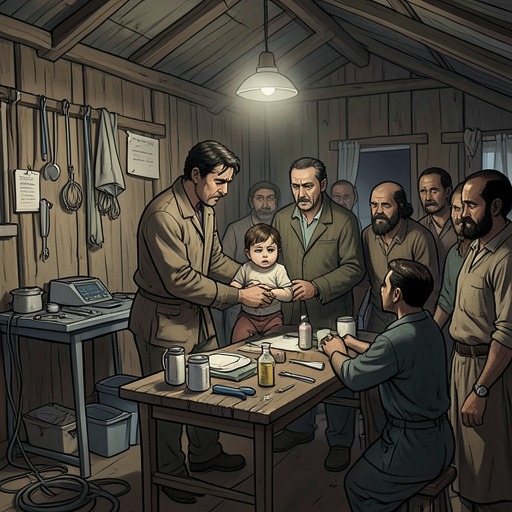
As evening comes, the work changes from containing the fire to caring for those hurt by it. Qasim calls for lamps, and the open-air clinic takes shape around Lin’s first-aid kit. Johnny Cigar and Prabaker assist as translators and nurses while Lin treats the injured. Qasim’s decisions have helped create the conditions for Lin’s new role in the slum. Lin had trained in first aid as a teenager and later used his skills in emergencies, but he does not consider himself a doctor and protests when others treat him as one. The clinic nonetheless becomes a practical response to community need, not a position Lin set out to claim.
Qasim’s leadership again becomes explicit during the cholera outbreak. After an official from the Bombay Municipal Corporation’s Department of Health has examined the settlement, Qasim takes control of the local response and declares his home a command centre. About twenty residents gather there to plan how to purify the water, beginning with the holding tanks and then addressing the pots and buckets in the settlement’s seven thousand huts. He gives Johnny a thick bundle of rupee notes to buy purification tablets and other medicines. The scale of the task is immense, but Qasim’s first move is to make it a shared undertaking with specific responsibilities and supplies.
His attention to continuity extends beyond immediate emergencies. Over breakfast, he and Lin sort medicines and bandages delivered from the leper camp. Qasim cannot read or write English, so he asks Lin to explain the medicines and their uses. His son Ayub writes their names and descriptions in Urdu on small scraps of paper and labels the containers. Qasim has chosen Ayub to learn the work and eventually replace Lin when Lin leaves the slum. The arrangement shows Qasim thinking past the present clinic: care must be made teachable and able to continue after its current provider is gone.
Justice and Restoration
Qasim’s authority includes discipline, but he rejects punishment as an end in itself. When two young men have harmed people across the slum’s religious communities, he silences the gathering and rebukes them for injuring their own people. His argument is grounded in shared vulnerability: the poor already face enough enemies outside the settlement, and internal conflict threatens everyone. He makes the young men answer not only for a private quarrel but for the harm done to the community that depends on living together.
The same restorative principle appears in the community’s treatment of Joseph after his brutal, drunken attack on his wife. After Joseph has been beaten and chastised by his neighbours, Qasim approaches at the point when the punishment gives way to care. The men who had struck him cradle and wash him; residents give him water, comb his hair, offer kind words, and tell him that genuine remorse can be met with forgiveness and help. Joseph is made to touch the feet of those he has wronged and is dressed in a clean shirt. Qasim stays close and looks into his eyes as this change from punishment to possible repair takes place.
Qasim explains the principle behind that sequence: justice must be both fair and forgiving, and it is incomplete if it satisfies only those who punish. The wrongdoer, too, must be given a chance to be saved. That standard is not permissiveness; Joseph has been held accountable, and the young men have been publicly confronted. But Qasim’s measure of a judgment includes what happens after the offense. Years later, Joseph has stopped drinking, regained his wife’s love, and earned the respect of his neighbours through sustained work for his family and community. When Qasim is away, Joseph is accepted without opposition as temporary head man. His later responsibility gives a concrete consequence to the possibility of reform that Qasim’s approach had preserved.
Relationships and Continuing Work
Qasim’s dealings with Lin combine practical trust with hospitality and instruction. He asks Lin to give an honest opinion about whether life among the city’s poorest people can teach someone something, suggesting that he regards the slum not simply as a place of need but as a community with knowledge worth encountering. On another visit, he offers Lin chai and leads a conversation about religious and communal tensions, the still-unfinished twin towers, and the upcoming weddings of Prabaker and Johnny Cigar. When Lin is sombre, Qasim directs him toward the wedding preparations, where neighbours are building a ceremonial tent and stage. Community life, in Qasim’s world, continues alongside grief and political strain.
His authority does not require him to be present at every later moment. During a six-month holiday in his home village in Karnataka with most of his family, Joseph serves as the slum’s head man. Residents report that the settlement has survived the latest monsoon with little damage and no serious outbreaks of illness. Qasim is also described as well and in good spirits after the birth of his fourth grandson. When Lin returns, he pays Qasim a courtesy visit and accepts the chai offered to him. These details place Qasim within a community whose routines and responsibilities persist during his absence, while also showing that his own life includes family and a home village beyond the slum.
Narrative Role and Significance
Qasim’s clean, freshly washed and ironed clothes become a visible sign of the integrity the residents associate with him. He changes them twice a day, and the narrator contrasts this care with the vanity that similar habits might suggest in a less respected man. In the slum, the white clothes signify moral steadiness, a quality residents depend on as urgently as they depend on water from the communal well. The image links personal discipline to public trust without making Qasim’s authority merely symbolic: his standing is continually tested through decisions about shelter, conflict, illness, and responsibility.
Near the end of the supplied narrative, Lin reflects that gang leaders and killers who imagine their factions to be little kingdoms are mistaking force for genuine power. He identifies Qasim and Johnny Cigar instead as men who possess meaningful authority because they work to better the world. Qasim’s significance lies in the contrast between power that claims dominion and leadership that sustains other people. His command during fire and epidemic, his insistence on restorative justice, and his preparation for the clinic’s future all express the same ethic: the community’s survival depends not only on resisting danger but on preserving the possibility of care, accountability, and change.