Kishan Mango Kharre
ShantaramKishan Mango Kharre, the father of Prabaker Kharre and husband of Rukhmabai Kharre, is introduced as a farmer whose expansive smile contrasts with the fatigue and worry etched into his face. His significance lies not in a long sequence of actions but in two forms of care: the loving recognition with which he welcomes his son and the simple touch that prompts Lin to confront the human consequences of his past. The account of his marriage also places that warmth within a household shaped by careful work, family resources, and the uncertainties of farming.
Identity and Introduction
Kishan first appears on an ox-cart along a rambling, weedy path. A huge, café-latte-coloured ox with curved horns draws the tall basket-shaped cart, whose narrow, steel-rimmed wooden wheels rise almost to Lin’s shoulder. Kishan sits on the ox-bow yoke, legs dangling, smoking a beedie cigarette. The scene introduces him not in a formal setting but amid the practical movement of village life, travelling with the animal and cart that carry him along the path.
He is a tiny man, shorter even than Prabaker, with close-cropped grey hair, a short grey moustache, and a prominent paunch on an otherwise slender frame. His white cap, cotton kurtah shirt, and dhoti mark him as a farmer. The description of the dhoti lingers beyond its practical uses: it can be gathered for field labour or loosened into trousers, and its changing folds follow the body through movement and stillness. That attention makes Kishan’s clothing part of the account’s larger portrait of work and rural life, rather than a detachable costume detail.
Family and Marriage
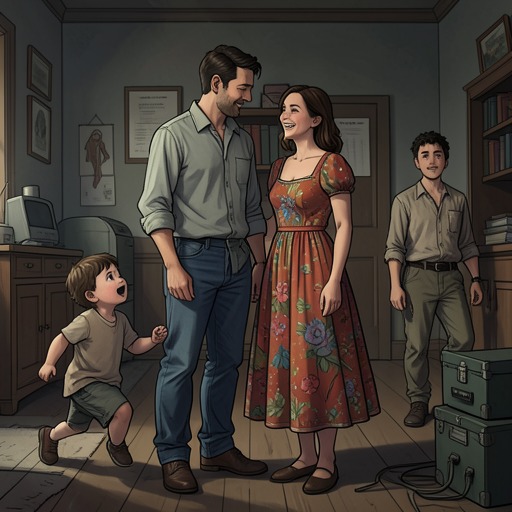
When Prabaker runs to him, Kishan springs down from the yoke and embraces his son shyly. His smile is vast enough to fill his whole face, and Lin sees in it a striking resemblance to Prabaker’s own expression—an almost doubled smile, with the father’s seeming an even grander version. Meeting them side by side, Lin finds himself grinning in response. Their physical resemblance is equally clear in their nearly round faces and upturned, button noses, though the difference in their expressions is important: Prabaker appears open and unlined, while Kishan’s face bears deeper wrinkles and, when he is not smiling, a weary shadow.
The account of Kishan and Rukhmabai’s marriage begins with that smile. Rukhmabai first sees him while hiding behind a curtain. Although she is convinced he cannot see her, Kishan looks directly toward her hiding place and smiles. The smile reassures her; she finds herself smiling back and comes to love him for its warmth. She offers no objection when her father announces their marriage arrangement. Within two months of that first glimpse, she is married and pregnant with their first son, Prabaker. Kishan’s smile thus becomes more than a family likeness: in Rukhmabai’s recollection, it is the first sign of the trust and affection on which their marriage begins.
Work and Household Prosperity
The couple’s household grows through land, record-keeping, and careful decisions. At the time of their marriage, Kishan’s father gives the eldest son two fertile fields, and Rukhmabai’s father adds a third to the couple’s endowment. Rukhmabai takes charge of their small wealth and uses her literacy to keep meticulous accounts of profits and losses in school exercise books, tied together and stored in a zinc trunk. Kishan is part of a shared family enterprise whose material foundation is described concretely: land, crops, livestock, and savings.
Investments in neighbours’ enterprises and careful management keep losses few. By the birth of their third child, when Rukhmabai is twenty-five, the couple has become the village’s wealthiest household. Their holdings include five fields planted with cash crops, three milking buffalo, three oxen, two milking goats, and a dozen laying hens. They also have enough money in the bank to provide substantial dowries for their two daughters. The narrative gives particular attention to Rukhmabai’s financial skill, while Kishan’s family provides part of the land that makes the household’s growth possible. Its prosperity is presented as collective and practical, rooted in resources that must be managed and protected.
Kishan’s Touch and Lin’s Awakening
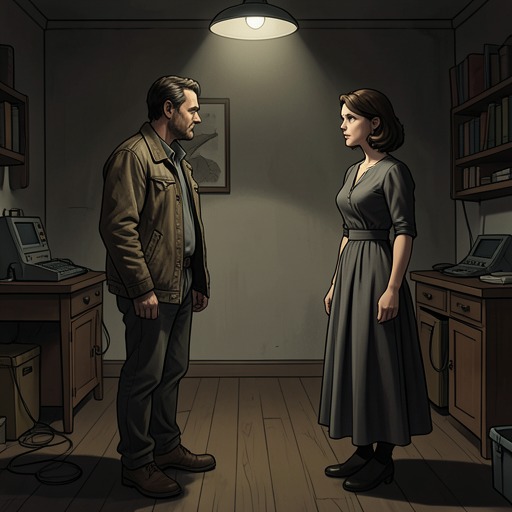
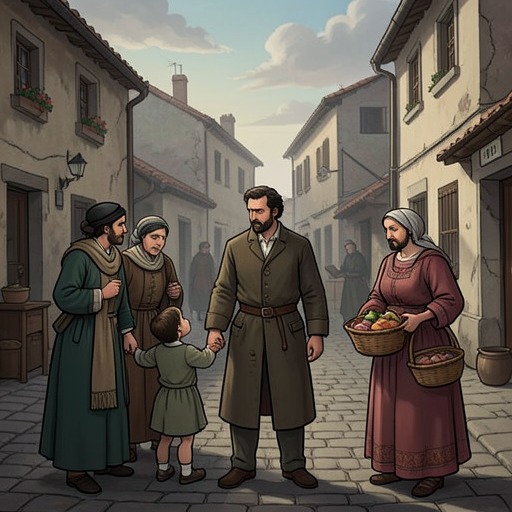
On Lin’s first night in the village, Prabaker explains that his family and neighbours worry Lin will feel lonely, far from his own family. They gather around his low bed and keep a vigil until they believe he is asleep, forming a protective circle. Kishan reaches out from Lin’s left and rests a hand on his shoulder. The gesture is simple, but it abruptly interrupts Lin’s drift toward sleep and brings memories of his daughter, parents, and brother, together with the crimes he committed and the loves he betrayed and lost.
Lin recognizes that he had not truly grasped what those crimes had done. Heroin had clouded his experience of the armed robberies; later, during the trial and three years in prison, he had been absorbed in being punished. Even his escape and life as a hunted fugitive had not given him a full understanding of the acts and consequences that shaped his life. Kishan does not deliver a speech or offer a solution. His hand, placed amid the family’s quiet vigil, is the immediate circumstance that breaks through Lin’s emotional distance. In the contrast between the ease of this kindness and the weight of Lin’s memories, Kishan’s brief appearance becomes a turning point in the account of Lin’s growing awareness of responsibility and loss.