Kano
ShantaramKano is a performing bear whose attachment to his handlers turns an animal-welfare operation into a perilous escape. After officials seize him under a policy against cruelty to dancing bears, his distress and the handlers’ loyalty set off a chain of events that brings him into hiding, disguises him as Ganesha, and leaves his eventual fate uncertain.
Identity and Capture
Kano is known to Lin as a bear who has been jailed before, but this time he is held in an animal jail after the Wildlife Protection Authority captures him under a new policy intended to stop cruelty to dancing bears. The policy, as explained to Lin, fails to account for the particular bond between Kano and the men who work with him: they regard him as a much-loved companion, and he is attached to them in return.
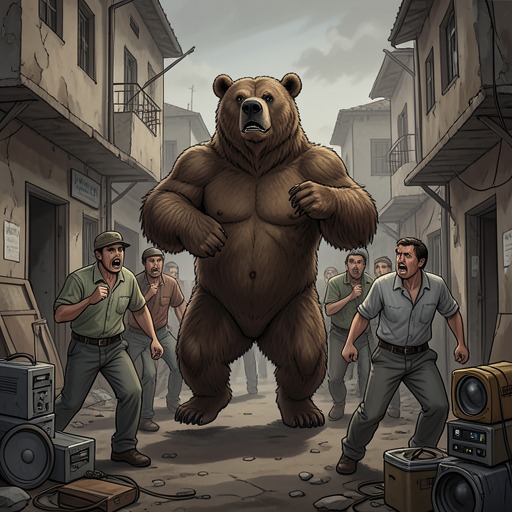
When the handlers gather outside the jail, Kano cries for them and they cry for him. Two watchmen, upset by the scene, beat the handlers with lathis. Seeing them attacked, Kano breaks out of his cage. The handlers then fight off the watchmen and flee with him. Their rescue is an act of reciprocal attachment: Kano’s escape follows his response to their danger, and their flight follows their determination not to leave him behind.
Hiding and Planned Escape
Kano and his handlers hide in a hut in the slum that had once been Lin’s home. With a wanted notice out for both the bear and the men, the group cannot simply walk them out of the city. A truck is waiting at Nariman Point, and its driver has agreed to take Kano and the handlers away. The immediate problem is moving him from the slum to the truck without their being captured.
The Ganesha Disguise
To conceal Kano, Rakeshbaba and the others prepare an elaborate figure of Ganesha. A huge elephant head is fitted over the bear’s head and set above a rounded pink body with attached arms. Light-blue silk covers the base on the trolley, while garlands of flowers conceal the join around the head. The result is not merely a covering: the assembled figure makes Kano appear to have been transformed into the elephant-headed god.
The disguise remains vulnerable to the animal within it. When the group sees the completed figure, Kano turns his head at the sound of a voice. The movement is recognizably that of a bear rather than a person, and the onlookers recoil in surprise. The episode makes the disguise both ingenious and precarious: its success depends on concealing a living animal whose actions cannot be fully made to resemble a statue.
Uncertain Fate and Narrative Significance
Kano’s last relevant appearance in the supplied account does not confirm whether the escape succeeds. Later, after Lin has been badly injured, he murmurs a hope that Kano got away. That wish returns the story to the bear’s unresolved vulnerability: the handlers have found a way to resist the authorities’ custody, but the account leaves the outcome open.
Kano is not only a figure around whom human loyalty gathers. His escape is prompted by his own response to the handlers’ suffering, and his movement disrupts the human plan to pass him off as an inanimate religious image. The disguise reveals the limits of control: even at the center of an elaborate human scheme, Kano remains a living animal whose actions matter to what happens next.