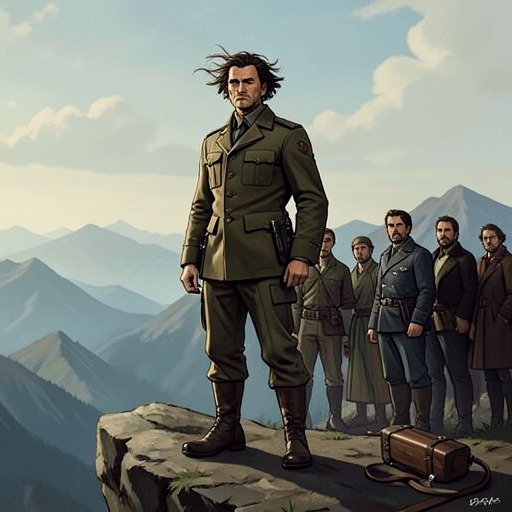
Mackenzie Esquire
ShantaramMackenzie Esquire, remembered by Abdel Khader Khan as his first teacher and a dear friend, connects Khader’s education to the contested history of Afghanistan. His lessons shaped Khader’s understanding of that history, while a family connection to the wars he taught gave their friendship an unusual intimacy: their ancestors had fought on opposing sides.
Identity and Place in Khader’s Life
Khader identifies Mackenzie Esquire as his first teacher and recalls him with affection. Their relationship was not limited to formal instruction. Mackenzie became Khader’s friend, and Khader later imitated one of his habitual sayings, a small sign of how a teacher’s manner could endure in a student’s speech.
Mackenzie’s importance also appears in Khader’s account of seeking knowledge beyond what he had learned from him. When Khader’s studies of philosophy and religion led him to questions requiring scientific expertise, Mackenzie’s teaching in that area proved elementary. Khader then sought help from Wolfgang Persis, a physicist at the Bhabha Atomic Research Centre in Bombay. The distinction leaves Mackenzie’s role clear: he was the formative teacher who opened a path of learning, not the source of every answer Khader later pursued.
Teaching and Historical Memory
Mackenzie taught Khader about the wars between Britain and Afghanistan, bringing particular knowledge and fascination to the subject. That interest was personal as well as scholarly. Mackenzie was the grandson of a man who had served in the army of Lord Frederick Roberts; Khader’s own kinsmen had fought against that army in the Second Anglo-Afghan War.
The family histories met in the explanation of Mackenzie’s saying, Bobs your uncle. He had told Khader that it came from Lord Frederick Roberts, whom British soldiers called Uncle Bobs because they believed that, under his command, things would go well. Once Khader learned the expression’s origin, he stopped using it. A casual phrase had carried the memory of a commander associated with the deaths of Khader’s people; understanding its history changed its meaning for him.
Friendship and Narrative Significance
Khader’s recollection holds the teacher’s affection and the history of violence together without treating either as an abstraction. He describes Mackenzie as a friend even though their grandfathers’ generation had fought across the divide of the Anglo-Afghan wars. Their relationship thus gives Khader’s account of national history a personal scale: the past is present not only in battles and inherited losses, but also in the friendships made by people whose families once stood on opposing sides.
Mackenzie is recalled through Khader’s narration rather than presented as an active participant in the main action. The recollection deepens the portrait of Khader as a student who retained his teacher’s words, pursued knowledge beyond their limits, and could recognize the painful history embedded in an everyday expression. His place in the narrative rests on that lasting intellectual and personal influence.