Jeetendra
ShantaramJeetendra’s story turns on a devastating double recognition: he is Lin’s vulnerable neighbor, bereaved husband, and father, but also Jeetudada, the killer who operated under the name Sapna. The later revelation does not erase the life Lin knew in the slum; it makes that life harder to read, placing ordinary grief and community belonging beside a concealed history of organized violence.
Identity and Introduction
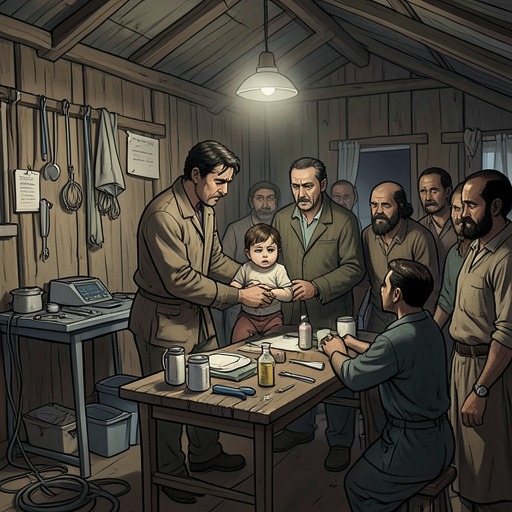
Jeetendra enters the narrative as a neighbor who calls for Lin when his wife, Radha, becomes dangerously ill. He clambers over rocks to find him, frightened and short of breath, and explains that Radha has fever, vomiting, and severe diarrhoea. The urgency of his appeal establishes a domestic life at the story’s center: Jeetendra is not introduced through the criminal world but through his dependence on a neighbor’s help.
At home, Radha lies on a thin blanket, while Jeetendra’s mother, Chandrika, tries to care for her. Jeetendra explains that the illness began two days earlier. He had tried three times to get Radha admitted to hospital, but each attempt failed. After waiting six hours among other sick people, he brought her home when she begged to leave. His account makes clear that he did not simply overlook her illness or refuse help; he had repeatedly sought care in a system too overcrowded to receive her.
That first portrait also places Jeetendra within the slum’s dependence on informal relationships. He searches specifically for Lin, whose clinic and medical assistance have made him a resource for neighbors. Jeetendra’s distress becomes a measure of how urgently the community needs care, and of how little formal help is available when Radha’s condition worsens.
Radha’s Death and Jeetendra’s Grief
The illness is identified as cholera as it spreads rapidly through the settlement. By nightfall there are ten serious cases and twelve more suspected; by the following dawn, sixty people are in advanced stages and as many as a hundred show symptoms. Radha is the first victim to die. Her death turns Jeetendra’s earlier plea into the beginning of a bereavement that will shape his subsequent appearances.
In the immediate aftermath, Jeetendra sits outside the huts with his face in his hands, overwhelmed by grief. Lin, occupied with the emergency, asks him to make large purchases and check pharmacies for oral rehydration treatment. The errand gives him a concrete task amid the crisis, but Lin also worries about him and about his young son, Satish, who is ill. Jeetendra’s grief is shown not as a resolved episode but as part of a household suddenly left exposed: Radha is dead, Satish is sick, and Jeetendra must continue to act while mourning.
The epidemic also leaves a mark on the way the narrative measures its own community. Jeetendra’s repeated efforts to get Radha treated contrast with the hospitals’ refusal to admit her, while the illness moves from one hut to scores of cases. His family’s loss is therefore both intimate and part of a wider emergency in which overburdened medical services and the slum’s precarious circumstances compound one another.
A Neighbor Rejoins Community Life
Jeetendra appears again among Lin’s former neighbors at a gathering in Qasim Ali Hussein’s home. The meeting is described as genial, with conversation ranging from religious and communal tensions in the city to construction, family, and the upcoming weddings of Prabaker and Johnny Cigar. Jeetendra’s presence there places him back within the familiar network of men whose company gives Lin confidence. He is not presented as an outsider to the neighborhood or as a conspicuous figure in the gathering.
Later, Jeetendra supervises construction for the wedding celebrations. Johnny Cigar and other neighbors are raising a shamiana and building a stage; Jeetendra directs the stage work. His once-familiar paunch has diminished, but his eyes are bright and his smile no longer seems forced. The change is carefully qualified: he has recovered from the grief that had enfeebled him, but recovery does not mean that loss has vanished.
Satish, too, remains visibly affected by Radha’s death. While helping with the preparations, he accepts a hundred-rupee note from Lin and returns to cutting coconut-fibre rope for the bamboo supports. His face takes on a numb expression that Lin recognizes as the look of someone whose trusting happiness has been damaged. Jeetendra’s household thus appears in two different stages of grief: the father has regained some hope and activity, while the son still carries the shock of losing his mother.
At a later gathering, the account of the slum’s survival through another monsoon records that Jeetendra has continued to work, pray, and laugh. He has vowed never to remarry. Satish, after a period of being sullen and quarrelsome, becomes engaged to a girl he has known since childhood in the settlement. The couple are still too young to marry, but their betrothal gives them joy and offers Jeetendra a reason to look toward the future. These details make his life after Radha’s death a gradual, unfinished recovery rather than a simple return to what came before.
The Jeetudada and Sapna Revelation
Much later, Lin asks who the real Sapna was and who had carried out the killings associated with Abdul Ghani. Nazeer supplies the answer: the man’s name was Jeetendra, and he was known as Jeetudada. Ghani had brought him from the Delhi area with four other men and kept them in five-star hotels for two years. The information identifies the previously familiar neighbor with the hired gunman behind the Sapna killings.
Salman adds that Jeetudada had been carrying out the Sapna role for nearly two years. After Abdullah was killed and others began saying that Sapna was dead, Jeetudada became drunk and started claiming to be the real Sapna. He also threatened to disclose who had planned and paid for the killings. The assumed identity had become entangled with the man himself: Salman describes him as beginning to believe his own claims, or Ghani’s version of them. Jeetendra’s concealed role was therefore not merely a name attached to an operation; the account suggests that maintaining it had altered his grasp of the story he was acting out.
The men learned of Jeetudada’s disclosure while he was at a bar in the President Hotel. He was warned to stop talking, but said that he was not afraid of Abdel Khader Khan and threatened him as well. After he began waving a gun, one of the men present alerted Abdel Khader Khan. Abdel Khader Khan went with Nazeer, Khaled Ansari, Farid, Ahmed Zadeh, Andrew Ferreira, and others to confront Jeetudada and his associates near the hotel car park.
A shoot-out followed. Two members of Abdel Khader Khan’s group were hit; Ahmed Zadeh helped get one of them to hospital. Jeetudada and three of his men were killed, with Abdel Khader Khan firing the final shots. A fifth man was absent from the car park, escaped, and was never traced after returning to Delhi. Salman says Jeetudada was responsible for eleven killings and had nearly escaped identification. The revelation therefore establishes both the scale of the Sapna operation and its violent end, while leaving one participant unaccounted for.
Narrative Significance
Jeetendra’s double identity changes the significance of his earlier appearances without making them false. The frightened husband who sought help for Radha, the father grieving with Satish, and the supervisor helping build a wedding stage all belong to the same character whom Nazeer later names as Jeetudada. The narrative places those lives beside one another rather than offering an explanation that resolves their contradiction.
That contrast also unsettles the apparent boundary between the slum’s everyday community and the criminal networks operating around it. Jeetendra can be recognized as a neighbor and participate in shared work, while elsewhere he is a hired killer carrying out an identity constructed for a campaign of murder. His eventual exposure comes through retrospective testimony from men who knew the operation, not through Lin’s earlier knowledge of him. The delayed account forces the reader, like Lin, to reconsider how much a familiar place and an ordinary social role can conceal.