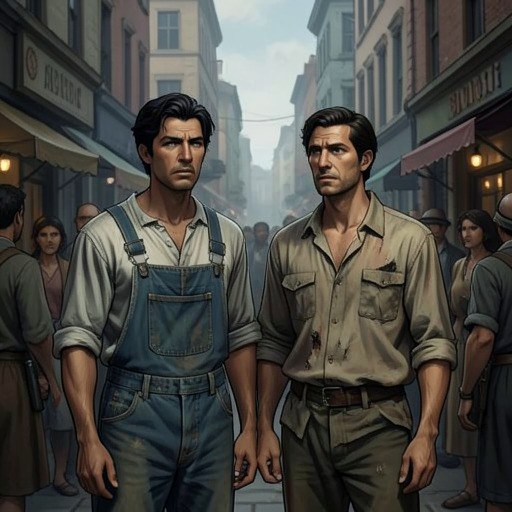
Mahmoud Melbaaf
ShantaramMahmoud Melbaaf is an Iranian exile who joins Abdel Khader Khan’s Afghan supply mission after escaping political imprisonment and rebuilding his life in Bombay. His history of resistance and loss helps explain his allegiance to Abdel Khader Khan, but his defining role in the mission is practical and humane: he works beside the fighters, translates for Lin, tends the wounded, and shepherds survivors through a dangerous recovery. His quiet loyalty gives the novel a measure of care amid the violence of war and organized crime.
Identity and Background
Mahmoud is thirty years old when Lin first meets him during the group’s journey through Karachi. Lin initially mistakes his resemblance to his dead friend Abdullah Taheri for a sign of likeness, then notices the differences in Mahmoud’s face. The recognition briefly sharpens Lin’s grief and his guilt about Abdullah’s lonely death; Mahmoud’s presence thus enters the story first through the emotional wound he unintentionally recalls.
His own losses are political and familial. As a boy, Mahmoud’s parents were killed in prison after opposing the Shah. When he grew up, he joined the struggle against the Pahlavi regime, was imprisoned twice, and endured beatings and electric torture. The revolution drove the Shah from power but did not end the abuses: the SAVAK personnel who had served the old regime continued working under Ayatollah Khomeini’s government. Mahmoud was imprisoned and tortured again, while his friends died in prison or in the war against Iraq. He escaped Iran and made a living in Bombay through black-market business with other Iranians.
Joining the Mission
Mahmoud recounts that he was conducting passport business with a friend on a Bombay street when Abdullah approached him and said Abdel Khader Khan wanted to meet. Mahmoud went with Abdullah, rode with Abdel Khader Khan, and, after their conversation, joined his organization. He regards Abdel Khader Khan as the one great man he had encountered. When he speaks of the Khan’s death, his emotion interrupts the account; his allegiance is personal as well as political.
The mission brings together about thirty men, with the core party including Lin, Khaled Ansari, Nazeer, Ahmed, Mahmoud, and Abdel Khader Khan. Its members come from Afghanistan, Iran, Palestine, Algeria, New Zealand, Morocco, Tunisia, Pakistan, Iraq, and the Gulf, while the Afghan fighters themselves represent different regions and ethnic groups. Their destination is the resistance near Kandahar. Mahmoud understands that this is not a simple alliance against a common invader: Afghan factions continue to fight one another, while Pakistan seeks influence over the postwar settlement and favors leaders rejected by the forces receiving the group’s supplies. His observation that the Afghans will defeat the Russians yet continue fighting captures the mission’s entanglement in a conflict with no easy political end.
Work and Companionship in the Mountains
For two months, Mahmoud and the others work daily among the fighters. Lin’s account of the camp records the labor that sustains the mission: repairing and modifying weapons, gathering fuel, carrying water, digging latrines, caring for animals, preparing food, and tending minor injuries with the First-aid kit. Mahmoud is part of this shared routine rather than a distant observer. In the evenings, the men sing softly, exchange stories translated by Khaled, Mahmoud, and Nazeer, and gather around their memories of home. Lin kneels silently when they pray. The group’s common life makes Mahmoud’s later care for Lin part of an established practice of mutual dependence, not an isolated gesture.
His attention is particularly evident after Abdel Khader Khan’s burial. Mahmoud tends the ceremony with such gentleness that Lin begins to cherish him as a friend. Nazeer, by contrast, is consumed by shame at having survived the Khan without being wounded; grief and exhaustion leave him seriously ill. Lin can see the damage but does not know that Abdel Khader Khan had given Nazeer a final instruction to kill a man in the event of his own death. Mahmoud’s steady presence around the bereaved group stands against the destructive force of that undisclosed obligation.
Care, Translation, and Survival
During the later crisis in the mountains, Mahmoud translates Habib Abdur Rahman’s account of the enemy positions and the limited escape route. The information reveals that the surrounding forces have mined the easiest exits and that the apparently open southeastern route is dangerous because Russian troops hold the valley. Mahmoud adds the practical assessment that going that way would expose the group to the forces expected to arrive there. Translation in this scene is a survival skill: it lets Lin understand both the proposed opening and its cost.
Mahmoud’s care becomes still more immediate when Lin wakes after the fighting. Nazeer has insisted that Lin’s injuries be treated and that his fingers not be cut off. Mahmoud tells Lin what Nazeer did, returns Lin’s Stechkin APS pistol, and keeps it for him when Lin cannot yet hold it. For the next six weeks, Mahmoud guards Lin and the other vulnerable survivors as they move between tents, slum huts, and hidden rooms. The Inter-Services Intelligence is interested in foreigners entering Afghanistan without authorization, and Lin’s identity as an escaped Australian convict makes discovery especially dangerous. Mahmoud’s role is therefore not simply nursing: he helps keep the wounded man concealed while they recover.
Later Loyalty and Narrative Significance
Mahmoud remains present when the conflict returns to Bombay. During the assault at Chuha’s hideout, Lin recognizes Mahmoud among the men arriving with the others. After the fighting, Mahmoud pulls Lin away from the violence and tells him that Salman Mustan and Raj have been lost, while Amir is badly wounded but alive. His report marks the cost of victory: the Sapna killers are defeated, but the old Khader council has effectively ended with Salman’s death. Mahmoud carries the news without turning it into triumph, as Lin sees the surviving men crying.
Later, after the survivors have made their way back into the city, Mahmoud leads prayers at Haji Ali Shrine. Lin walks with Mahmoud and Abdullah across the bay, and Mahmoud kneels at the front of the gathered group, speaking the prayer for the men behind him. This closing image gathers the strands of his characterization: the political exile who joined through a street-level encounter, the comrade who endured the Afghan mission, and the caretaker who answered grief and danger with service. Mahmoud’s significance lies less in command than in the continuity of that care, carried from the mountains into the aftermath of the gang war.