Doctor Hamid
ShantaramDoctor Hamid is a physician whose work links Lin’s informal clinic in the Colaba hutments to the formal medical system. He arranges free consultations and hospital treatment for residents who cannot afford the referrals they need, and later assists during a cholera outbreak. His importance lies not in a grand intervention but in the practical bridge he makes between charitable care, public hospitals, and an underserved community.
Background and Medical Work
Doctor Hamid works at Bhatia Hospital, a modern institution endowed by charitable Parsee trusts. Its large building contains expensive wards for wealthy patients as well as free treatment centres for the poor. He is on duty there two days a week; the rest of the time, he sees patients at his surgery in Fourth Pasta Lane, close to the Colaba clinic.
His medical career is part of Abdel Khader Khan’s longer effort to educate gifted children from the city’s slums. More than twenty years earlier, Hamid was among those selected for support: the children were funded through secondary and tertiary studies and encouraged toward professional careers. Some became physicians, surgeons, nurses, teachers, lawyers, and engineers. Hamid’s presence in the city’s medical system is thus also the result of a planned return of educational opportunity to communities that had produced talented children but lacked resources.
A Referral Route for the Hutments
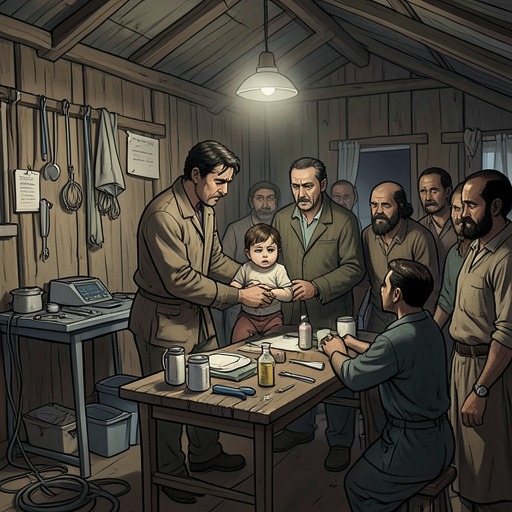
Abdullah brings Lin to Bhatia Hospital to meet Hamid. Lin is introduced as the doctor in the Colaba hutments, but immediately resists the title: he has only been drawn into helping and does not consider himself properly trained or very competent. Hamid does not dwell on the distinction. He has heard from Abdel Khader Khan that Lin is troubled by the referrals he has been making to St. George Hospital, and turns the meeting toward the problem those referrals expose.
Lin explains that he is working with limited knowledge. When he cannot identify an illness, he sends patients to St. George, but many return without having seen a doctor or nurse. He insists that the residents are genuinely ill and do not ask for help lightly. Hamid asks whether Lin has spoken with the hospital directly. Lin has gone there twice and been told that staff are overwhelmed. The hospital sees about six hundred patients a day, sometimes as many as a thousand; Lin’s small clinic sees about fifty. The public hospital’s overcrowding is not presented as indifference: Lin believes its staff are doing what they can, but the residents lack the money to see a licensed doctor and obtain the referral that might help them move through the queue.
Hamid offers a workable alternative. Residents can be referred to his practice in Fourth Pasta Lane, and he will arrange treatment at St. George when he considers it necessary. His services for Lin’s patients will be free. Afterward, he explains the procedures Lin should follow. The arrangement does not remove the shortage of hospital capacity or make Lin a trained physician; it creates a dependable point of contact where previously the referral system had repeatedly failed the poorest patients.
Care, Fatigue, and Community
The meeting also presents Hamid as one of the health professionals whose work sustains the city under pressure. After an hour of discussion, Lin notices the exhaustion in Hamid’s lined face and reddened eyes. Lin believes that Hamid could have accumulated wealth and lived in luxury through private practice abroad, but instead has chosen to work among his own people for a fraction of that reward. The narrative measures his achievement both by what he accomplishes and by what he has forgone.
Hamid’s service is connected to the community through more than geography. His own early life included residence in a slum, and his education was enabled by Abdel Khader Khan’s support. When that network later helps Lin’s clinic, the assistance is described as the return of obligations built over years: education has produced professionals who can respond when their former communities need care. Hamid is not shown as acting alone, but as a participant in a wider chain of investment and reciprocity.
The Cholera Emergency
During a monsoon cholera outbreak, Hamid stands with Lin, Abdullah, Prabaker, and Qasim Ali Hussein as a Bombay Municipal Corporation health official examines the settlement. The outbreak is part of a broader regional emergency: the official reports twelve other sites between the settlement and Kandivli, alongside a severe outbreak in Thane, where more than a hundred new cases are appearing each day. Local hospitals are already overcrowded.
Hamid is among those assessing the situation, and the public-health official responds to his medical judgment. When asked what help the authorities can provide, the official says trained volunteers will be arranged but warns that immediate assistance will be limited. Oral rehydration salts are already available through the network associated with Abdel Khader Khan’s lepers; Lin explains that the supplies came with instructions for their use, although some patients are too ill to keep them down. The episode shows both the value and the limits of Hamid’s professional presence: he can contribute medical judgment and help organize a response, but the scale of illness exceeds the resources available.
Narrative Significance
Doctor Hamid provides a counterpoint to Lin’s improvised medicine. Lin’s first-aid training and experience treating overdoses have made him useful in the settlement, but he knows that his knowledge is inadequate for many illnesses. Hamid neither humiliates him for that limitation nor treats the clinic as a substitute for professional care. Instead, he listens to the circumstances of failed referrals and establishes a route to further treatment.
Through Hamid, medical care appears as both an individual practice and a structure shaped by poverty, access, and collective responsibility. The contrast between wealthy hospital wards and free treatment centres, between six hundred or a thousand patients a day and a small clinic’s fifty, makes clear why a formal system alone cannot meet every need. Hamid’s work connects that system to residents who otherwise risk being turned away, while his fatigue and modestly rewarded service make the city’s dependence on such professionals visible.