Dominick Corvaisis
StrangersDominick Corvaisis’s story turns an apparent private disorder into a route back to a suppressed shared history. A writer who wakes in closets, finds unexplained words on his word processor, and fears losing the life he has built, he follows those disturbances from his home toward the Tranquility Motel and the buried events of July 6. His path from involuntary actions to deliberate use of telekinesis makes bodily control, memory, and responsibility inseparable: what first appears to be a symptom becomes evidence of what was done to him and, eventually, a means of acting on behalf of others.
Identity and the Life He Fears Losing
Dominick is a writer working on a new, as-yet-untitled book. The typewriter has become a word processor: when he calls up chapter eighteen on his IBM Displaywriter, he finds that the document has grown beyond the point where he left it. A full page of unfamiliar green text has appeared where he remembers only half a page. The machine, ordinarily an instrument of deliberate composition, is already registering activity he cannot remember performing.
The disturbance threatens a life Dominick has struggled to claim. At thirty-three, he looks back on the summer he spent in Utah as the point after which he changed dramatically, though he cannot explain why. He had finally taken hold of his life and moved beyond a dreary former existence; he likes the person he has become and fears falling back into the withdrawn life he left behind. That fear helps explain why he insists on staying alone in his own house rather than accepting an alternative that seems to him like retreat. His independence is not casual stubbornness: it is bound up with the hard-won belief that he has already become someone different.
Sleepwalking, Fear, and Unconscious Messages
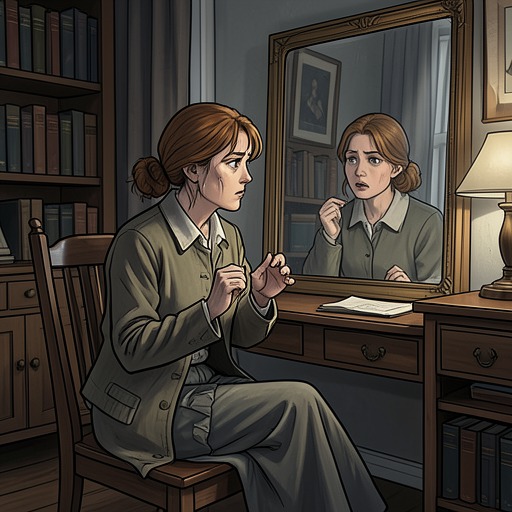
The first evidence of the problem is physical and immediate. Dominick goes to sleep in his bed beneath a light wool blanket and crisp white sheet, but wakes curled in a fetal position at the back of the large foyer closet, concealed behind coats and jackets. His fists are clenched; his neck and arms ache with the tension of a nightmare he cannot recall. His body has acted while his conscious memory has failed to accompany it. The closet offers a stark contrast to the bed where he began: he has crossed the house and hidden himself without knowing what drove him there.
The episodes recur, and the word processor gives them another outlet. On earlier occasions, Dominick has apparently gone to the Displaywriter in a night trance and typed I'm scared. Later, the words change to the moon. The messages are brief, but their recurrence gives them the force of a signal: material unavailable to his waking mind keeps entering the ordinary routines of his house and work. His nightmares, wandering, and typing do not explain themselves, yet together they make forgetting look less like an absence than like a barrier under pressure.
At first, the treatment prescribed by Dr. Cobletz seems to interrupt that pattern. Dominick commits himself to physical activity more single-mindedly, and with more punishing persistence, than the doctor recommended. He falls deeply asleep and, for one morning, does not wake in the closet. Dr. Cobletz has recently examined him thoroughly and found no signs of physical disorder, so he advises trying other treatments before concluding that a brain disorder is driving Dominick to fortify and defend himself in his sleep. When Dominick and Parker Faine visit the doctor on December 2, the possibility of a medical cause remains open rather than settled.
Dominick’s improvement is also less secure than he lets the doctor believe. He privately takes Valium on some days and sometimes two or three Dalmane tablets at night, washing some down with beer or Scotch. He withholds this because he believes Dr. Cobletz is right that the treatment is working and expects he will soon be able to stop the medication. His confidence rests on a hoped-for reprieve, not on a full understanding of what is happening. When a vividly remembered dream sends him fleeing through the house in a somnambulistic panic, the change is double-edged: he has recovered part of an episode that had previously left no conscious trace, but the new clarity arrives with terror.
The Notes and the Journey into the Past
An unsigned note gives Dominick a direction his own bewilderment cannot supply. A plain envelope with no return address contains a typed warning that the sleepwalker should search the past for the source of his problem and that the secret is buried there. The message unsettles him because it treats his sleepwalking not simply as an illness but as a clue—and implies that someone else knows enough to point him toward its origin. He rereads it repeatedly, still unable to tell who sent it or how the sender learned about his nighttime behavior.
A second anonymous message narrows the mystery to two words: The moon. Dominick is excited and frightened, but has no way to identify the sender or make a logical start on finding answers. The note seems to answer the words appearing on his Displaywriter while deepening the question of who has access to his private experiences. Its brevity turns the moon into both a lead and an image that has followed him without his understanding.
Dominick decides to retrace the drive he made the summer before last: he will fly to Dom's Portland, rent a car, and travel toward Dom's Reno, across Nevada and part of Utah on Interstate 80, then on to Mountainview. He believes that whatever traumatic episode he has forgotten did not disappear without assistance. In his view, something he saw or experienced was so shocking that it still presses through his subconscious in sleepwalking and messages, while a form of brainwashing has failed to erase it completely. He also suspects that one of the people involved is risking exposure to send him hints. The journey is therefore neither ordinary travel nor a confident investigation; it is an attempt to follow an incomplete memory while accepting that other people may have shaped what he can remember.
Tranquility and the Return of Memory
At the Tranquility Motel, the past becomes recognizable before Dominick can put it into a calm account. Standing in the place, he remembers its details and senses what seem like ghosts at the edges of his vision. The narrative identifies these not as spirits but as bad memories haunting the shadowy corners of his mind. At nine o’clock he phones Parker to report that he is on schedule and has reached the place. The simple confirmation carries a larger weight: Dominick has found the location toward which his clues have been pushing him, though the recovered past is not yet fully mastered.
His account helps connect his experience with those of the other witnesses. When Dominick finishes telling his story, Ernie Block and Faye Block share an account of their own, and Ned Sarver learns of Ernie’s fear of the dark. The sequence does not make their experiences identical; it reveals that the disturbances belong to a wider group whose members have carried different pieces of an extraordinary history. For Dominick, speaking becomes part of the investigation: private, disjointed symptoms can be compared with what others remember.
The July 6 episode returns in particularly concrete form at Zebediah Lomack’s house. Dominick had wanted to tear the paper moons from the walls as his frustration with the deepening mystery grew. In recounting the scene, Ginger Weiss explains that the pictures fell through his power, not through his hands, and that when he shouted for the movement to stop, he himself stopped it. The apparent haunting had obscured an action that was his own. This revised understanding changes the meaning of the earlier event: Dominick had not merely witnessed something beyond his control; he had exerted an ability without recognizing it.
From Unconscious Force to Deliberate Action
The change from unexplained movement to controlled action is tested in front of Ginger and the others. Dominick focuses on a salt shaker, becoming so absorbed in the ordinary object that he forgets the people watching. Instead of sliding across the table, the shaker rises and floats four feet above it. The scale of the movement matters less than its character: this is no longer an object apparently stirred by a hostile presence, but an act Dominick brings about through concentration. The onlookers’ astonishment makes visible what he has only begun to understand about himself.
He then faces a more violent version of the same problem. When chairs rattle and shakers whirl, Dominick remembers the paper moons in Lomack’s house and raises both hands toward the disturbance. He clenches his fists, shutting the red-ring marks on his palms out of sight, and commands the objects to stop. His response ties remembered experience to present choice: the fear and confusion that once accompanied his power do not vanish, but he can now act rather than simply wake afterward to its effects.
At Thunder Hill, this ability has immediate consequences. As Falkirk and Lieutenant Horner hold machine guns, both weapons wrench free of their owners’ hands and fly through the air. The force cuts Falkirk’s fingers and tears off a couple of his nails; the guns land near Ernie Block and Jack Twist, who take them up and cover the two men. Dominick’s power has become part of a group’s defense, not merely a private marvel. Later, when the elevator doors open onto the main cavern at the bottom level, he rushes toward the backpack nuclear weapon standing there. He sees the digital clock and says, “Jesus.” The evidence leaves him at the edge of that urgent confrontation, with the device and its countdown now the immediate stakes.
Relationships and Narrative Significance
Parker Faine is an important witness and companion in Dominick’s response to the crisis. He accompanies Dominick to Dr. Cobletz’s office, and Dominick keeps him informed during the journey to the motel. Parker’s presence does not solve the mystery, but it gives Dominick someone to whom he can report what he is doing rather than face every discovery alone. Ginger Weiss becomes essential in a different way: she helps interpret his recovered account of Lomack’s house, and she shares the recognition that their experiences connect them. After the summer night when they entered the ship together, Dominick understands why their response to each other was so powerful when she arrived at the Elko County airport. Their bond is grounded in a shared event that neither had been able to grasp fully.
Dominick’s arc gives the novel a structure of delayed recognition. The closet, the typed pleas, the moon notes, the remembered motel, and the moving objects are not separate curiosities; each forces a revision of what the previous signs might mean. His body acts before his conscious explanation catches up, and the story gradually turns that mismatch into evidence of erased memory and suppressed history. The movement from hiding in the dark to standing before a floating salt shaker, from trying to tear down the moons to disarming armed men, marks a real change in agency. Yet the clock on the nuclear weapon prevents that change from becoming a simple triumph: recovered ability places Dominick inside a larger danger, where understanding what happened is inseparable from deciding what to do next.