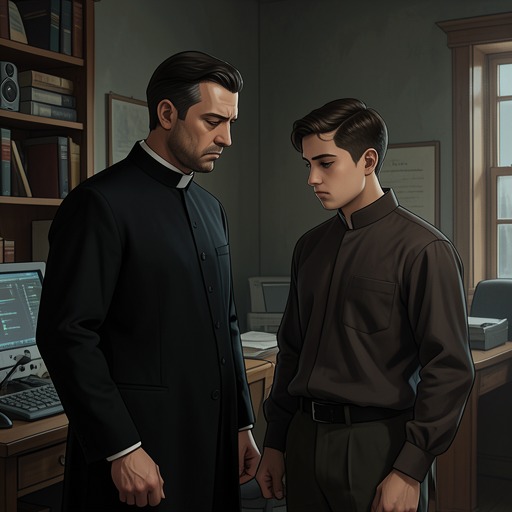
Emmeline Halbourg
StrangersEmmeline Halbourg is a ten-year-old whose sudden recovery from a crippling, apparently fatal illness becomes one of the clearest signs that Brendan Cronin’s healing has consequences beyond restoring damaged bodies. First seen at St. Joseph's Hospital for Children as a child already transformed by recovery, she later discovers a power of her own: when she concentrates on ordinary objects, they move and perform with startling precision. Her story joins a medical marvel to a new, still-unexplained ability—and makes the child Brendan had helped a witness to the widening effects of his gift.
Identity and Introduction
On Christmas Day, Emmeline is surrounded by her parents, two sisters, grandparents, an aunt, and an uncle at St. Joseph's Hospital for Children. The crowded wards are unusually bright with holiday visitors, gifts, music, and laughter, but her bedside is singled out as a particular center of hope. Her relatives welcome Father Stefan Wycazik, assuming that he is one of the hospital’s chaplains. He has come because of what he learned from Brendan Cronin, and he expects to find a child on the mend. What he sees instead is a girl who seems already well.
Only two weeks earlier, Brendan’s account had described Emmeline as crippled and dying. Now her dark eyes are clear, the pallor has left her face, and her knuckles and wrists are no longer swollen. She appears free of pain. Rather than remain in bed, she stands with crutches and moves among her admiring relatives; her wheelchair is gone. The contrast is not merely between illness and improvement: the visible signs that had defined her as a patient have given way to a child taking part in family life.
Recovery and Brendan Cronin
The change has a striking medical chronology. Emmeline had taken namiloxiprine for three weeks without noticeable effect. Then, about two weeks before the examination described by her doctors, her body entered remission and began rebuilding damaged tissue. X-rays taken across six weeks show changes in her bones and joints; tests also show that plaque which had obstructed the haversian canals—the network carrying blood vessels and lymphatics through bone—has almost disappeared. With circulation restored, the body has the conditions needed for repair.
That recovery coincides with the first appearance of the strange rings on Brendan Cronin’s hands. Emmeline had noticed the marks on December 11, before Brendan noticed them himself. Father Stefan Wycazik recognizes the timing but does not mention the coincidence. He wants to ask Emmeline whether she felt anything unusual when Brendan touched her, and to learn more about what she saw that day, but her family’s presence makes a private conversation impossible. He is not yet ready to explain why he is asking. The scene therefore leaves an important connection visible but unresolved: Emmeline’s recovery and Brendan’s emerging gift belong to the same developing pattern, though she does not yet know how.
Emmeline’s relationship with Brendan is affectionate and familiar. She knows him as Pudge, a friend who had brushed her hair while she sat in her wheelchair, not as the source of a power whose nature Father Stefan Wycazik is trying to understand. When he visits on Christmas, he carries Brendan’s greeting. The warmth of that small message sits alongside the larger mystery: the child’s cure is already changing how adults interpret Brendan’s actions, even as Emmeline experiences him simply as a friend.
The Objects in Her Bedroom
At a later visit to the Halbourg home, Father Stefan Wycazik finds Emmeline’s bedroom in the middle of an inexplicable disturbance. She is standing on her bed in pajamas, healthier even than on Christmas Day, while her frightened family watches from the doorway. Two small teddy bears waltz in midair. Roller skates travel separate routes around the room, hats jiggle on a rack, and a Care Bear bounces on a bookshelf. For Emmeline, the spectacle is beginning to seem fun; for her relatives, it is frightening and difficult to explain.
The room also carries evidence of a less playful beginning. A ceramic lamp has been knocked down and broken, a poster is torn, and the dresser mirror is cracked. Emmeline remembers that the activity was scary at first, before it calmed. The effects are therefore not simply a cheerful performance: the same unexplained force that now entertains her has already damaged her surroundings and frightened the people closest to her.
The flute makes the connection between Emmeline and the moving objects harder to miss. It rises from its open case to about seven feet above the floor and begins playing “Annie’s Song” as a composed tune rather than a scatter of notes. Emmeline recognizes it as music she used to play. She had given up the flute a year earlier because her knuckle joints had become too bad; although she is now cured, her hands are still not well enough for her to play it herself. Father Stefan Wycazik tells her that she is playing it now, but she initially denies that she is responsible.
Her attention appears to matter. When she looks away, the bears lose their graceful coordination, and the flute produces only a few poorly played notes before falling silent, still suspended but wobbling. When she looks back, it steadies and plays again. The scene does not begin with Emmeline confidently controlling a power: she first watches it as something happening around her, then recognizes her own part in it. As that recognition takes hold, she turns to her sister and parents in astonishment, repeating that it is her.
Change and Narrative Significance
Father Stefan Wycazik understands the scale of the reversal. A month earlier, Emmeline could not dress herself and seemed to have nothing ahead but worsening disability, pain, and death. Now her damaged bones have reknit, and she possesses what he recognizes as a spectacular gift. Her trajectory thus extends beyond a miraculous recovery: she moves from being the recipient of Brendan Cronin’s care to a person who may herself affect the world around her.
Father Stefan Wycazik suspects that Brendan unwittingly passed this gift to her, but explaining that theory would require him to explain how Brendan obtained his own ability. He has neither time nor a settled account to offer. With the situation in Elko County drawing his attention, he leaves without telling the family what he suspects. Emmeline remains with the floating bears, which resume their formal dance when she looks at them. Her final delight contrasts with the earlier fear and the broken objects, while her new awareness turns the room’s poltergeist-like activity into the first glimpse of an ability she had not known she possessed.
Later, operatives investigating Emmeline and Winton Tolk find that their recoveries cannot be adequately explained by current medical knowledge. A reconstruction of Father Stefan Wycazik’s Christmas Day visits confirms that he believes Brendan Cronin was responsible for the miraculous cures. Emmeline’s case therefore matters on two levels: her recovery gives the extraordinary healing a concrete medical history, and her bedroom revelation suggests that its effects may extend to powers that are not medical at all. The narrative does not resolve how her ability works or what she will do with it; it ends this part of her story at the moment she recognizes herself as its source.