Stefan Wycazik
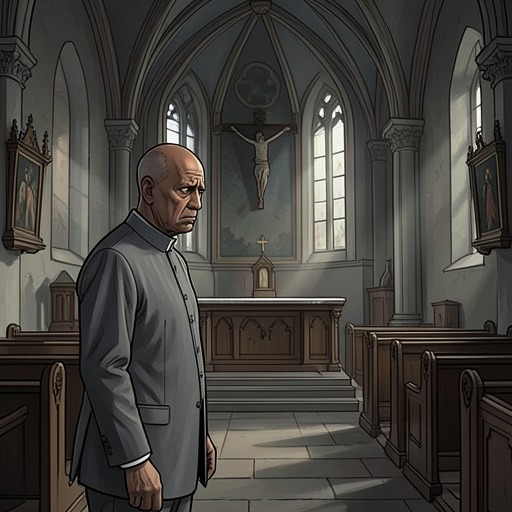
StrangersStefan Wycazik is a parish priest, seasoned troubleshooter, and mentor whose granite confidence in faith is tested by events he cannot explain. At the Church of St. Bernadette, he has made a failing parish into a thriving one; when Brendan Cronin’s faith collapses, Wycazik responds with the same combination of work, discipline, and personal care that has defined his ministry. His death at Thunder Hill leaves Brendan grieving, but Wycazik’s belief that the extraordinary can reaffirm faith continues to shape how the survivors understand what happened.
Formation and a career of service
By the time the story finds him, Wycazik has been a priest for thirty-two years and rector of the Church of St. Bernadette for nearly eighteen. Doubt is not a familiar condition to him. His confidence was built through a career in which he repeatedly accepted responsibility for difficult people and institutions, without believing that the work was beyond his capacity.
After ordination, he served as curate at St. Thomas’s, a small parish in Illinois farm country. Its elderly priest, Father Dan Tuleen, was beloved by his parishioners but troubled by arthritis and failing eyesight. The Cardinal selected Wycazik, still a rookie, because the assignment required someone able to take on more responsibility than a junior priest normally would. Wycazik shouldered virtually all the parish work. When Tuleen died quietly in his sleep three years later, Wycazik moved on to a suburban Chicago parish where the rector, Francis Orgill, was struggling with alcohol. His task was not to condemn Orgill but to support and guide him toward recovery.
During the next three years Wycazik served at two more problem-plagued churches. The archdiocesan hierarchy came to call him the Cardinal’s troubleshooter, a reputation earned through practical intervention rather than display. His most arduous assignment took him to Our Lady of Mercy Orphanage and School in Saigon, where he served for six years as second in command to Father Bill Nader. The war zone had already cost Nader two bullet wounds and the lives of two Vietnamese priests and an American predecessor. Wycazik nevertheless remained convinced both that he would survive and that his work mattered. When Saigon fell, he, Nader, and thirteen nuns escaped with 126 children. The mass deaths that followed did not persuade him that those lives were insignificant.
Back in the United States, Wycazik declined a promotion to monsignor and instead requested a parish of his own. The Church of St. Bernadette was deeply indebted, in need of major repairs, and losing worshippers; its rectory was in danger of collapse, and it had no school. Wycazik took on the challenge. Within four years he had increased Mass attendance by forty percent, cleared the debt, and repaired the church. Within five years he had rebuilt the parish house; within seven, attendance had doubled and construction of a school had begun. In recognition of this work, the Cardinal made him permanent rector, securing his tenure at the parish he had brought back from spiritual and financial decline.
Parish leadership and the bond with Brendan
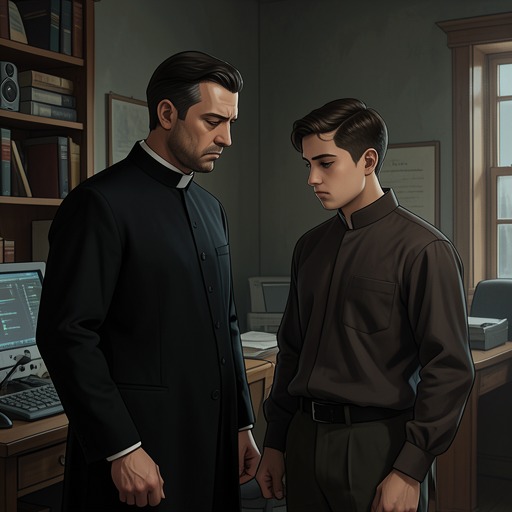
Wycazik’s confidence in his work is matched by a capacity to revise his first impressions. When Brendan arrived from Rome, Wycazik initially distrusted his appearance and worried that his plumpness and soft expression suggested an idle character. Brendan instead proved hardworking, good-natured, and unpretentious. He visited shut-ins, taught children, and solicited funds; Wycazik came to regard him as the best curate he had received in eighteen years.
That affection makes Brendan’s outburst during Mass especially distressing. Brendan has hurled the chalice in despair and lost his faith, and Wycazik cannot understand how a priest so capable has reached this point. Yet the crisis also recalls Wycazik’s earlier work with priests in trouble. He sees an opportunity to help Brendan and feels renewed purpose in taking up that role again.
Wycazik does not treat Brendan’s unexplained loss of faith as an intellectual argument to be defeated with religious reading. Because Brendan cannot identify its cause, Wycazik reasons that the problem may be psychological, with its roots in the subconscious. This interpretation offers Brendan a way to understand the crisis as a failure within himself rather than proof that God has failed him or does not exist. Wycazik proposes arranging analysis with one of two Jesuit psychiatrists who work with members of the Society of Jesus, but first asks Brendan to give him until Christmas. He promises no more pep talks or debates about good and evil, and proposes trying his own theories about psychological disorders; if Brendan remains deeply distressed, he will refer him to a psychiatrist.
The first practical step is a week at St. Joseph’s Children’s Hospital, where Brendan is to dress as a layman and work as an orderly under Dr. James McMurtry, changing bedclothes and emptying bedpans. Wycazik’s method places Brendan among suffering children rather than keeping the crisis at the level of abstract theology. Their courage moves Brendan deeply, but it does not restore his belief: he remains struck by their resilience, and the suffering still stirs the rage that had led him to throw the chalice. Wycazik’s intervention therefore offers care and a path forward, not an instant cure.
Faith amid inexplicable events
Wycazik continues to accompany Brendan through the crisis by interpreting his frightening dream of black hands as a symbolic expression of doubt and an approaching inner battle. He reassures Brendan that he will not face it alone, and insists that God is beside him as well. His certainty is pastoral rather than detached: he puts himself alongside his curate, making companionship part of his answer to fear.
His attentiveness extends beyond Brendan. During the Uptown sandwich-shop shootout, Brendan is riding with Winton Tolk and Paul as an observer, under a cover arranged by Wycazik with the local precinct captain. For five days Brendan has worn ordinary clothes and posed as a church lay consultant studying the need for Catholic charity programs. The arrangement puts him among officers and residents of a poor, crime-ridden neighborhood, and Wycazik’s support has helped make that exposure possible.
When Winton is gravely injured, Wycazik tells surgeon Bennet Sonneford that he senses a force beyond the human, a Presence whose concern is more closely tied to Brendan than to the wounded officer. He connects Brendan’s role in reaching Winton with the earlier miraculous healing of Emmy Halbourg, while taking care not to claim certainty about what the events mean. Later, asked whether Brendan is a saint, Wycazik distinguishes goodness from sainthood: Brendan is a good man, but that does not explain how he healed Winton. The question remains open even to the priest who most hopes to see divine purpose in the events.
In a call with Dominick Corvaisis, Wycazik exchanges what he knows of Brendan’s loss of faith, miraculous cures, and strange dreams for Corvaisis’s reports of poltergeist phenomena, sleepwalking, fear of darkness, lunar obsessions, and suicides. Corvaisis sees too many signs of human conspiracy to interpret the events as the hand of God. Wycazik acknowledges the force of this objection without abandoning hope that Brendan’s journey to Nevada may bring him back toward Christ. He offers help with the investigation, unwilling to remain on the sidelines if the events might involve God’s manifest presence.
That openness persists even when Wycazik considers the possibility of extraterrestrial life. He argues that a universe containing other living beings would not diminish God; a universe entirely empty of life might instead suggest that human evolution was mere happenstance. Nor, in his view, does a vastly different physical appearance exclude another species from bearing the divine image. What matters is the capacity for reason, compassion, love, and friendship. Wycazik’s account shifts the test of kinship away from bodily resemblance and toward care, intelligence, and moral relation. The argument also gives Brendan a way to reconcile a remembered encounter with beings superior to humanity with the Church’s teaching about human worth.
Death and what he leaves behind
At Thunder Hill, Wycazik is mortally wounded. Brendan kneels beside him and tries to heal him, praying with the conviction that his new power and the Virgin’s intercession might restore the rector. When Wycazik remains motionless, Brendan at last accepts that it is God’s will for him to die. He finishes the Litany of the Blessed Virgin, takes Wycazik’s limp hand in both of his, and grieves. When Leland Falkirk orders him back to the others, Brendan insists on remaining to perform the duties of a priest for a man who has died without an opportunity for confession. He no longer responds to Falkirk with fear.
Wycazik’s death does not resolve the conflict between religious faith and the survivors’ encounter with the unknown. Falkirk orders his men to bury him in an unmarked grave, treating the priest’s body as another matter to conceal. Yet Brendan’s grief and insistence on honoring him expose the limits of Falkirk’s view that Brendan’s humanity might be a deception. Later, Ginger reminds Brendan that Wycazik understood what had come down that night and regarded it as a reaffirmation of faith. Brendan answers that, for Wycazik, everything could become such a reaffirmation. The difference between them remains: Wycazik could incorporate mystery into belief, while Brendan cannot yet do so. But the message survives its bearer, leaving Brendan with the example of a priest whose faith did not require indifference to suffering or certainty about every cause.