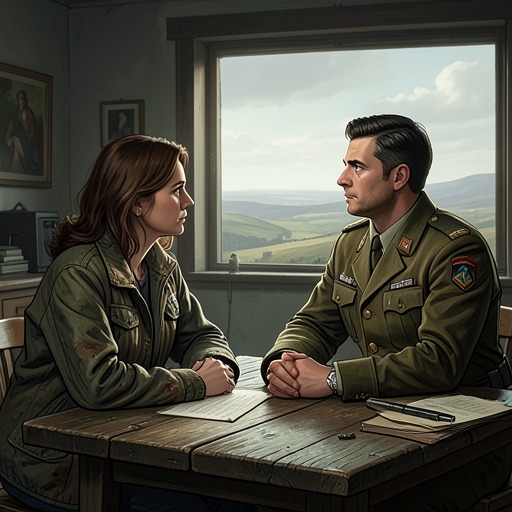
Jorja Monatella
StrangersJorja Monatella is a casino waitress and single mother whose story joins hard-won independence to the mystery surrounding the Tranquility witnesses. After her marriage to Alan Rykoff ends, she builds a practical future for herself and Marcie while confronting the damage he left behind. Her care for her daughter, and her willingness to act alongside the other witnesses, make her more than a peripheral participant in their search for the truth.
Work, Boundaries, and Independence
Jorja works as a cocktail waitress in Las Vegas, in a casino where powerful customers can treat access to a woman as another service to be arranged. High-rollers from Detroit, Los Angeles, or Dallas regularly ask pit bosses to set them up with her. A few waitresses are available to them, but Jorja refuses to join that arrangement. Her answer to the bosses is blunt: "To hell with him. I'm a waitress, not a hooker." The distinction matters to her: she is doing a job, not offering herself for sale.
The pressure is not limited to customers. In one especially charged moment, a Texan in yellow Day-Glo polyester pants approaches her without knowing how angry she is; the narration says he would not have tried to get her into bed had he known she was in the mood to castrate someone. Her fury has a deeper source than an unwanted advance. Alan is the chief cause of her foul mood, and the memories of what he did to her and Marcie outlast the marriage itself. She has reclaimed her maiden name, Monatella, but cannot simply shed those memories with Rykoff.
Jorja is not content to remain in work she once thought defined her. For eleven months she has fitted business-management courses at UNLV around an already hectic schedule. She intends first to finish paying the bills Alan left her, then to build a nest egg and open a dress shop. The plan is detailed, revised until she considers it realistic, and grounded in her confidence that she will follow through. Her ambition is not a sudden escape fantasy: it is a step-by-step project for financial independence.
Marriage, Separation, and Motherhood
Before the divorce, Jorja tried to repair the marriage through a carefully planned three-week family road trip. The summer before last, she believed that she and Alan spent too little time together: he dealt baccarat at one hotel, she worked at another, and their shifts and sleep schedules rarely matched. She hoped that an adventurous trip with Alan and Marcie would give them time together and salvage their rocky relationship. The attempt did not prevent the marriage from ending, but it shows that she had tried to address the separation rather than simply accept it.
After Alan walked out, Jorja had to manage the household and the consequences of his departure while raising Marcie. She remains protective of the girl’s experience of family life. On Christmas morning, Jorja’s parents, Mary and Pete Monatella, arrive at six, tired but determined to take their places beside the brightly trimmed tree before their only grandchild wakes. Jorja is preparing the turkey when she insists that Marcie should not lose Christmas because her father has behaved badly: "Marcie shouldn't have her Christmas ruined just because her father's a jackass." The scene places ordinary family care—presents, a holiday meal, grandparents waiting for a child to wake—against the instability Alan has brought into their lives.
Jorja’s attention to Marcie is practical as well as affectionate. When she collects her daughter from Kara Persaghian’s house, Marcie rushes out and into her arms. Later, during the journey to the Tranquility group, Jorja is alert to how exhausted the child is: Marcie dozes in her mother’s lap beneath the diner’s wagonwheel lights, with weariness visible in the rings around her eyes and the blue veins beneath her pale skin. When Jorja agrees to join an investigation team, she immediately adds that Marcie will need somewhere to sleep. Participation does not cancel her responsibilities as a parent; she negotiates the terms around them.
Marcie’s Medical Fear and the Moon
When Marcie refuses to go to a hospital, her terror is unmistakable: "I won't go to a h-h-hospital in a million years. I won't ever let those doctors touch me." Jorja recognizes that the child’s dread of physicians is unexplained, but she cannot let that fear keep Marcie from care. She plans to take her to a doctor in the morning and worries that the visit may provoke a scene. Christmas Day makes finding the right physician unusually difficult; Jorja is frightened both by Marcie’s fear of treatment and by the possibility of not seeking help.
For the next three nights, Marcie sleeps in Jorja’s bed in case an anxiety attack occurs. None does. The nightmares become less frequent and less powerful, and Marcie’s sleep-talking wakes Jorja only twice. The words remain striking—"The moon, moon, the moon!"—but the repeated cry has softened into something almost forlorn. Jorja asks why the moon interests her daughter, a question that acquires greater significance when the same fixation appears in Alan’s belongings and, as Jorja later learns, in his dreams.
Alan’s Death and the Lunar Clue
Jorja learns at the casino that Alan has killed himself. She is named executor of his will, but the more startling provision is that he leaves what he owns to Marcie, despite having been prepared to deny that he was her father. The will makes his contradictory relation to the child newly visible: his past abandonment remains, yet his final instructions direct his property to her.
At Alan’s room, Jorja experiences the space as eerie and unreal. Three things have filled her with fear; the first is a group of books on the nightstand. She sees the word moon on two spines, sorts through the half-dozen volumes with trembling hands, and finds that every one concerns the same subject. The books turn Marcie’s repeated dream-word into a possible shared pattern rather than an isolated childhood preoccupation.
Jorja has not yet told Marcie that Alan is dead. After speaking with Ted Coverly, she learns that Alan, too, had been dreaming about the moon and had independently developed an intense lunar fascination. Ted advises waiting until Monday to tell Marcie and proposes that Jorja bring her to the appointment so they can explain the death together. Jorja fears that, despite Alan’s inattention, Marcie will be devastated. She ultimately tells her the previous night, though she withholds the fact that Alan died by suicide. Marcie cries, but not for long; at seven, she understands death without grasping its full finality. The narration connects her limited grief to Alan’s earlier abandonment: for Marcie, in a sense, he had already been gone for more than a year.
On Monday morning Jorja buries Alan beneath a shifting Las Vegas sky, as shafts of winter sunshine move across the cemetery and illuminate the flowers around the lowered casket. The funeral follows the news and the disclosure to Marcie, but it does not erase the complicated history between them. That afternoon, Jorja and Marcie are due to fly to Elko to join Dominick Corvaisis, Ginger Weiss, and the others; the appointment with Ted is canceled. Private grief and the collective investigation now meet in the same journey.
The Tranquility Witnesses and a Changed Sense of Possibility
At the group’s gathering, Jorja proposes taking their account public. She points to the deaths of Zebediah Lomack and Alan, the murder of Pablo Jackson, the witnesses’ similar nightmares, and the Polaroids as material that could persuade the media and bring public opinion to their side. Her argument is also an argument against isolation: if they make their understanding known, they will not have to face the danger alone. She treats publicity as a means of gaining leverage, not merely as a way to tell a sensational story.
Jorja’s connection to Ginger is personal. As the group leaves, Jorja reminds Ginger that she provided emergency treatment for Marcie on a Friday evening in July, before the group checked into the Tranquility Motel. Jorja remembers Ginger as young, pretty, and feminine, yet also as a doctor who was efficient and quick-thinking. That encounter altered her own estimate of what she could do. She had thought of herself as a born cocktail waitress and nothing more; later, when Alan left, she remembered Ginger and decided to make more of herself. She tells Ginger, "In a way, you changed my life." Her ambition to study business and someday run a dress shop is thus linked to a specific act of competent care she witnessed.
Jorja’s role among the witnesses combines advocacy with restraint and attention to those who depend on her. She volunteers to investigate, but first asks that Marcie be accommodated. Jack Twist divides the group into teams, and Brendan Cronin offers to join the first team with Jack and Jorja. Brendan’s response gives Jorja a peculiar pang that she does not recognize as disappointment until later. The moment registers an emerging feeling without resolving it; her immediate concern remains the practical question of where her tired daughter can sleep.
Across these episodes, Jorja’s trajectory is defined by a repeated refusal to let other people’s choices determine the limits of her own life. She rejects the casino’s sexual bargaining, tries to build an independent livelihood, protects Marcie through illness and bereavement, and argues that the witnesses should speak publicly rather than remain alone. Her account of Ginger’s influence makes that development explicit: the image of a capable woman doctor helped Jorja imagine a larger future for herself, and she carries that enlarged sense of possibility into the group’s investigation.