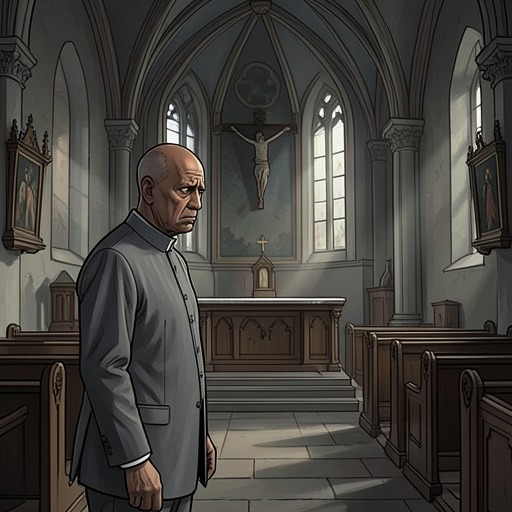
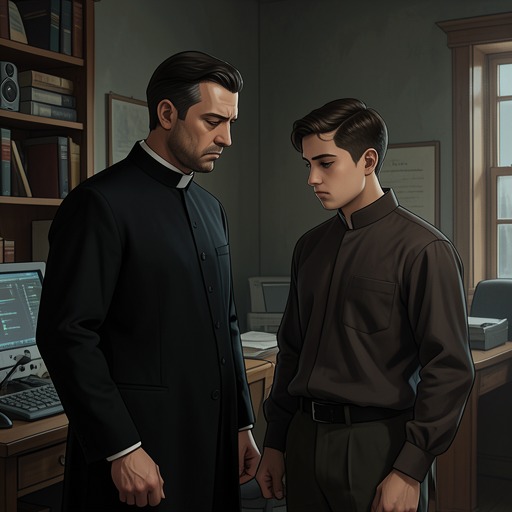
Winton Tolk
StrangersWinton Tolk’s story turns a wounded police officer into evidence that Brendan Cronin’s healing power can pass from one person to another. First shot twice in the chest during an armed robbery, Tolk survives injuries that should have been fatal; later, he uses an apparently inherited ability to save a child from a lethal wound. His recovery becomes both a personal miracle and a public danger in a story where authorities fear what they cannot explain.
Identity and Introduction
Tolk is a police officer assigned to Uptown, Chicago, where he patrols with his partner, Paul Armes. For five days, Brendan Cronin rides with them as an observer under an arrangement made by Father Stefan Wycazik with the local precinct captain. Cronin’s supposed role is to study the need for Catholic charity outreach programs, a cover story accepted by those around him. The neighborhood is described as Chicago’s poorest and most crime-ridden, home to black and Indigenous residents as well as many Appalachians and Hispanics. During those five days, Cronin comes to like both officers and sympathize with the people living and working amid the area’s decaying buildings and filthy streets.
Tolk’s introduction is bound to the violence of the beat. While he enters a sandwich shop, a robbery erupts: gunshots and the shop window’s shattering glass reach the patrol car almost together. Cronin is caught inside the car as the robbers emerge, and one swings a sawed-off shotgun toward him. The gunfire makes Tolk’s ordinary patrol route suddenly lethal. The incident is the worst Cronin has encountered during his ride-along, and Tolk, who has walked unknowingly into the robbery, is struck twice in the chest.
Wounding and Survival
The gunfire leaves Brendan Cronin pinned to the floor of the patrol car, unable to see who has been hit. When he finally enters the sandwich shop, its small tables are overturned, money and condiment bottles are scattered across the floor, and Winton Tolk lies amid a pool of blood. Tolk has been shot twice in the chest. His eyes are closed, and he does not respond when Brendan calls his name; the wounds appear too severe for a tourniquet or ordinary first aid to make a difference. Brendan reaches from Tolk’s neck to his chest, then begins to cry as blood wells between his fingers and shock gives way to helplessness.
Tolk then chokes, coughs, and opens his eyes. His pulse is still weak, but stronger and more regular than before. Brendan lifts his head slightly and turns it to one side so blood and mucus can drain from his mouth; Tolk’s breathing improves, though every inhalation remains difficult and he still urgently needs medical care. The scene turns from apparent death to precarious life without making the danger disappear. Tolk is alive, but his survival is only the first sign that his body may be recovering in a way ordinary explanations cannot account for.
The Medical Mystery of His Recovery
Tolk’s survival soon becomes a medical puzzle rather than merely a fortunate escape. In the hospital he is alert, sitting upright in bed, his chest heavily bandaged and a cardiac monitor hanging around his neck. An intravenous line delivers glucose and antibiotics, yet he seems remarkably well given the severity of the shooting. He tells Father Stefan Wycazik that he is not planning to die, a remark that sounds like ordinary resolve until the course of his recovery gives it an uncanny edge.
Dr. Royce Albright, who is interested in the case though he is not Tolk’s personal physician, calls him incredibly lucky. Both .38-caliber bullets missed the heart and other vital organs; neither caused major damage to a vein or artery, and the vessels that were nicked were not severed. Tolk was out of intensive care within twenty-four hours, a speed that Albright says no one at the hospital would previously have expected after two point-blank chest wounds. For a time, the account of good fortune and robust health offers a plausible explanation.
The surgeon’s examination complicates it. Father Wycazik learns that the bullets lodged in soft tissue without the bone damage that would explain their trajectory: if they had struck bone, they should have left chips or splinters, while a path unobstructed by bone should have carried them through Tolk’s body and out again. Instead, they remained lodged in muscle. The apparent neatness of the wounds does not fit either expected outcome.
Sonneford then describes what happened during surgery. He had clamped and prepared to stitch a torn intercostal vein, but when he turned to repair it, the tear was gone. He removed the clamps, and blood flowed without leaking. Later, as he extracted the bullets, he watched the muscle tissue knit together. He also believed the shots had shattered Tolk’s sternum and a rib and sent fragments of bone through him, yet by the time of the operation the bones had reformed and the major damage had almost entirely healed. The superior mesenteric artery and intercostal vein, initially severed and responsible for the rapid blood loss, had already closed almost completely, leaving only small tears. What looked from outside like a lucky survival thus contains a much more radical reversal: injuries that should have remained catastrophic were repairing themselves before the surgeon’s eyes.
From Patient to Healer
Winton’s recovery continued beyond the hospital’s early predictions. Three weeks after being shot point-blank twice in the chest, he returned to work and found that the scars were nearly gone. The entry wounds had faded to dime-sized discolorations; the surgeon’s incisions were fine lines visible only on close inspection, without the swelling, inflammation, or heavy scar tissue he had seen in other men wounded by bullets. The contrast between the violence of his injuries and the near-erasure of their marks made his survival harder to dismiss as mere luck. He sought Father Stefan Wycazik out urgently, asking how Brendan Cronin had healed him and what had happened to his own body.
Winton’s account of a later emergency revealed that his recovery was not simply something that had happened to him. He described reaching the home of the Mendozas, where a young boy named Hector was dying from a deep cut to his neck. The wound had severed major blood vessels; Winton knew that a child with such an injury could die within minutes, and that neither a tourniquet nor direct pressure could stop bleeding from the neck. Sick, frightened, and angry at the thought of the boy dying, he pressed his hands against Hector’s throat, though he believed there was little he could do.
The blood stopped spurting against Winton’s fingers. Hector’s eyes closed, and Winton initially thought he had died; when he moved his hands to inspect the wound, he saw that the cut had closed, leaving a raw red line where the flesh had knit together. The change was not confined to the first spontaneous healing. Remembering his own disappearing chest scars and making a connection to Brendan’s intervention at the sandwich shop, Winton placed his hands over the wound again and concentrated on Hector’s being alive. Within about a minute, the boy opened his eyes and smiled. When Winton lifted his hands, the scar remained but had grown lighter. Hector sat up and asked for his mother.
The act had witnesses: Paul Armes, the Mendozas, and two other uniformed officers who arrived as the police shot the attacker. Winton was overcome by joy at the boy’s recovery, and he held Father Wycazik’s hands as he recounted it. His account changes the meaning of the earlier scene at the sandwich shop: Brendan’s healing had not ended with Tolk’s survival but had become a power Tolk could exercise himself, first in a crisis and then with a deliberate attempt to restore a child’s life. Winton believed the ability remained in him, and sensed that it included something beyond healing, though he could not yet identify what that might be.
A Gift That Becomes a Public Crisis
Winton’s urgent appeal to Father Stefan Wycazik carries his experience beyond the hospital and into a widening chain of consequences. He had returned to work after his recovery, but the later healing of Hector Mendoza made it impossible for him to regard his altered body as a private stroke of luck. He believed the power was still within him, and felt that it included something beyond healing—though he could not yet say what. The uncertainty matters: Winton recognizes a change without claiming to understand its limits or origin.
The incident quickly becomes difficult for authorities to contain. The stabbing and shooting at the Mendoza home draw reporters and television crews, while Winton withdraws to his own house and gives no interviews. Foster Polnichev warns Leland Falkirk that, if Winton eventually speaks publicly, he may name Brendan Cronin, allowing reporters to trace a connection to Emmy Halbourg. In this way, Winton’s recovery is not only a medical anomaly: his ability creates a visible link among people whose experiences the government has tried to keep separate.
Polnichev and Falkirk read that link in opposing ways. Polnichev regards the healings and other emerging abilities as evidence that the July 6 events may benefit humanity; he argues that miraculous cures would be a strangely conspicuous method for an infection to spread. Falkirk answers that the people affected might have surrendered control to a parasite, or might unknowingly coexist with one, and therefore can no longer be trusted as fully human. Winton is consequently cast by the government as both a possible danger and a possible sign of transformation, although the evidence establishes neither infection nor possession as fact. The dispute exposes the cost of interpreting unexplained power through fear: even a policeman who has saved a child can become an object of suspicion.
Winton’s story also gives Brendan’s gift a moral meaning beyond its astonishing effects. In a conversation about Brendan’s crisis of faith, Father Stefan Wycazik argues that humanity is not defined by physical appearance or technological superiority, but by reason, compassion, love, friendship, and care. Winton’s actions make that claim tangible: he responds to a child’s mortal wound not with certainty or mastery, but with desperate concern, then discovers that his care has become effective in a way he cannot explain. His new capacity remains mysterious, but its first decisive use is an act of rescue.
The Pace of Recovery
The hospital’s early milestones make the later disappearance of Tolk’s scars more striking. He left intensive care within a day, was discharged three days after being shot, and felt ready to return to work by the tenth day; the department nevertheless kept him home for two weeks. When he eventually resumed duty, the nearly vanished wounds suggested that recovery had continued well beyond what those initial clinical assessments could explain. Tolk did not immediately turn the experience into a public claim: after the Mendoza incident, he gave no press interviews and remained at home while reporters gathered outside, leaving the connection between his recovery and his new healing ability both urgent and difficult to verify publicly.
The Unfelt Mechanism
Winton’s account distinguishes the moment healing first happened from the moment he tried to make it happen again. At Hector’s throat, he felt nothing unusual in his hands; he recognized a change only when the blood stopped spurting and the boy’s eyes closed, which made him think Hector had died. The wound’s closure became visible only when Winton lifted his hands to inspect it. On the second attempt, he deliberately covered the wound again and focused on Hector living. The contrast leaves the power’s mechanism unexplained: Winton could identify a connection to Brendan and his own recovery, but not a sensation or technique that accounted for it. What he could report was the result, witnessed by others—the boy awake, the wound closed, and its bright red scar already growing lighter.
The Question of Where the Power Comes From
Winton’s testimony establishes what he can attest to, but not how his new ability works. When Father Stefan Wycazik asks how Brendan Cronin might have passed the power to him, Stefan also allows another possibility: perhaps the power belongs to neither man, but is God acting through them. Winton cannot explain its origin, yet he rejects the idea that it is merely a past event or an effect that has already spent itself. He turns his palms upward and says that the power remains within him; he senses, too, that it may involve more than healing, though he cannot yet identify what.
That exchange leaves Winton between two kinds of explanation. His certainty concerns the continuing presence of the ability, while its source and reach remain unknown. Stefan’s theological interpretation offers meaning without resolving the mechanism; Winton’s own account offers conviction without a theory. The distinction matters in a story where officials treat unexplained change as grounds for suspicion: Winton’s experience is neither proof of infection nor a complete account of a miracle. It is a witness’s bounded knowledge, held open to explanations he cannot yet settle.